
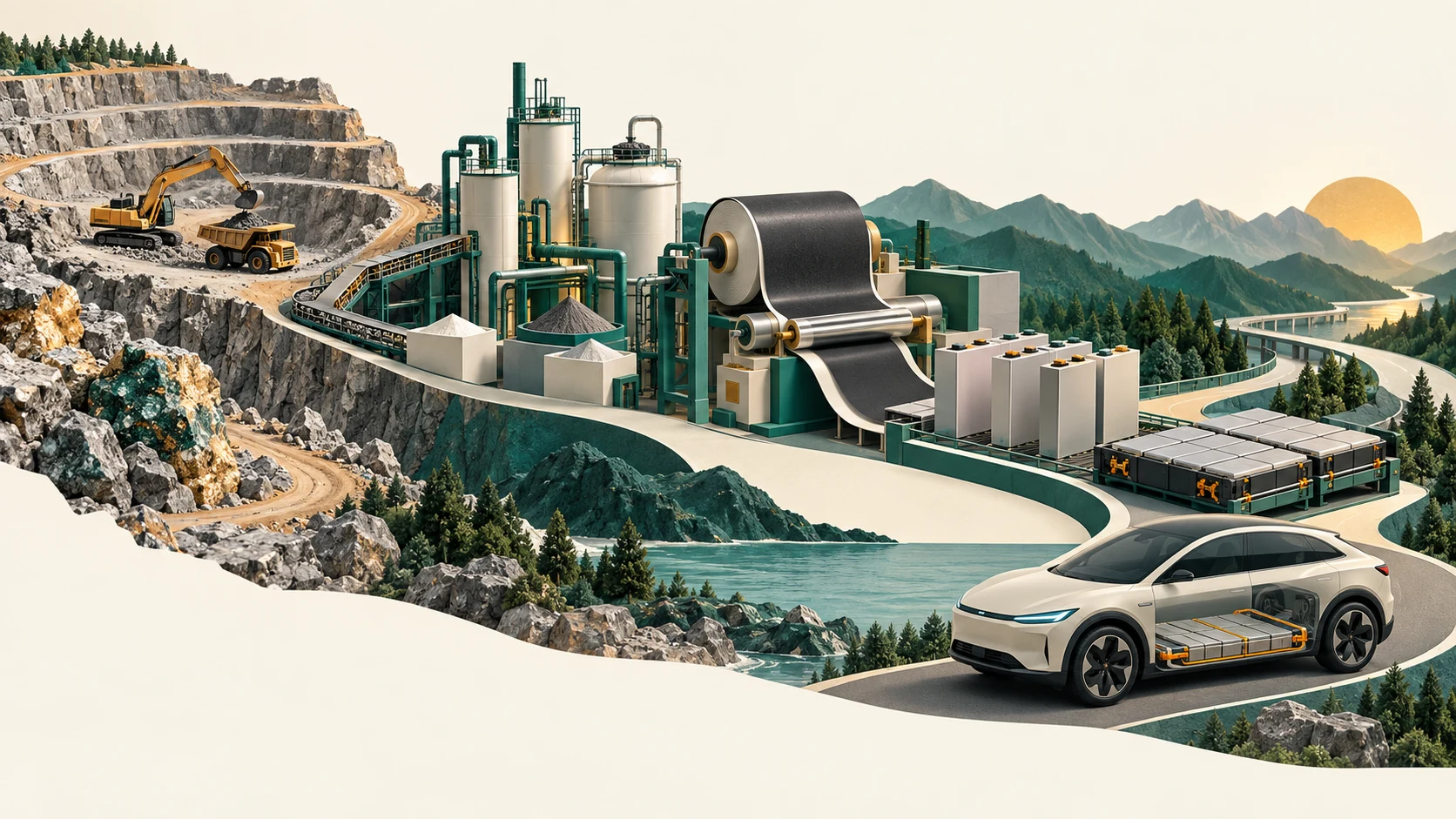
A lithium mine supplies the beginning of a battery. Between that mine and an electric car sit chemical plants, powder manufacturers, coating machines, cell assembly lines and pack engineers. Each changes what the material can do. The finished battery depends on all these transformations: extracting a useful element, giving it a useful structure and making that structure work repeatedly inside a manufactured device.
China's central role extends across this chain. The International Energy Agency's Global EV Outlook 2026 puts China's share of global battery-cell production above 80% in 2025. Explaining that position requires looking inside the stages between a mineral deposit and a finished cell.
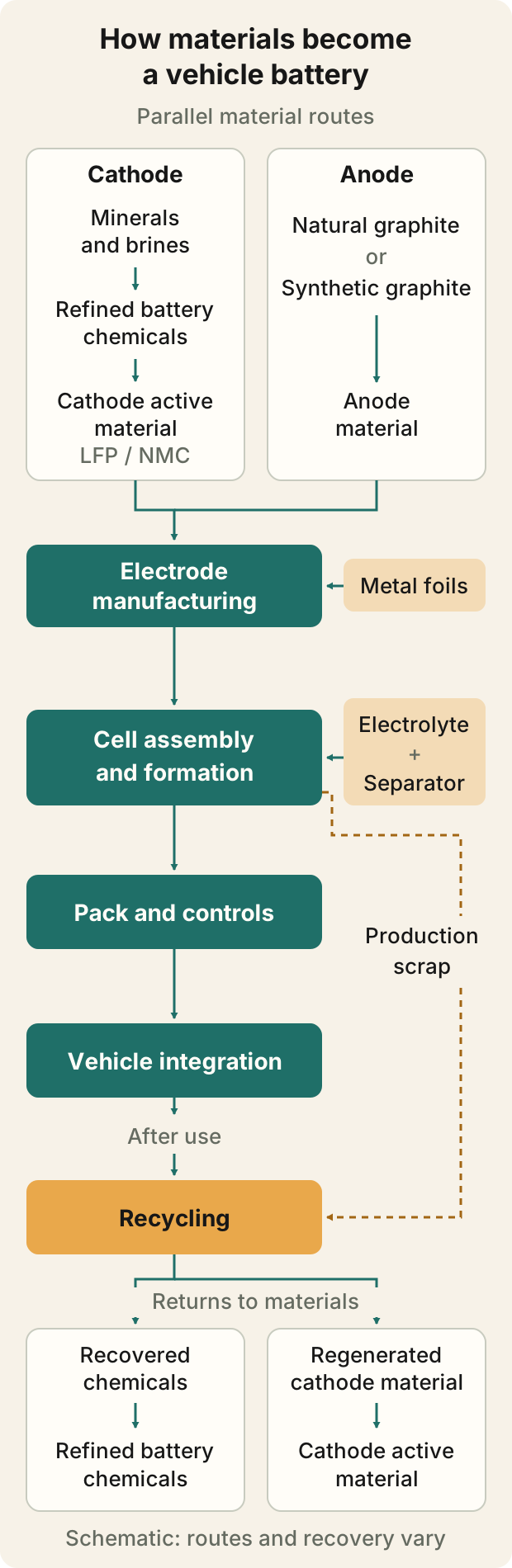
The journey also branches. Changing a cathode from nickel-based material to lithium iron phosphate changes some upstream suppliers while leaving other material requirements in place. And recycling, when it becomes possible, can return material to several different points along the route.
A cell brings different material industries together
A rechargeable battery stores energy as chemical potential. During discharge, electrons travel through an external circuit while ions move inside the battery through the electrolyte. Charging reverses the process. The two electrodes provide the chemical environments that make this exchange possible, as the US Department of Energy's battery explanation describes.
In a conventional lithium-ion cell, the positive electrode is usually called the cathode and the negative electrode the anode. During discharge, lithium ions leave the anode and enter the cathode; during charging, they return. A porous separator keeps the electrodes apart while allowing ionic transport.
Cathode ingredients and anode graphite follow separate routes. Electrolyte, separator and metal foils join them at cell manufacture, connecting several specialized suppliers.
Mining supplies lithium; refining makes a battery chemical
Lithium extraction has a geography quite different from finished battery production. The US Geological Survey's 2026 lithium summary estimates the following mine production for 2025:
| Country | Estimated 2025 lithium mine production, tonnes of lithium content |
|---|---|
| Australia | 92,000 |
| China | 62,000 |
| Chile | 56,000 |
These are the three largest reported national totals in that table. The measure includes lithium recovered from brines and counts lithium content, rather than tonnes of ore or battery chemicals. USGS identifies major mineral operations in Australia, both mineral and brine operations in China, and brine operations in Chile. The country's position in extraction describes the resources entering the chain, before later chemical processing.
Ganfeng Lithium's account of its extraction technologies shows what happens next. For ores, the company describes pressure leaching and sulfuric-acid roasting, followed by impurity removal. For concentrated brines, it describes membrane separation, evaporation and crystallization, impurity removal and lithium precipitation to produce battery-grade lithium carbonate.
Each route has to separate lithium from a different surrounding mixture. Ganfeng describes controls for sodium and potassium and the use of membranes and resins to remove impurities. These details explain why access to a resource and the ability to make a battery chemical are separate industrial capabilities. The processing plant must turn a particular feedstock into a consistent output that its customer can use.
Even then, the refinery has not made a cathode. Lithium carbonate and lithium hydroxide are inputs to further synthesis. Their suitability depends on the product: a 2025 battery-manufacturing review describes the preference for lithium hydroxide in high-nickel cathode synthesis.
The cathode determines which branch the chain follows
LFP and nickel-based batteries belong to the lithium-ion family. Their names identify different positive-electrode materials.
| Cathode family | Constituents named by the chemistry |
|---|---|
| LFP: lithium iron phosphate | Lithium, iron and phosphate |
| NMC: lithium nickel manganese cobalt oxide | Lithium, nickel, manganese, cobalt and oxygen |
| NCA: lithium nickel cobalt aluminium oxide | Lithium, nickel, cobalt, aluminium and oxygen |
The distinction affects both materials demand and cell behavior. Nickel-rich cathodes support high cell energy density; LFP offers good thermal stability and lower material costs, but generally lower cell energy density. The Nature Communications analysis explains how the comparison changes between active material, cell and pack. Packaging, cooling and operating limits affect how much of a material's theoretical advantage reaches the car.
LFP's rise has already changed the upstream demand mix. The IEA reports that LFP exceeded 55% of global EV battery deployment in 2025, measured by battery capacity in newly registered vehicles, excluding two- and three-wheelers. Its chemistry grouping also includes lithium manganese iron phosphate.
Nickel passes through intermediates
Huayou's Indonesian nickel business makes an upstream stage visible. The company identifies the Huayue and Huafei processing projects on Sulawesi and Halmahera. Its products include mixed hydroxide precipitate (MHP), an intermediate that needs further refining to become pure enough for battery-precursor production. The finished cathode requires more than extracting nickel from a resource.
The example also gives “China's role” a more precise geographical meaning. A Chinese company's production can take place in Indonesia. Company ownership and factory location describe different aspects of how the chain is organized.
For NMC synthesis, a common route combines nickel, manganese and cobalt in sulfate solutions. Controlled coprecipitation produces a mixed hydroxide precursor, followed by processing with lithium to make the cathode material. The 2025 manufacturing review explains why homogeneous mixing is an important reason for this precursor step. The supplier is already engineering the particle before the cell maker receives it.
LFP replaces the recipe, not the need for processing
The same review describes solid-state synthesis as the mainstream LFP route, involving mechanical grinding and high-temperature processing. Particle morphology and impurity control remain manufacturing challenges. Abundant ingredients still have to become a reproducible battery material.
This is how LFP's mineral advantage can coexist with industrial concentration. The IEA reports that LFP cathode-material and precursor production remains almost entirely concentrated in China. Removing nickel and cobalt from the recipe changes the processing industry the battery needs; it does not remove that industry.
The anode has its own supply chain
Graphite is the main anode material in conventional lithium-ion batteries. It can come from a mine or synthetic production. The latter offers control over purity and performance, but is energy intensive and relies on fossil-derived feedstocks, as a Nature Reviews Materials perspective explains.
These routes require different industrial investments. Natural graphite needs extraction and processing; synthetic graphite needs a manufacturing route to the required carbon structure. A map of graphite mines consequently covers only part of the anode supply chain. An increase in synthetic supply need not correspond to an increase in graphite mining.
BTR's anode-business description shows both routes within one Chinese supplier. It describes a natural-graphite chain extending from mines to anode products, including purification and modification, alongside integrated artificial-graphite factories. Its artificial-graphite portfolio includes products aimed at energy density, fast charging, cycle life and power.
That range matters because anode material is a designed input. The supplier is adapting it to the behavior sought from the cell.
A cathode switch leaves this other side of the cell in place. Conventional LFP and nickel-based cells can both use graphite anodes, as the commercial battery analysis shows. Reducing exposure to nickel and cobalt can therefore coexist with continued dependence on anode-material processing.
Cell manufacturing turns powder into a repeatable device
In conventional wet processing, active material, binder and additives become a slurry that is coated onto metal foil and dried. Rollers compact the coating through calendering, and the electrode web is cut to size. The 2026 RWTH–VDMA guide describes this sequence. It also presents dry coating, which eliminates the solvent and its drying equipment while changing the demands on materials and machinery.
The coating must adhere to its current collector and provide paths for charge transport. Compaction affects its thickness and electrical contact. Assembly brings electrodes together with a separator through winding or stacking, followed by enclosure and electrolyte filling. A 2023 industrial paper coauthored by SVOLT researchers describes the connections between these operations.
One of its factory examples is revealing. Graphite residue damaged a separator and caused small internal short circuits. An earlier insulation test did not identify the problem; abnormal self-discharge appeared after electrolyte filling and the first charge. The authors suggest that mechanical stress during charging may have worsened the damage.
The defect became visible after more work had been invested in the cell. That illustrates why manufacturing performance depends on the sequence as a whole: a problem introduced upstream can consume downstream time and material before it is detected.
The first charge is part of making the battery
A newly assembled cell undergoes formation: controlled initial charging that helps establish its internal interfaces. On the negative electrode, reactions form the solid electrolyte interphase, or SEI. Creating this layer consumes some lithium, but the layer protects the electrode against continuing reactions that would degrade the battery. SLAC's explanation of formation research describes this initial investment in subsequent performance.
In a controlled 2024 formation experiment, the SLAC–Stanford team found that changing first-charge conditions could improve the lifetime of its test cells while shortening formation. Current and temperature were important variables.
The implication extends beyond the laboratory result. Cell production includes creating the chemistry of a working interface after the components have been assembled. A factory needs to reproduce that outcome, alongside consistent materials, coatings and mechanical assembly. Manufacturing knowledge remains part of the battery even when it is invisible in the finished pack.
The pack connects cell chemistry to vehicle design
Cells must be connected, supported and integrated with thermal management and controls. A conventional architecture groups cells into modules and modules into a pack. Battery-management systems monitor the pack, and cell arrangement and chemistry determine its voltage and capacity. The Australian government's battery-system explanation shows how these parts work together.
Cell-to-pack designs reduce the intermediate module structure. CATL's June 2022 Qilin announcement illustrates the approach: the company described combining the internal crossbeam, cooling plate and thermal pad into a multifunctional interlayer, with liquid-cooling components between adjacent cells. It described versions for both nickel-based and LFP systems.
The engineering change was the arrangement of functions inside the pack. Structure, cooling and the space occupied by cells were being designed together. This gives pack engineers another way to improve a battery system alongside changes in its electrode chemistry.
Tighter integration also affects the later life of the battery. A 2026 perspective on battery integration explains how reducing component count can improve packing while making local repairs and disassembly harder. With less access to individual parts, a localized fault may require a larger replacement. An architecture chosen during manufacture thus influences maintenance and eventual material recovery.
The vehicle adds another set of connections. Power electronics regulate energy delivered to the traction motor. An onboard charger converts incoming AC electricity to DC for the battery, while a motor-generator can return energy during regenerative braking. The DOE's vehicle-component explanation follows these electrical and mechanical links to the wheels.
The car's range also depends on efficiency, size, terrain, driving and climate, as the Australian guidance notes. A battery reaches the end of its manufacturing journey inside a vehicle whose design determines how much transport the stored energy provides.
China's advantage accumulates in the manufacturing process
A factory's equipment sets out what it could produce. Scrap and downtime help determine how much saleable output it actually produces, and how much cost that output must carry.
The IEA's Energy Technology Perspectives 2026 analysis attributes more than 40% of the battery manufacturing cost gap between the European Union and China to higher manufacturing efficiency in China. This is a modeled comparison using 2024 conditions for NMC811 cells with graphite anodes, rather than a 2026 price comparison across all battery types.
The process sequence helps explain the result. Fewer rejected electrodes preserve material; less downtime spreads plant costs across more output. These advantages can accumulate through production. Conversely, establishing a cell factory in another country leaves upstream dependencies intact unless its materials supply develops too. The ETP analysis examines these vulnerabilities across successive supply-chain stages.
The Chinese examples show several distinct kinds of work: Ganfeng's chemical separations, Huayou's overseas resource processing, BTR's anode products, SVOLT's cell-manufacturing experience and CATL's pack integration. Together, they locate industrial capability across transformations that a count of mines or cell factories alone cannot capture.
Recycling returns to the middle of the chain
Recycling reconnects used batteries with materials production. Mechanical processing separates components and can produce black mass, a mixture containing electrode materials. Hydrometallurgy chemically leaches compounds that can feed cathode production. Pyrometallurgy uses high-temperature treatment to recover metals and intermediates. Direct recycling seeks to retain the cathode material's structure instead of breaking it down into constituent metals. The DOE recycling overview distinguishes these routes.
Their products return at different points. Recovered chemicals feed material synthesis; useful regenerated cathode material can preserve more of the work already performed. Separating different battery materials remains a difficulty, because the next manufacturer needs a consistent input from a variable waste stream.
LFP presents a particular economic challenge. Avoiding nickel and cobalt lowers exposure to costly cathode ingredients, but also removes valuable metals from the recycler's feedstock. A review of battery-recycling economics explains why more of LFP's value lies in its manufactured material than in its constituent elements.
That makes efficient recovery and preserving or restoring useful material especially important. It does not make LFP unrecyclable. It changes the relationship between what the recycler spends on processing and what the recovered product is worth. The cheaper ingredient mix that helps at the beginning of the chain creates a different economic problem at its end.
Feedstock also arrives on a different schedule from new demand. The IEA's 2026 assessment describes recycling's current reliance on manufacturing scrap while many recently deployed EV and storage batteries remain in use. Growth in new batteries cannot immediately supply equivalent volumes of retired batteries.
The chain therefore remains a combination of extraction and repeated transformation. Its difficult work is making each output suitable for the next process: a purified chemical, a controlled particle, a consistent electrode, a working cell, a usable pack and eventually a recoverable material. Much of China's industrial role becomes visible in the work between those steps.