

By China Made & Tech Team. Independent English field guide to China's niche hardware brands, hidden champions, founders, factory towns, and supplier clusters.
A CATL battery can appear in a vehicle quote, a storage integrator's bill of materials, a product launch, or a market-share headline. Those references are useful. They tell you that the company sits at an unusually consequential intersection of cell development, manufacturing, automotive demand and energy storage. They do not, by themselves, tell you whether the item in front of you has the chemistry, revision, plant, documentation, warranty or operating record you need.
That distinction matters because CATL is genuinely large. In its 2025 results, the company reported RMB 423.7 billion in revenue, 661 GWh of lithium-ion battery sales and 772 GWh of global production capacity. Separately, SNE Research recorded 464.7 GWh of CATL battery usage in registered EVs in 2025, within a global total of 1,187 GWh. Both are consequential records. Neither is a certificate for a particular vehicle, cell, pack or energy-storage system.
The best way to understand CATL is therefore not as “the company that powers half the world's electric cars.” That phrase is too broad and hides the work a reader still has to do. CATL is a battery platform. Its scale is visible through several ledgers that use different definitions:
- CATL's own corporate ledger: revenue, profit, battery sales, R&D and capacity.
- The EV market ledger: batteries installed in registered battery-electric, plug-in-hybrid and hybrid vehicles.
- The energy-storage ledger: lithium-ion batteries shipped into storage systems and projects.
- The product ledger: the exact cell, pack, BMS, factory, origin, test evidence, contract and service path behind the product being evaluated.
The first three explain why CATL deserves attention. The fourth is where a buying, engineering, operating or sourcing decision is actually made.
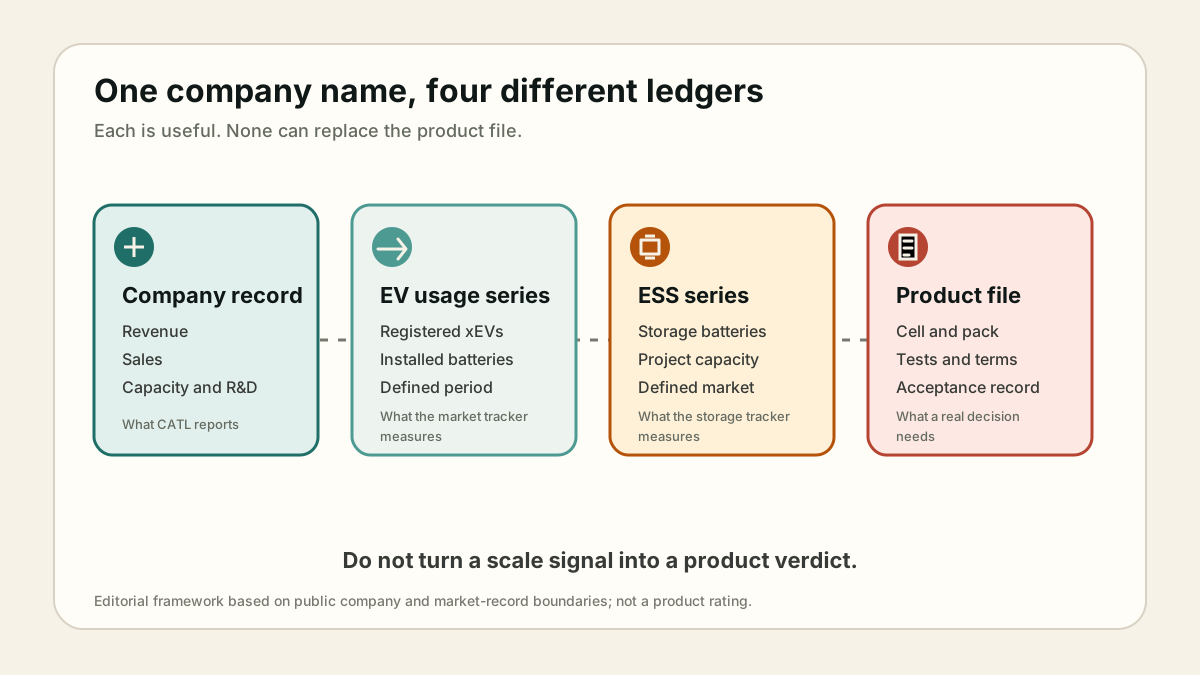
The short answer: a battery platform, not a universal product verdict
CATL—Contemporary Amperex Technology Co., Limited—is not usefully described as just an EV-battery brand. Its 2025 public reporting spans power batteries, energy storage, new product lines, swapping activity and recycling. That breadth is why the company keeps appearing in discussions that otherwise seem unrelated: a passenger EV launch, a heavy-truck programme, a grid-scale storage tender, a sodium-ion announcement or a debate about battery-material exposure.
The platform framing is useful because it explains the company's strategic weight. A cell maker with a large factory estate but no EV customers would face one set of questions. A battery supplier embedded only in cars would face another. A storage supplier without automotive demand would have a different exposure again. CATL's significance lies in the overlap: it develops and manufactures electrochemical products, sells into more than one demand system, and has to make technology, production and commercial relationships work at the same time.
But “platform” can become a flattering word if it is left undefined. It does not mean that every CATL-labelled battery is equivalent. It does not mean that all CATL cells come from the same plant or serve the same application. It does not mean that a battery pack built around a CATL cell has CATL's own warranty, service network or acceptance record. And it does not establish whether a named vehicle or storage project is safe, economical, available in a particular region or suitable for a particular duty cycle.
That is the practical tension in the CATL story. Scale changes the starting point of diligence. It does not remove the need for diligence.
For an EV buyer, the company name may be one clue about the upstream cell supplier, but the relevant object is still the vehicle's exact battery pack and the local support arrangement. For an ESS developer, a CATL cell or cabinet reference may narrow the technical conversation, but the relevant object remains the whole project: integration, thermal design, controls, installation, grid requirements, warranties, operations and acceptance. For a procurement team, a name on a specification may be a lead; it is not a chain-of-custody record.
This is the same reason an automaker comparison should not stop at a cell supplier. Our BYD–Tesla comparison treats batteries as part of a larger vehicle strategy: chemistry, pack integration, factory choices, charging, software and market access interact. CATL belongs inside that system story. It should not be used to flatten it.
CATL's corporate ledger: what the company reported in 2025
CATL's annual figures establish an important baseline: this is a large, resource-intensive industrial company with the ability to fund product development and expand manufacturing. They are most useful when each number keeps its own label.
| 2025 measure | CATL reported | What it shows | What it does not show |
|---|---|---|---|
| Operating revenue | RMB 423.7 billion | The reported commercial scale of the group | The price, margin or service level of a specific cell or project |
| Net profit | RMB 72.2 billion | Reported profitability for the period | Future performance, a buyer's price, or a contract's risk allocation |
| Lithium-ion battery sales | 661 GWh | Reported battery sales across CATL's business | EV installations, ESS project performance or a number of vehicles |
| R&D investment | RMB 22.1 billion | Resources directed to research and development | Independent proof that a new product has met a reader's requirements |
| Global production capacity | 772 GWh | Reported manufacturing capacity | Actual output, plant eligibility or supply available to a particular customer |
| Capacity under construction | 321 GWh | Reported expansion pipeline at year-end | Completion timing, utilisation or committed supply |
Start with sales. CATL said it sold 661 GWh of lithium-ion batteries in 2025, up 39% year on year. This is a company sales measure. It belongs in a corporate scale story because it shows the amount of battery business the company reports across its applications. It should not be silently relabelled as electric-car sales, EV battery installations, delivered storage projects or usable capacity in the field. Those are different denominators.
Capacity is another frequent source of confusion. CATL reported 772 GWh of global production capacity, with 321 GWh under construction at the end of 2025. Capacity describes an industrial ability to produce under stated assumptions; it is not a measure of actual output, a promise of shipment, a guarantee that a particular factory can serve a specific market, or proof that a buyer will receive cells from that capacity. Between a capacity number and an item on a dock lie qualification, allocation, local content rules, logistics, testing, commercial terms and the condition of the final pack or cabinet.
R&D spending should be treated with similar restraint. RMB 22.1 billion is evidence that CATL was investing substantial resources in research and development. It helps explain why the company can run several product programmes at once and why its product cadence attracts attention. It cannot establish that a claimed performance feature will survive a specific climate, charging regime, vehicle calibration or storage-duty cycle. A large R&D budget is a capability signal, not an acceptance test.
The recycling figure in the same release illustrates why corporate breadth is real but easy to overread. CATL said it recycled 210,000 tonnes of spent batteries and regenerated 24,000 tonnes of lithium salts in 2025. The statement is relevant to the company's circular-economy narrative. It does not disclose the full materials footprint of a particular product, prove a buyer's end-of-life pathway, or settle a lifecycle claim in another jurisdiction. A recycling headline still needs product-specific collection, processing, legal and chain-of-custody evidence before it can become a procurement conclusion.
Put plainly: CATL's corporate ledger tells a reader that the company has scale, cash generation, manufacturing assets and a broad technology agenda. That is already important. It just belongs at the correct level of the analysis.
Why the EV market number is useful—and why it is not a vehicle count
The independent EV ledger answers a different question from CATL's sales figure: how much battery capacity associated with CATL was installed in vehicles registered during the year?
SNE Research's 2025 global tracker reports 1,187 GWh of EV battery usage, up 31.7% year on year. It records CATL at 464.7 GWh, up 35.7% from the prior year. That is a very large figure, and it gives the company a central role in the worldwide EV battery supply picture. But the definition is the key part of the statistic. SNE says its series is based on battery installations in BEV, PHEV and HEV vehicles registered during the relevant period across 80 countries.
That wording rules out several tempting but inaccurate translations.
It is not the number of cars that CATL “powers.” Battery packs have different sizes, and the same GWh figure can be spread across very different vehicles. A large SUV, a compact city car, a plug-in hybrid and a commercial vehicle consume very different amounts of installed battery capacity. Converting GWh into a vehicle count would require a defined mix of pack sizes and applications, not a slogan.
It is not the same as CATL's 661 GWh of lithium-ion battery sales. Sales can cover more than registered EV battery installations, and registrations do not necessarily coincide with the period in which a battery was produced, invoiced, shipped or recognised as a sale. The two measures may point in the same direction—a big company with a significant EV footprint—but they are not designed to reconcile line by line.
It is not a universal technical ranking. The tracker says something about installed volume in registered vehicles, not cell energy density, thermal performance, fast-charge durability, pack design, BMS software, recall history, warranty treatment or a vehicle owner's local service experience. Those questions are governed by a specific model and market.
And it is not a stable entitlement. The report itself describes a market shaped by customer programmes, regional demand and competition. Vehicle registrations move with consumer demand, incentives, model cycles, logistics, OEM sourcing decisions and regional rules. A company can be significant in the measure while individual programmes still change, and a buyer can receive a different cell configuration after an otherwise familiar brand name appears in a launch announcement.
Why use the number at all? Because it shows something a corporate report cannot: CATL's scale reaches into actual registered xEV demand rather than existing only as a factory claim. It also explains why CATL is a relevant reference point when global manufacturers discuss battery sourcing. In its 2025 release, SNE notes that CATL batteries were used by Chinese OEMs and by international manufacturers. That customer context helps readers understand the company's reach. It is still not a guarantee about any one model year, plant, trim or market.
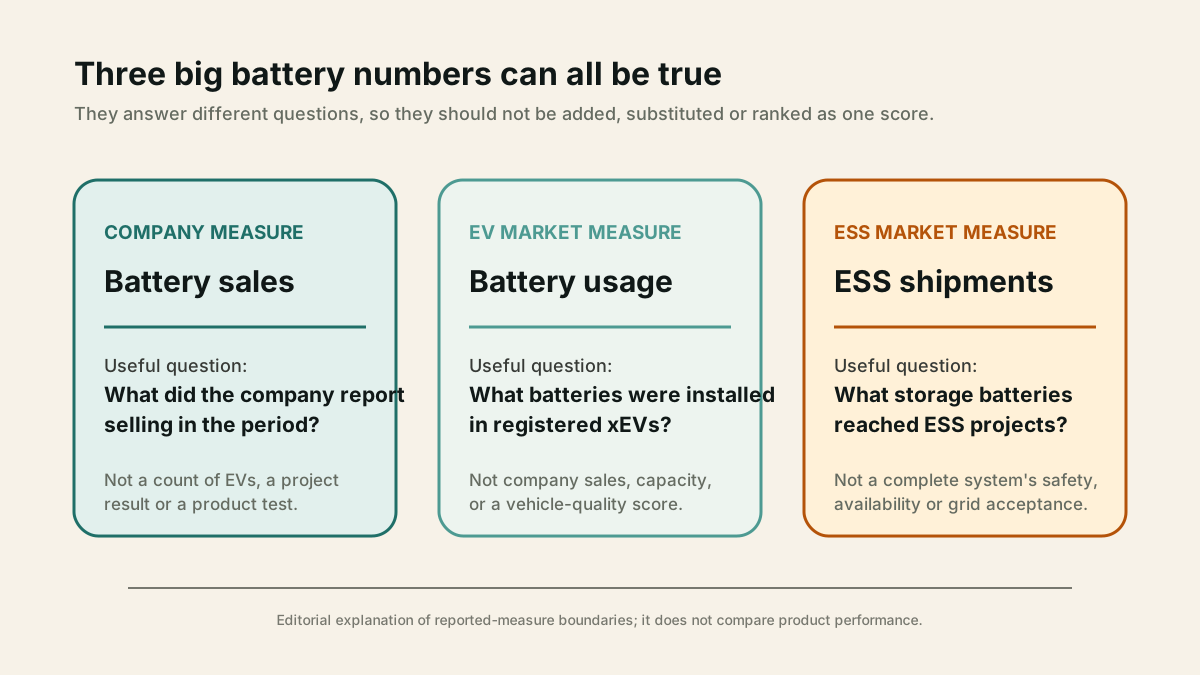
The difference between “installed battery usage” and “vehicle result” is worth holding onto when comparing Chinese EV narratives. A large upstream supplier can improve the availability of technology options, but the consumer or fleet buyer interacts with the vehicle maker's pack design, software calibration, repair network, charging environment and warranty counterparty. Those layers are not footnotes. They are the product.
Energy storage is a second market, not a footnote to EVs
CATL's importance cannot be read from EV data alone. Energy storage has different customers, buying cycles, technical requirements and delivery paths. It deserves a separate ledger.
SNE Research reported that the global lithium-ion ESS market reached 550 GWh in 2025, up 79% from 307 GWh in 2024. In that series, SNE said CATL shipped 167 GWh and held 30% market share. The ESS release is especially useful because it makes its own scope explicit: unlike EV batteries that are embedded in consumer products, ESS batteries are installed directly into regional projects, so the report treats shipment volume and installed capacity as aligned for the purpose of the series.
That makes the ESS number easier to interpret in one narrow sense. It is not trying to infer installed capacity from car registrations. But it still does not make 167 GWh a whole-project score.
An energy-storage project has more layers than its batteries. A buyer may be evaluating cells, modules, racks, enclosures, thermal management, fire detection and suppression, power conversion, energy-management software, grid-forming controls, civil works, interconnection, commissioning, insurance, warranties, maintenance and operator response. A large shipment number tells you that a supplier is materially present in the storage battery market. It does not tell you how those layers were specified or performed in the project you are considering.
This is where a data point can become more misleading as it becomes more impressive. The fact that storage batteries are installed directly into projects does not mean every project has the same design, operating conditions or risk allocation. It means the unit of market measurement is closer to installed storage capacity than the EV series. It does not erase the differences between a grid-scale project, commercial-and-industrial storage, a microgrid, a renewable-energy plant, a data-centre installation or a home backup system.
The distinction matters more as storage moves from a simple “battery attached to solar” picture toward a power-system role. The reader evaluating a large project needs to know not merely who supplied the cells, but whether the full system can meet the required grid code, controls regime and maintenance plan. The site’s China battery-storage boom guide provides wider context on why those system and acceptance questions matter. CATL's ESS presence is a reason to investigate the system more carefully, not a shortcut around the investigation.
There is also a market-structure lesson. SNE said Chinese companies occupied the top seven positions in its 2025 ESS lithium-ion ranking and that the top seven held 83.3% combined share. This tells a reader that the storage battery supply landscape is heavily shaped by Chinese manufacturers and LFP-oriented production. It does not tell a buyer that Chinese suppliers are interchangeable, that a particular country-of-origin or tariff treatment applies, or that a local integrator can support the final system. Market concentration changes the importance of supplier diligence; it does not abolish it.
Technology announcements identify a path, not a finished product outcome
CATL's product events are among the most visible parts of its public story. In April 2025, the company announced the Naxtra battery, the Freevoy Dual-Power Battery and a second-generation Shenxing battery. The CATL announcement and independent trade coverage from Electrive establish the date and the named product lines.
That is a useful fact. It tells a reader that CATL was signalling an effort to extend its technology portfolio across multiple architectures and applications. It is one reason sodium-ion, dual-power systems and fast-charge products appear so often in discussions of the company. It also shows that the company is trying to shape the next question in the market rather than simply defend a mature product line.
But product identity is the point at which careful reading should begin, not end.
Take a sodium-ion launch. The technology can matter because it changes the materials, cost and performance trade-offs a designer may consider. Yet the word “sodium-ion” alone does not tell a reader the exact chemistry, cell format, energy density, thermal behaviour, charge profile, mass-production status, vehicle integration, supplier qualification, local certification, warranty or field performance. A claim made for one configuration should not migrate into a conclusion about another configuration simply because both use the same branded technology name.
The same is true for a dual-power architecture or a fast-charge product. A company announcement may describe the intended architecture and performance target. A vehicle maker may then adopt a version of that platform under a particular pack design, cooling strategy, charging curve and software calibration. The final user experiences the vehicle or storage system, not the press-event slide. The relevant documents are the current specification, the configuration identifier, the applicable test standard, the test report, the service terms and the acceptance record.
The temptation to collapse these layers is understandable. A new battery launch looks like a simple answer to an old problem: range, charging time, cold performance, materials exposure or cost. In reality, it often creates a new verification task. If a buyer hears that a chemistry reduces dependence on a material, the next question is not “therefore it is better.” The next question is: better for which product, in which application, under which requirements, with which evidence and at what commercial trade-off?
This is why a serious technology profile should resist turning a launch into a review. There is no independent, product-specific testing in the public evidence set here that can support a general recommendation of Naxtra, Freevoy or Shenxing for a reader's use case. The article can establish that the products were announced. It should not invent the field evidence that would be needed to recommend them.
Scale changes the questions; it does not end the risk
It would be a mistake to move from the previous section to the opposite extreme and say that corporate scale is irrelevant. It matters precisely because it can change a company's ability to develop products, negotiate upstream supply, support several customer programmes, build factories and remain influential in market standards and commercial conversations.
The correct inference is narrower: scale is context, not a substitute for terms.
The International Energy Agency's 2026 battery analysis describes an industry with intense competition, uneven margins and high concentration. That is an important reminder that even a large supplier operates inside moving markets. Demand can change by region. Battery-material prices can move. OEMs can adjust sourcing. Storage projects can have long development and installation cycles. Policy, trade restrictions and local manufacturing requirements can reshape an otherwise straightforward supply chain.
For a reader, this means CATL's scale can be read as a source of optionality and exposure at the same time. A broad platform may have more resources to serve several markets, but it is also exposed to more kinds of demand, technology and regional change. A high share in a market metric may be evidence of reach, but it can make dependencies more consequential for customers and policymakers. A large capacity figure may support a story of industrial depth, but it does not establish the allocation or compliance path for a particular destination.
Materials illustrate the same logic. Battery systems depend on a chain that includes minerals, refining, cathode and anode materials, cell manufacturing, pack assembly, recycling and logistics. A CATL profile cannot settle that chain with one company number. Readers interested in upstream concentration should pair this page with the site's critical-materials guide, while remembering that rare-earth supply and battery materials are overlapping but not identical industrial questions. The aim is not to build a bigger China-dependence headline. It is to trace the relevant part of the supply chain for the product in view.
Factory geography matters too. A global capacity total does not identify the plant that made a cell in a particular pack. That fact has implications for origin documentation, customer qualification, logistics, local-content rules, trade exposure and service arrangements. It is a reason to read corporate capacity as a map of possible production, not a certificate of the production origin of an item on a quote.
This is a useful general rule across Chinese manufacturing. Scale can explain why products improve quickly, why pricing pressure is credible, why supply ecosystems are dense and why global buyers must pay attention. It cannot tell you whether a particular product is traceable, serviceable or compliant. The same distinction runs through China's industrial-cluster story: the ecosystem creates capabilities and speed, while the actual supplier and product still need evidence.
Turn a CATL connection into a battery evidence file
The most practical output from a CATL profile is not a “yes” or “no.” It is a better file request.
If a seller, vehicle maker, storage integrator or prospective supplier says that a product uses CATL batteries, ask them to turn that statement into a bounded record. The required detail varies by application and jurisdiction, but the following framework makes the missing layers visible.
| Evidence layer | What to identify | Why it changes the decision | A weak answer |
|---|---|---|---|
| Cell identity | Exact manufacturer, cell model, chemistry, format, revision and nominal specifications | “CATL battery” can cover many products and use cases | A brand name with no cell identifier |
| Pack and controls | Pack model, BMS version, thermal design, charging/discharging limits and relevant firmware | The pack and controls shape real system behaviour | A generic cell datasheet used as a pack claim |
| Manufacturing and origin | Plant, country of origin, serial/lot traceability, bill of materials and custody documents as relevant | Corporate capacity does not identify the unit's source | A worldwide factory list or marketing map |
| Test and approval evidence | Applicable standards, configuration-specific test reports, certificates, test dates and scope | A launch claim is not a test outcome | A press release or a certificate for another configuration |
| Commercial path | Contracting entity, warranty scope, exclusions, remedies, delivery terms, spare-parts route and service contact | A cell supplier name may not be the party standing behind the product | “Global service” without local terms or a counterparty |
| Acceptance record | Vehicle validation, project commissioning, operating requirements and documented acceptance criteria | This is where a proposed system becomes an accountable one | A market-share figure or a customer-logo slide |
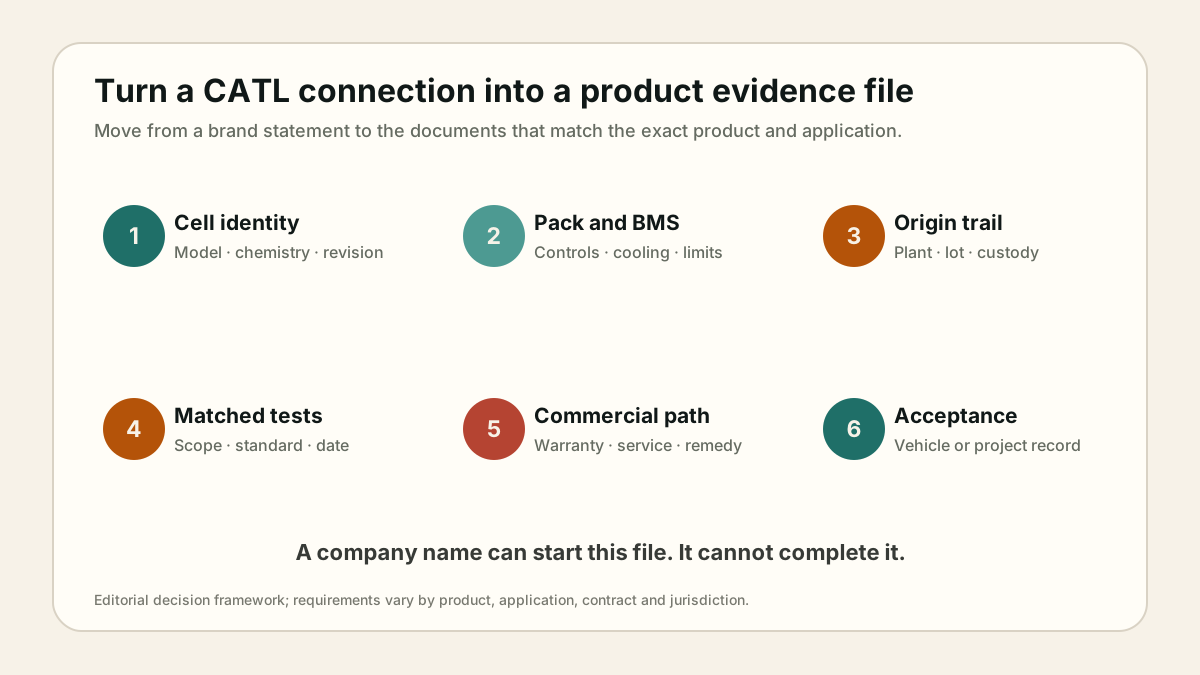
Consider three different uses of the same phrase, “it uses CATL batteries.”
For a consumer EV, the buyer may need to know the vehicle's battery warranty, pack capacity, repair pathway, charging guidance, local homologation and the exact scope of the dealer or manufacturer's obligations. The cell maker is meaningful background. The vehicle company remains the immediate product counterparty.
For a fleet programme, the decision may also require degradation assumptions, thermal operating limits, charging infrastructure, duty cycle, service-level commitments and downtime plans. The battery supplier name alone says little about how the vehicle will behave under a particular route, payload and climate.
For an ESS project, the evidence file expands again: system architecture, enclosure and thermal design, protection scheme, controls, grid interconnection, commissioning method, availability calculation, maintenance, insurance conditions and emergency response can all be material. A cell-supplier reference helps identify part of the system. It is not the system.
The framework also helps readers know when to pause. Pause when the seller cannot identify the exact battery configuration. Pause when a company claim is being offered in place of a current product document. Pause when a certificate does not clearly match the cell, pack or system configuration. Pause when origin is inferred from brand reputation rather than traceability. Pause when warranty and service responsibility disappear into a chain of distributors and integrators.
Proceeding does not mean certainty. It means the product record is becoming specific enough to compare against the actual requirement. That is a much stronger decision position than either accepting a headline or dismissing a large supplier out of hand.
What CATL's scale changes for different readers
For an industry observer, CATL's numbers show why batteries are not a peripheral part of the EV story. A company reporting 661 GWh of battery sales and appearing prominently in independent EV and ESS measures is part of the industrial plumbing of electrification. The company's decisions on product direction, capacity and customer programmes can influence the options that automakers and storage integrators have available.
For an automaker or large buyer, the same scale increases the importance of supplier mapping. A meaningful upstream supplier can affect programme timing, product-roadmap conversations, regional manufacturing choices and materials exposure. Yet a buyer still needs its own approved-source process, contractual safeguards, validation, allocation plan and contingency options. No public profile can substitute for that work.
For an energy-storage developer, CATL's ESS market presence is a reason to understand the battery layer, but it should push attention outward to the system boundary rather than inward to the cell alone. The more critical the storage asset is to a grid, industrial site or data centre, the less useful it is to treat cell market share as the final diligence measure.
For a policy or trade reader, CATL is a reminder that Chinese industrial influence is often networked rather than confined to one exported finished good. Cells, materials, equipment, factories, system integrators and end-product brands form connected but non-identical layers. A policy change may touch one part of that network without applying equally to every part. The right question is not “is CATL involved?” but “which entity, plant, component, route and product configuration are in scope?”
For a serious enthusiast, the conclusion is simpler: the company name can orient your research, but it cannot finish it. Treat the name as the first line of a dossier, not the last line of a review.
Three shortcuts that make the CATL story less useful
The first shortcut is to use one market-share number as if it were a universal measure of battery leadership. It is not. SNE's EV series and ESS series are both valuable precisely because each has a stated scope. The EV number tells you about batteries installed in registered xEVs. The ESS number tells you about lithium-ion batteries shipped into storage systems and projects. Neither one answers the other's question, and neither one answers whether the battery in a particular proposal meets the relevant specification.
This is more than a statistical nicety. A reader who treats 464.7 GWh of EV usage as a general “CATL product score” may overlook that different vehicles use different cell formats, pack designs, charging policies and service arrangements. A reader who treats 167 GWh of ESS shipments as a complete storage-system score may overlook the power-conversion, control, installation and operating layers that determine whether a project is financeable, acceptable and maintainable. Good market data narrows the question. It does not erase the rest of it.
The second shortcut is to see capacity as a promise of availability. A capacity figure is often the most seductive number in a battery story because it appears to answer the question buyers worry about most: can the supplier deliver? But reported capacity is only one element of deliverability. It does not show utilisation. It does not identify the product mix that capacity can make. It does not show which customers have allocation, which plants have been qualified for a programme, which routes are allowed into a market or how a particular contract handles shortages and substitutions.
That does not make capacity unimportant. It makes it a starting question: which specific capacity is relevant to this product, and how is it connected to the programme being discussed? The more important the application, the more that question should be answered through documents and commercial commitments rather than through a global total in a corporate presentation.
The third shortcut is to treat a named technology as though it were a completed design. A branded chemistry or charging architecture can be a powerful sign that a supplier is working on an important problem. But a technology name travels much faster than a configuration. By the time the name appears in a launch story, a product team still has to decide how it fits the vehicle or storage system: cell format, pack layout, cooling, electronics, mechanical protection, controls, charging curve, test plan and service path all remain application-specific.
This is why the article does not grade CATL's announced Naxtra, Freevoy or Shenxing products. The public evidence establishes that the named products were announced, and the announcements help explain the company's technology direction. It does not contain the independent test and configuration record needed to generalise a recommendation. The useful reader response is not cynicism. It is to ask which evidence would turn a technology announcement into a defensible product conclusion.
There is a fourth, subtler shortcut: to turn a large Chinese company's role into a geopolitical answer rather than an industrial map. CATL is an important company in a supply chain that includes materials, equipment, cells, packs, vehicles, storage systems, software and regional commercial arrangements. Those layers do not all move together. A trade rule may apply to a finished product but not to every component. A local-content requirement may change a plant decision without altering the chemistry. A change in materials prices may affect a negotiation before it changes a consumer product. Reading the network is harder than repeating a headline, but it is much more useful for a global reader.
The discipline here is portable. When a Chinese supplier is large, do not ask whether scale is “good” or “bad.” Ask which layer of the system the scale describes, what it allows the company to do, what it leaves unresolved, and what document would close the remaining gap. That approach avoids both naive confidence and reflexive dismissal.
A practical reading sequence for a CATL-linked product
When time is limited, work from the object in front of you outward rather than from the company headline inward.
Start with the product. Is it an EV, a replacement pack, a rack, a containerised ESS, a commercial system or a cell procurement? Write down the exact model and configuration, not just the brand relationship. This prevents the discussion from drifting into a corporate profile before anyone has identified the item that needs to work.
Then identify the battery layer. Ask for the cell model, chemistry, format and revision. For a pack, add the BMS, thermal design, voltage window and relevant firmware. For a storage system, add the rack architecture, enclosure, power-conversion and controls layers. The aim is not to create paperwork for its own sake. It is to make sure every performance, safety, warranty and origin claim is attached to an identifiable configuration.
Only after that should the reader use CATL's corporate and market context. The reported sales, capacity and R&D figures can help explain why the supplier is strategically relevant. The SNE EV and ESS figures can show where the company is materially present in end markets. The technology announcement can explain which future product directions deserve attention. These facts help form a better question for the supplier or integrator. They should not be written into the answer before the product record is open.
Finally, decide what would change your mind. For a consumer vehicle, that could be a current warranty document, a local repair route and a configuration-specific safety record. For a fleet, it could be route-level operating data and service obligations. For an ESS project, it could be a matched test package, protection and controls design, interconnection evidence, commissioning criteria and a clearly allocated warranty. If the answer cannot name the evidence that would change the decision, it is probably still a headline rather than a diligence process.
Frequently asked questions
What is CATL's market share in EV batteries?
CATL says its power-battery share reached 39.2% in 2025, citing SNE Research. The independent SNE release directly reports 464.7 GWh of CATL battery usage within 1,187 GWh of global EV battery usage for the year. That series measures batteries installed in registered xEVs, not CATL sales, a vehicle count or the quality of a particular battery product.
Does CATL make batteries only for electric cars?
No. CATL publicly describes activity across power batteries and energy storage, among other battery-related systems. SNE also reports a separate ESS market measure, where it says CATL shipped 167 GWh of lithium-ion ESS batteries in 2025. EV use and ESS shipments should remain separate measures because the products, customers and project boundaries are different.
Are CATL batteries good?
That question is too broad to answer responsibly from a corporate profile. A useful answer requires the exact cell and chemistry, pack and BMS configuration, test scope, vehicle or project design, warranty, service path and operating conditions. CATL's scale and market position are relevant context, not independent proof of performance for a specific product.
What should I verify when a supplier says it uses CATL batteries?
Ask for the exact cell and pack identifiers, configuration-specific test and approval records, manufacturing and origin traceability, warranty/service terms and the final vehicle or project acceptance evidence. A brand name, a market-share statistic or a product-launch announcement should not substitute for those documents.
Method and limitations
This is a desk-research article based on CATL public disclosures, HKEX's public filing record, SNE Research market releases, independent trade reporting and IEA industry analysis. CATL's revenue, sales, capacity, R&D, recycling and product statements are attributed to the company. SNE's EV and ESS series are treated as separate market measures with the definitions stated by SNE.
The article does not report a battery teardown, laboratory test, factory visit, supplier audit, customer interview, procurement review or project acceptance audit. It does not recommend a CATL product, a vehicle, an ESS system or a supplier arrangement. A real technical, commercial, safety, customs or compliance decision requires product-, contract-, jurisdiction- and application-specific review by the responsible people.