
By China Made & Tech Team. Independent English field guide to China's niche hardware brands, hidden champions, founders, factory towns, and supplier clusters.
An EV listing says “LFP battery.” A storage proposal says “sodium-ion ready.” A launch deck says “solid-state.” Those phrases are not empty. They point to real choices about materials, cost, energy density, supply chains and manufacturing. But they are being asked to carry far more meaning than they can hold.
The useful question is not which Chinese battery chemistry wins. It is: which layer of the product does this claim describe, and what evidence is still missing? A chemistry tells you something about the cell's design space. It does not identify the cell format, the pack layout, the thermal system, the battery-management software, the exact test configuration, the warranty, or the way a vehicle or storage project will behave in service.
That distinction is especially important in Chinese battery technology because the industrial scale is real. The International Energy Agency (IEA) estimates that China accounted for more than 80% of global battery-cell production in 2025, alongside about 85% of cathode-active-material production and more than 90% of anode-active-material production. Those are consequential supply-chain facts, not product scores. The IEA manufacturing record does not tell you whether the battery in a quotation came from a particular plant, uses a particular revision, or meets your application requirements.
This guide therefore reads the technology as a stack:
- Chemistry — LFP, sodium-ion, NMC, or a solid-state design direction.
- Cell — its physical format, energy and power trade-offs, and the manufacturing route behind it.
- Pack and controls — module strategy, thermal management, BMS, enclosure and integration into a vehicle or storage system.
- Evidence — the configuration-specific records that establish what the finished system actually is, has been tested for, and is contractually supported to do.
The short answer is straightforward. LFP is the current scaled baseline, while cell format and pack integration remain distinct system choices. Sodium-ion has credible, bounded reasons to expand. Solid-state remains a commercial scale-up question. None of the three labels, including when attached to a Chinese supplier, is a verdict on a particular battery system.
Start with the boundary: a chemistry is not a battery system
It is tempting to think of a battery as one thing. In everyday language, that is fine. In a technical or commercial decision, it creates avoidable confusion.
At the chemistry layer, a name usually points to the cathode, the active material that helps determine a cell's voltage, energy density, cost exposure and operating behaviour. LFP means lithium iron phosphate. Sodium-ion replaces lithium with sodium as the charge-carrying ion and uses a different material system. “Solid-state” normally describes a direction in which a solid electrolyte replaces some or all of the liquid electrolyte system used in conventional lithium-ion cells. These are meaningful distinctions.
But the chemistry is only one part of the electrochemical cell. The cell also has an anode, electrolyte, separator, current collectors, casing, tabs and a manufacturing process. A cell built around a particular chemistry can be tuned differently for energy, power, charging, temperature performance, cycle life, cost and manufacturing yield. A chemistry headline does not reveal those choices.
Nor does it reveal the physical format. Cylindrical, pouch and prismatic cells package similar electrochemical ideas in different geometries. The IEA says prismatic cells represented more than 60% of EV battery deployment in 2025 and most stationary-storage deployment. That does not make prismatic inherently superior. It does show why a reader cannot stop at a cathode label when trying to understand the products coming out of China: cell geometry has become part of the industrial and system-design story.
Then comes the pack. A pack adds electrical connections, contactors, fuses, sensing, cooling or heating, a BMS, crash structure, enclosure, service interfaces and software. It may use modules, or it may integrate cells more directly into the pack or vehicle structure. The IEA notes that cell-to-pack and cell-to-chassis approaches can improve energy efficiency and density while also creating repair and recycling trade-offs. That design boundary is exactly why “this is an LFP car” says too little.
Finally, the finished system meets a duty cycle. A city delivery van, a passenger EV driven in a hot climate, a backup-power cabinet, and a four-hour grid-storage project can all use cells associated with the same broad chemistry while requiring very different choices in power, thermal design, cycling, controls, warranty and service. The buyer's product is the system assembled around the cell, not the chemistry word alone.
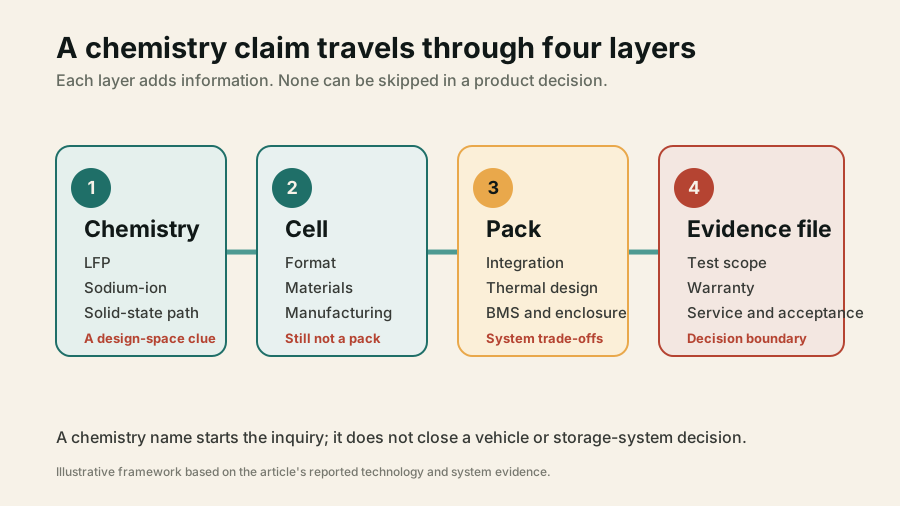
This is not pedantry. It changes how a reader should hear a claim. “LFP” is an initial technical clue. “Sodium-ion” may be a clue to a different temperature, material or cost logic. “Solid-state” may be a clue to an R&D and scale-up direction. None of them tells a buyer that the exact item on offer will meet a route profile, charge window, installation code, acceptance test or service obligation.
The same systems logic appears in our BYD–Tesla comparison. Battery chemistry matters, but it interacts with pack architecture, vehicle integration, charging, software and the market in which the vehicle is supported. The chemistry layer is important precisely because it is not the whole answer.
LFP is the scaled baseline—not a universal answer
LFP is often presented in two misleading ways. One is as the bargain chemistry: cheap, safe, lower energy density, end of story. The other is as proof that Chinese battery makers have already solved the entire battery problem. Both descriptions are too thin.
The reason LFP deserves to be called a baseline is observed deployment, not promotional language. The IEA reports that LFP exceeded 55% of global EV battery deployment in 2025, up from about half the year before in its accounting. It also reports that LFP represented more than 90% of global stationary-storage battery deployment in 2025. Those figures do not mean every vehicle should use LFP. They show that LFP is no longer a marginal alternative whose relevance has to be argued from a single flagship product.
The cost context is real as well. In the IEA's 2025 average-pack comparison, LFP pack prices were more than 40% lower per kilowatt-hour than NMC pack prices. The word “average” is doing essential work. The agency notes that stationary storage's lower energy-density requirements partly contribute to that difference. A price gap measured across a mix of pack applications is not a quote for a particular passenger car, bus, container or home-storage unit.
The following table is a useful way to preserve the scope of the headline numbers.
| 2025 evidence | What the measure says | What it does not say |
|---|---|---|
| LFP: more than 55% of global EV battery deployment | LFP was the leading chemistry family in the IEA's global EV deployment measure | That every LFP vehicle has the same range, charging behaviour, price or life |
| LFP: more than 90% of stationary-storage deployment | LFP has become the dominant chemistry in stationary storage | That every storage project has the same safety case, availability or economics |
| Average LFP packs: more than 40% below NMC per kWh | The IEA observed a substantial average pack-price advantage in 2025 | The price, total cost or performance of a particular vehicle or system |
That industrial translation matters. A chemistry can be known for decades without becoming the default in a mass market. It needs precursor supply, active-material production, cell equipment, formation capacity, quality systems, pack engineering, customers and enough adjacent demand to keep learning cycles active. LFP's Chinese story is not simply a cathode story. It is an industrial-system story.
Still, “scaled baseline” is deliberately different from “best.” Energy density remains a design constraint. A car that must carry a large amount of usable energy in a limited mass and volume has a different problem from a stationary-storage installation with space for containerised equipment. A fleet operator focused on fast turnarounds may put more weight on power and thermal behaviour. A customer in a cold region may care about low-temperature performance more than an average global deployment chart captures. A luxury vehicle may make different packaging choices from a compact city car.
The right interpretation is therefore conditional. LFP is a mature industrial option with enormous deployed relevance. It can be a strong candidate where its system trade-offs fit the application. It is not a substitute for asking what the exact pack delivers under the reader's own operating assumptions.
Why an LFP label can hide important variation
Imagine two products that both say “LFP.” One could be a compact-car pack designed for a particular range target, price band and charging curve. The other could be a stationary cabinet designed for a specified depth of discharge, grid-control mode and service interval. Both may draw on LFP cells, but they are not interchangeable products. Their physical packaging, cooling, protection logic, service design and commercial support may be radically different.
Even within one category, the label can hide revisions. Cell dimensions, electrode loading, fast-charge strategy, thermal path, BMS calibration, firmware, suppliers of pack components and production sites may evolve. Some changes improve a stated property; some serve manufacturing yield, sourcing resilience or cost. A buyer needs the exact configuration and document revision, not merely a broad chemistry family.
For readers doing lower-voltage or DIY-adjacent work, the same rule applies to the control layer. A comparison of JBD, JK and Daly BMS options is a useful reminder that the BMS and its communications, balancing, limits and integration can be as important to system behaviour as the LFP cells behind it. That does not turn a component guide into a qualification for an assembled system. It makes the missing layer visible.
The cell and pack are where the chemistry becomes a product
The cell-to-system boundary is where Chinese battery technology becomes most easily misunderstood. Market discussions often jump from “China makes LFP at scale” to “Chinese EVs therefore have better batteries.” The first statement can be anchored in industry data. The second skips multiple engineering and commercial steps.
Start with the form factor. A prismatic cell is a rigid rectangular cell. It can make efficient use of a pack's space and is common in both EVs and stationary storage. A cylindrical cell is shaped like a can. A pouch cell is a flexible laminated format. None of these labels is automatically a verdict. They affect manufacturing, thermal design, mechanical packaging, service approach and how a manufacturer manages expansion, electrical connections and safety boundaries.
Then ask how the cells reach the pack. Traditional module-based designs place cells into intermediate modules and modules into a pack. Cell-to-pack designs remove or reduce that intermediate layer. Cell-to-chassis designs integrate the battery further into the vehicle structure. The potential appeal is clear: fewer structural layers can release volume or mass for cells and improve system energy density. The trade-off is not a footnote. The IEA specifically flags recycling and repair consequences alongside the integration benefit. A design that uses space efficiently may require a different service strategy after damage or at end of life.
This is why pack claims should be read as system claims. “Module-free,” “cell-to-pack,” “cell-to-body,” “dual chemistry,” and “integrated chassis” describe an engineering approach whose result depends on the actual cell, enclosure, joints, cooling, service route and controls. The claim may be important, but a name is not enough to determine repairability, safety outcome, cost or practicality for a fleet.
Thermal management makes the point even sharper. Cells produce and receive heat under charge and discharge. Packs manage that heat through geometry, cooling plates or other interfaces, sensors, software thresholds and operating restrictions. A chemistry has characteristic behaviours, but the system response depends on the pack's design. The same is true of fast charging: a cell's claimed charging capability does not tell you the charging curve in a particular vehicle, the ambient conditions behind the claim, the battery temperature at the start, the state-of-charge window, the charger power, the power electronics or the long-term management strategy.
The reader does not have to become a cell engineer to use this distinction. It can be turned into simple questions:
- What exact cell chemistry and physical format are used in the quoted configuration?
- Is the pack module-based, cell-to-pack, or structurally integrated in some other way?
- What is the thermal-management design and stated operating envelope?
- Which pack and BMS revision does the technical document describe?
- Which test record applies to that exact configuration rather than a family-level marketing page?
If the seller cannot connect the name of the chemistry to those records, the chemistry claim has not yet become decision-ready evidence.
Sodium-ion expands the map; it does not erase the constraints
Sodium-ion deserves a more careful reading than either dismissal or hype. It is not a fake technology. It is also not, on current evidence, a broad replacement for lithium-ion across every use case.
The core attraction is materials logic. Sodium is more abundant than lithium, and sodium-ion systems may reduce exposure to some inputs that matter in conventional lithium-ion supply chains. The IEA also notes sodium-ion's relative low-temperature performance as a potential advantage. Those characteristics make the technology relevant to specific applications where energy density is not the single dominant requirement and where materials diversification, temperature behaviour or supply-chain design matters.
The constraints are equally important. The IEA says sodium-ion batteries have lower energy density and that hard-carbon supply chains are still immature. It also reports that sodium-ion manufacturing capacity was just over 1% of lithium-ion capacity. That is not a reason to ignore the chemistry. It is a reason to keep its commercial position in proportion.
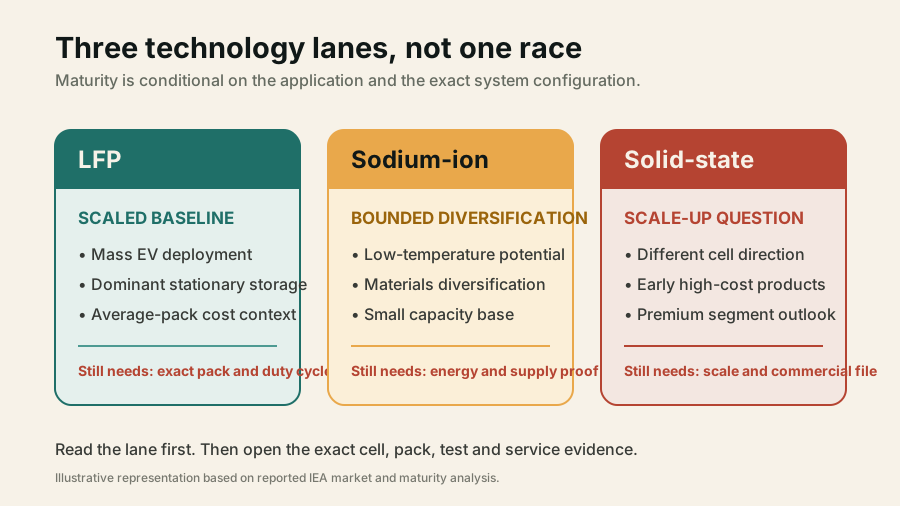
Capacity shares are not deployment shares, and neither is a product performance result. But together with the materials and energy-density constraints, they describe an early complementary lane rather than a demonstrated general substitution for lithium-ion. Sodium-ion may fit a defined application before it fits a mass-market long-range EV; it may matter in a market or climate where its particular trade-offs are useful before it becomes a global default.
China is central to this story because Chinese companies are among the firms trying to industrialise the chemistry and connect it to cells, packs and end-market demand. That is meaningful. It also raises the need to separate a company announcement from an independent product conclusion. CATL, for example, announced Naxtra sodium-ion, Freevoy dual-power and Shenxing products on 21 April 2025. The date and the product identities are a valid public record of direction and activity. The performance specifications in the release remain CATL's own claims. They do not substitute for a configuration-matched test, warranty record, production allocation or buyer acceptance file.
“Dual chemistry” requires the same discipline. Combining technologies in one system can be a response to real engineering goals: perhaps one source prioritises energy while another supports a power, temperature or charging objective. But a dual-chemistry architecture does not answer the difficult questions by naming two chemistries instead of one. It may add new questions about control strategy, thermal behaviour, service, failure isolation and warranty scope.
When sodium-ion may be a serious question
Sodium-ion is most decision-relevant when a buyer can identify a real constraint that the chemistry might address. That could include:
- a stationary or lower-energy-density application where volume and mass are less constraining;
- a low-temperature operating context that warrants a configuration-specific comparison;
- a supply-chain diversification question with clearly defined material, cost and origin requirements;
- a product family with an actual, documented sodium-ion variant rather than a roadmap reference;
- a project whose warranty, support, certification and service path are available for that variant.
The list is intentionally conditional. A buyer should not replace one chemistry slogan with another. The evidence request remains the same: exact cell identity, pack architecture, validated operating range, test scope, commercial terms, availability and service commitment.
What a sodium-ion announcement cannot settle
It cannot establish a delivered energy figure for the product a reader is considering. It cannot establish whether the announced cell is in the quoted pack, at which plant it will be made, in which market it can be sold, or whether a warranty applies. It cannot establish calendar life, cycling behaviour, cold-weather outcome, transport treatment or resale value. Those claims may eventually be answerable. They need the document and configuration that answer them.
This is not a double standard applied only to Chinese companies. It is the normal standard for emerging battery technology. The more novel the chemistry or architecture, the more important it is to distinguish a technical direction from a system that has completed the relevant manufacturing, qualification, certification, support and acceptance path.
Solid-state is a scale-up question, not a shortcut around diligence
Solid-state batteries attract attention because they seem to promise an escape from the familiar trade-offs of liquid-electrolyte lithium-ion cells. A solid electrolyte can change the materials and cell design space. It may enable useful future combinations of safety, energy density and manufacturing choices. The direction is real. The commercial inference is often premature.
There is no single finished thing called “the solid-state battery.” Different developers use different materials, interfaces, manufacturing processes and degrees of solid-electrolyte integration. Some systems may be semi-solid or hybrid in architecture. A headline can therefore compress a large amount of unresolved technical and industrial detail into two words.
The current independent boundary is sobering. The IEA says early solid-state batteries face high costs and are likely to remain concentrated in premium segments through the first half of the 2030s. This is a forward-looking assessment, not a guarantee that every programme will follow the same schedule. It is nevertheless a better guide than treating launch targets as proof that solid-state has already redrawn the mass market.
The issue is not only electrochemistry. A technology must move through manufacturing yield, process control, material supply, equipment, cell consistency, pack integration, testing, service strategy, customer validation and cost. One impressive laboratory or pilot result can be a genuine advance while leaving many of those industrial gates open.
For a buyer, the phrase “solid-state” should trigger a request for precision:
- What exactly is solid in the electrolyte and what remains conventional or hybrid?
- Is the cell production, pilot production, qualification sample or commercial production?
- Which vehicle or stationary pack configuration uses it?
- What testing has been completed, at what scale and under what conditions?
- What are the manufacturing location, delivery availability, warranty and service terms?
Those questions are not anti-innovation. They are how innovation becomes usable. A reader who understands solid-state as a scale-up challenge can follow progress without turning every announcement into a forecast for a specific purchase or fleet plan.
China's manufacturing role matters—but it is not a product verdict
It is possible to take China's industrial importance seriously without treating “Chinese” as a chemistry, quality grade or country-of-origin proof.
The IEA's 2025 manufacturing figures are striking: more than 80% of battery-cell production, roughly 85% of cathode-active-material production and more than 90% of anode-active-material production in China. Those figures help explain why battery material, cell-equipment, pack-design and pricing decisions made in China can affect global EV and storage markets.
They do not tell a reader the origin of an individual product. A globally sold battery can involve materials, cells, modules, packs, vehicles, inverters and final integration across several jurisdictions. The question “is it Chinese?” can conceal the questions that actually determine a compliance, sourcing or support answer: Which entity made the cell? Which factory made this revision? Where did the pack integration happen? What is documented in the bill of materials and chain of custody? Which market's rules apply? Who is responsible for warranty and service?
Manufacturing concentration also does not establish reliability. Volume can create learning, supplier depth and equipment ecosystems. It can also coexist with differences among suppliers, factories, product lines and quality-control regimes. A reader evaluating an item cannot outsource product diligence to a country statistic.
The broader China industrial-clusters guide is useful context here. Clusters can make sourcing, iteration and supplier discovery faster. They are discovery infrastructure, not a substitute for factory- and configuration-level evidence. Batteries make that principle unusually clear because the system contains so many layers: materials, electrochemistry, precision manufacturing, electronics, software, mechanical integration and after-sales obligations.
A standard record is a gate, not a product verdict
Public standards matter because they define an official boundary. They do not make that boundary self-executing for every product named in a brochure.
For Chinese EV traction batteries, the official registry lists GB 38031-2025, Electric Vehicles Traction Battery Safety Requirements, as current. The registry shows a publication date of 28 March 2025 and an effective date of 1 July 2026. That is useful information. It tells a reader which national-standard record to locate and confirms its current date boundary.
It does not tell a reader that a particular vehicle, cell or pack conforms. The public listing alone does not identify the exact product configuration, the test laboratory, the sample selection, the test scope, a market-specific certification path, a production-control arrangement or the continuing status of the supplied item. This article has not reviewed the full standard text or a product test report, so it makes no claim about the technical details of the standard or about any product passing it.
The practical response is to treat a standard as one row in a system file. If a seller cites it, request the configuration that the cited evidence covers and the document that ties the evidence to the exact item being offered. Then check what other regulations, transport rules, vehicle approvals, installation codes or customer requirements apply in the reader's own market. An EV traction-battery standard does not answer every stationary-storage, export, insurance or fleet question.
This may feel slower than accepting a standards number at face value. It is faster than discovering after shipment that the named standard, the tested configuration, the commercial product and the local requirement were never the same thing.
Turn a chemistry headline into a system evidence file
The most useful output of a battery-technology explainer is not a winner. It is a disciplined next request.
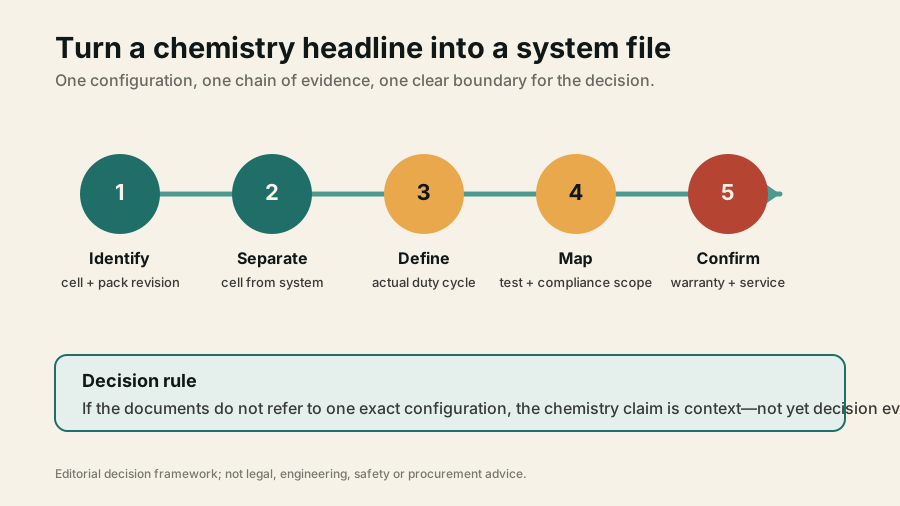
When an EV, cell or storage proposal says LFP, sodium-ion, dual chemistry or solid-state, create one file for the exact configuration under discussion. The file does not need to be a bureaucracy exercise. It should answer the questions that determine whether the headline travels all the way to a product decision.
1. Identify the object exactly
Start with the product identity, not the campaign name. Record the supplier legal entity, product name, model number, revision, cell chemistry, physical cell format, nominal capacity or energy, pack identifier and intended application. If the configuration differs by market, vehicle trim, factory, storage duration or software version, write that down.
This is where many general claims fail. A page can describe a technology family while the quotation refers to a specific revision. A launch event can name a product while the available configuration uses another pack. A vehicle badge can obscure a mid-cycle battery change. The first task is to make sure every subsequent document refers to the same thing.
2. Separate cell evidence from pack evidence
Ask which records describe the cell and which describe the pack. A cell datasheet may give a nominal specification. A pack document should identify enclosure, connections, protection, cooling or heating, BMS functions, charging/discharging limits and interfaces. A vehicle or storage-system document should explain how the pack is integrated and controlled.
The separation matters because responsibility can be separated too. One company may make the cell, another may assemble the pack, another may integrate the vehicle, and another may support the customer. A positive statement at one layer is not automatically a commitment at the next layer.
3. Define the duty cycle before comparing a claim
“Fast charging,” “long life,” “cold-weather capable” and “high safety” are not useful decision terms until the use case is defined. For a vehicle, document ambient range, route length, payload, charging power, dwell time, state-of-charge window, annual mileage and expected degradation tolerance. For storage, document duration, cycling pattern, depth of discharge, power profile, ambient conditions, controls, installation environment and maintenance plan.
This does not require the reader to generate a new laboratory test. It requires them to stop comparing dissimilar promises. An LFP pack may be appropriate for one duty cycle and inappropriate for another. A sodium-ion configuration may have a meaningful low-temperature case only if its specific system documentation supports it. A solid-state roadmap is not a duty-cycle answer at all until it has a commercial configuration and evidence.
4. Request test and compliance scope, not just a certificate name
Ask what was tested, which sample was tested, under what conditions, and whether the test applies to the supplied revision. If a seller cites a standard, certification or lab result, ask for the configuration mapping. If an OEM or integrator has its own acceptance process, ask where the supplied system sits within it.
The goal is not to demand confidential material indiscriminately. It is to make visible the boundary between a public technology statement and the proof appropriate to the transaction. A reader may need different documentation depending on whether they are buying a vehicle, sourcing cells, insuring a storage project, integrating equipment or evaluating a fleet programme.
5. Read warranty, service and change control as technology evidence
Battery performance does not end at shipment. Warranty language tells you which operating conditions, measurement methods, exclusions and remedies matter to the commercial relationship. Service documentation tells you who diagnoses a fault, who can replace a component, where parts come from and whether software access is required. Change-control terms tell you what happens if a cell, pack component, factory or software revision changes.
These documents are not separate from the technology. They are the mechanism through which a claimed system remains supportable in the field. A chemistry headline without warranty and service detail is still an incomplete product story.
6. Keep origin and availability as separate records
China's large industrial role makes it easy to assume a known origin or unlimited availability. Do not. Request origin and chain-of-custody records appropriate to the transaction, and distinguish capacity announcements from actual allocation. Ask whether the exact cell and pack are approved for the target market, what lead time and allocation assumptions apply, and what happens if a component changes.
This is especially relevant when trade rules, local-content requirements, transport conditions or procurement restrictions are in scope. An industrial statistic may tell you why a supply chain is exposed. It does not complete the evidence needed for a particular shipment.
A compact decision table
| If the proposal says… | Treat it as… | Ask for next |
|---|---|---|
| “LFP battery” | A chemistry and cost/energy-density clue | Exact cell and pack revision, duty-cycle data, thermal and warranty evidence |
| “Sodium-ion” | A conditional technology and supply-chain clue | Energy/power specification, operating range, production status, test and service file |
| “Dual chemistry” | An architecture claim | Control strategy, failure isolation, configuration test scope and warranty allocation |
| “Solid-state” | A maturity and scale-up claim | Cell architecture, production status, configuration evidence, availability and commercial terms |
| “Meets GB 38031-2025” | A claim about a public standard boundary | Product-specific conformance evidence, test scope and applicable local requirements |
What to watch next
Battery technology will keep changing, and this article should not be read as a fixed scorecard. Recheck market data, cell revisions, manufacturing capacity, standard status, product availability and commercial terms before making a live decision.
For LFP, watch whether deployment continues to broaden across vehicles and storage, but also watch the pack-level strategies that shape usable energy, repairability and cost. For sodium-ion, watch real configuration-specific deployments, hard-carbon supply-chain development, verified operating data and warranty-backed product availability. For solid-state, watch production status, cost, qualified configuration evidence and actual commercial placement rather than launch-count headlines.
For the China context, watch the specific companies, factories, materials and trade pathways attached to the product—not a generic national label. The same discipline applies to China's battery-storage buildout: market growth is useful context, while the individual project still lives or dies on its equipment, controls, warranty, integration, acceptance and operating case.
Frequently asked questions
Is LFP better than NMC?
Neither chemistry is universally better. LFP has become a scaled option in EVs and the dominant chemistry in stationary storage in the IEA's 2025 deployment data, while NMC can remain relevant where a different energy-density and system trade-off fits the application. Compare the exact pack, duty cycle, thermal design, price, warranty and service support rather than choosing from the chemistry name alone.
Are Chinese LFP batteries good?
“Chinese LFP batteries” is too broad to be a quality category. China has exceptional cell and material manufacturing scale, but that does not identify a specific cell, factory, pack design, BMS revision, test record or warranty. Evaluate the exact product and the evidence tied to it.
Is sodium-ion battery technology ready for EVs?
Sodium-ion has real commercial momentum and particular strengths, but the IEA's current analysis still describes lower energy density, an immature hard-carbon supply chain and a small capacity base relative to lithium-ion. It may be ready for defined configurations and applications; a general EV verdict requires the particular vehicle, pack, operating range, warranty and test evidence.
Are solid-state batteries already in mass production in China?
Treat that as a configuration and production-status question, not a national yes/no question. The IEA's current outlook expects early solid-state products to remain high cost and concentrated in premium segments through the first half of the 2030s. A launch or pilot line is meaningful progress, but it is not proof of broad mass-market availability.
Does GB 38031-2025 prove an EV battery is safe?
No. The official registry confirms the standard's identity, status and dates; it does not certify a specific battery. Safety and compliance conclusions need the exact product configuration, relevant test scope, applicable-market requirements and supporting documentation.
Method and limitations
This is a desk-researched technology explainer, not a battery test, teardown, plant audit, project review or supplier qualification. It uses IEA analysis of 2025 battery deployment, prices, manufacturing and emerging chemistry maturity, the IEA manufacturing and trade record, the public GB 38031-2025 registry entry, and CATL's dated April 2025 product announcement. Company-announcement language is used only to establish that the named event occurred; it is not used as independent proof of performance.
Market measures, standards status, product revisions, supply conditions, warranty terms and applicable rules can change. Before a purchase, sourcing, engineering or compliance decision, verify the exact cell, pack, system configuration, test scope, commercial terms and local requirements.