
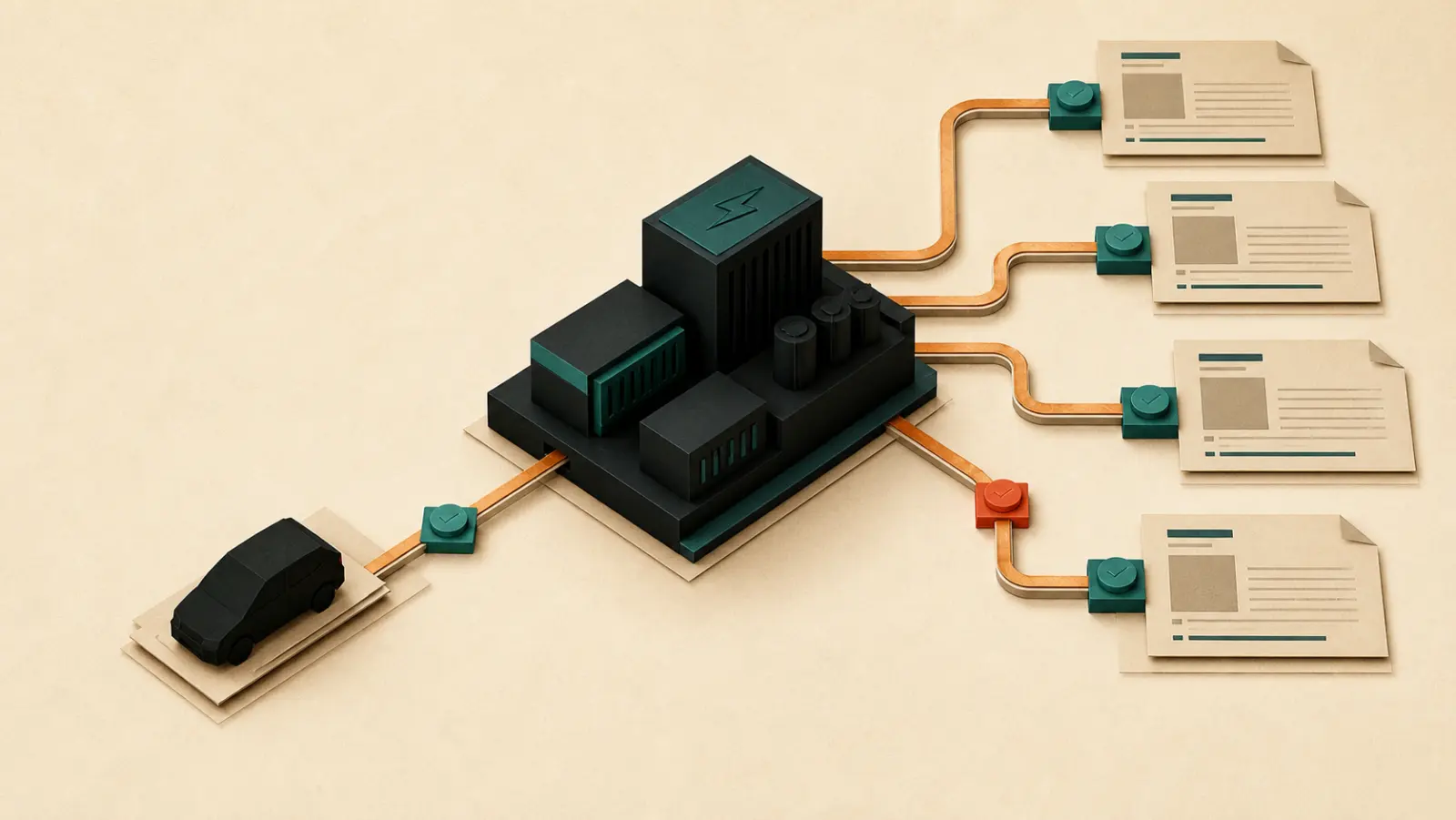
China’s charging network is a real industrial achievement. The National Energy Administration said that, at the end of June 2026, China had 23.057 million EV charging guns: 5.009 million public and 18.048 million private. That is a much more current starting point than the old “2.7 million public points” headline that still circulates in discussions of China EV charging infrastructure. It also explains why the country belongs in any serious EV infrastructure conversation.
It does not tell a driver, fleet manager, vehicle importer or infrastructure reader whether a particular car can complete a useful charge at a particular station. The national statistic does not identify the station, the connector, the vehicle revision, the charging account, the payment route, the access rule, the live queue, the allocated site power, the equipment condition, the maintenance history or the application’s software path. It is a map of inventory, not a receipt for a session.
That distinction is the useful way to read China’s charging scale. A large network can make discovery easier, support industrial learning and create a large field of possible sites and operators. It cannot make the missing record disappear. Nor is this merely a foreign-reader problem. China’s own 2023 State Council guidance described the network as large while identifying incomplete layout, uneven service and non-standard operations as issues that still needed attention. Scale and service are related; they are not the same claim.
This article is a public-record guide, not a route planner, charger review, site audit, vehicle test, payment test, electrical design, safety assessment or legal opinion. It does not tell a reader where to charge, which operator is best, which adapter to buy, whether a vehicle is compatible or what power a car will receive. It shows how to keep five records separate before anyone treats a China charging-network headline, standard, certification badge or nominal power label as evidence that a defined charging session will work:
- the measurement-and-map file;
- the compatibility-and-access file;
- the site-and-power file;
- the maintenance-and-incident file; and
- the grid-and-change file.
The files are connected. They are not interchangeable. A national number can support a discovery decision. A standard can establish a language for a technical question. A certification record can describe one layer of product control. A V2G pilot can show that a programme exists. None of those records, alone or stacked together, proves that a driver can arrive at a named location with a specified vehicle and leave with the expected energy.
The short answer: China’s charging count is a map, not a session
The most important question is not whether China has a very large charging network. It plainly does. The more useful question is: what exactly is being counted, and what decision is someone trying to make with the count?
The NEA’s June 2026 release reports charging guns. The split matters. Of 23.057 million guns, 5.009 million were reported as public and 18.048 million as private. A headline that repeats the total without the split can accidentally make privately installed equipment sound like publicly usable roadside capacity. Even the public number is not a list of open, working, compatible, available and payable sessions. It is a national inventory category at a dated point in time.
That is not a criticism of the statistic. It is the statistic’s job. National infrastructure data is meant to show system scale, development, public/private structure and change over time. It cannot carry every field that a live session needs. If a reader expects it to answer a live question, the reader is asking the wrong record to do the work.
Consider how quickly the question changes as it becomes real. “Does China have charging infrastructure?” is a country-level question. “Can our vehicle use public charging in the city where it will operate?” is a vehicle, market and access question. “Can this fleet charge at this depot at the expected operating window?” is a site, contract and electrical-service question. “Can this car receive a particular charging rate at this station today?” is a session question. Every move narrows the object and creates facts that the national total cannot contain.
The NEA itself has made the measurement boundary more visible. In a 2025 public explanation, it said that it had adjusted charging-facility statistical methods using national and provincial monitoring platforms, power-grid enterprise systems, local reporting and national verification, and would publish data monthly. That is useful institutional context: there is a described reporting process behind the aggregate. It still does not turn a national monitoring framework into a real-time promise about a pin, screen, parking bay or payment account.
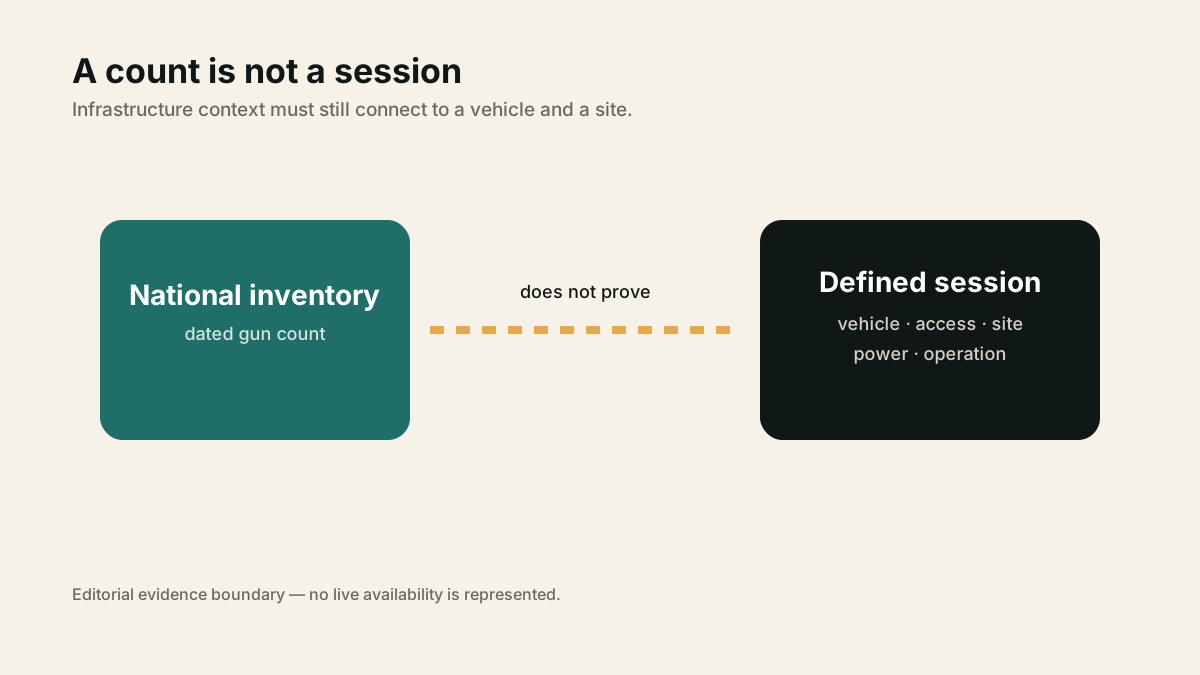
The denominator should change the next question
A useful reader habit is to state the denominator before making an inference. The following sentences are materially different:
| Statement | What it actually establishes | What remains unknown |
|---|---|---|
| China reports 23.057 million charging guns | A dated national inventory count | Whether a particular unit is public, open, working or suitable for a vehicle |
| China reports 5.009 million public charging guns | A dated public subset of that inventory | Site access, opening hours, payment, availability, connector and live condition |
| A station advertises a power class | A stated equipment or site claim | What a specific vehicle can receive in the actual session |
| An operator appears on a map | A discovery lead | Whether a reader can authenticate, pay, start and complete a session |
| A standard is current | A public technical reference exists | Whether the exact vehicle, station and software combination works together |
The correct conclusion from the NEA record is therefore positive but bounded. China’s public charging footprint is large enough that readers should investigate the network, the different operating models and the service layers around it. A public/private split also signals that the country’s charging system is not only a street-side network; residence, workplace, depot and other private contexts are a major part of the installed base. But the reader still needs evidence specific to the intended use.
For the vehicle and battery system that makes charging demand meaningful, see China EV Battery Industry: How the Feedback Loop Works. It explains a broader industrial system. It does not establish that a vehicle can use a given station. That same boundary applies to fast-charging headlines such as BYD 5-Minute Charging: What Buyers Can Actually Verify: a vehicle-platform claim and a public-session claim are different objects with different proof.
A current communication standard is not a session receipt
Standards matter because they create a shared language. They can identify an interface, a protocol, a test subject, a product category or an implementation date. They are often the right place to begin a technical conversation. They become misleading only when a team promotes them from reference to outcome.
China’s national standards register lists GB/T 27930-2023 as Digital communication protocols between off-board conductive charger and electric vehicle. The register marks it current, gives a publication date of 7 September 2023 and an implementation date of 1 April 2024. That is a specific, useful public record. It tells a reader that a named communication-protocol reference exists and is current in the registry.
It does not answer every link in a charging session. A public standards page does not show that a particular vehicle revision implements the relevant behaviour; that a particular charger is configured in the necessary way; that an account can authenticate; that a site permits access; that payment clears; that a station has capacity; that a connector is physically usable; or that a session will start and run normally. None of those gaps means the standard is unimportant. They mean that a standard record is one file in a larger chain.
Start with the defined vehicle and the intended access path
The compatibility-and-access file should name the object before a reader interprets a standards reference. At an early stage it can be concise. Its purpose is to stop a conversation about “EV compatibility” from drifting between different models, markets, firmware states, connector arrangements and account experiences.
A useful file normally records:
- the vehicle make, model family, market configuration and relevant revision boundary;
- the intended charging mode and interface being discussed;
- the country, region or site context in which access is expected;
- the station or operator relationship, if a named one is material;
- the account, authentication, payment or access assumptions that are known, unknown or owned by another party;
- the software or service dependencies that affect session initiation or status; and
- the source of each statement: vehicle document, station/operator record, contract term, test log or an unresolved question.
The list deliberately avoids declaring an acceptance procedure. A vehicle manufacturer, operator, fleet, property owner or technical reviewer may need a different and more detailed record. The editorial point is simpler: do not use “the standard is current” as a substitute for the statement of which vehicle, which access path and which configuration are under discussion.
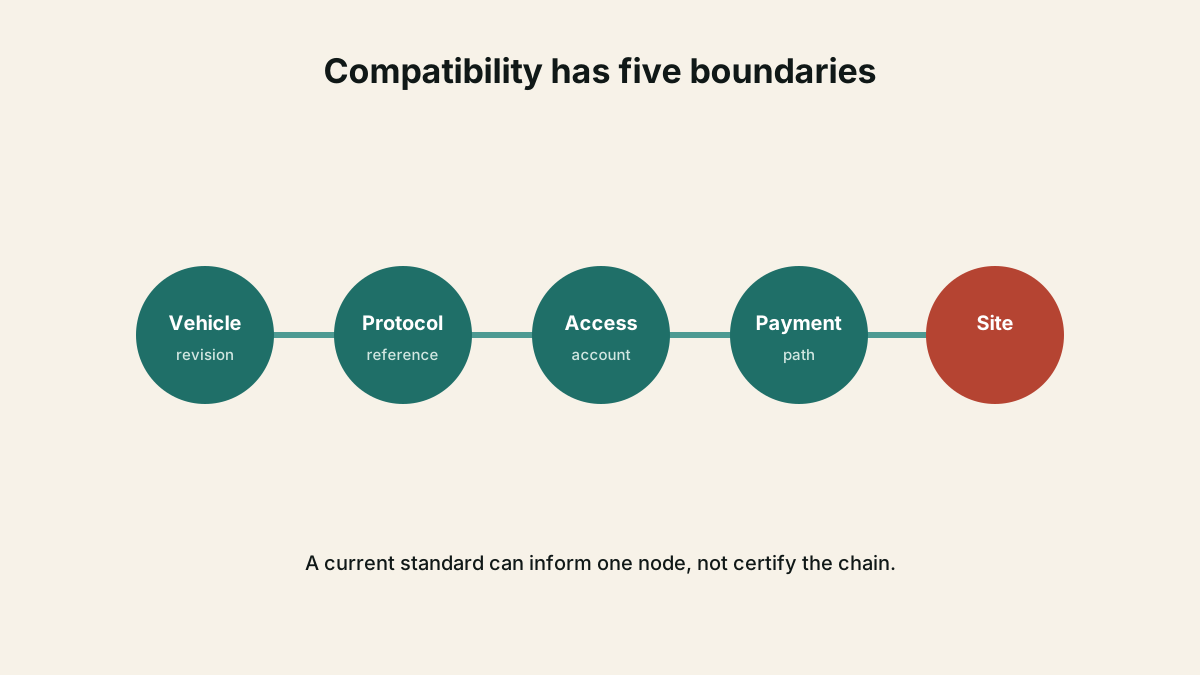
Interoperability has more than one boundary
The word interoperability often hides several decisions. A physical connection can be one question. Digital communication can be another. The right to use a site can be another. Authentication and payment can be another. A station may be discoverable without being accessible to every account. A vehicle may share a technical family with another model while differing in market configuration or software. A payment instruction may be visible without being available to a particular user or organisation.
For that reason, it is safer to break a broad compatibility claim into smaller statements. “The public protocol record is relevant to our interface question” is a bounded statement. “Our vehicle can complete a public session at every station using that protocol” is a much larger claim. The first can be supported by the standards register and an implementation discussion. The second needs evidence from the actual vehicle, station, account and session context. The article has no such evidence and does not make that claim.
This matters for imported vehicles and cross-market conversations, but it is not confined to them. Even within one national system, a charging session sits at the intersection of a vehicle, a station, a property or road context, an operator workflow and a user’s access path. A country-level standard is a necessary kind of map for the technical terrain; it is not a receipt proving that every path across it is open.
Targets are commitments, not a map of today
Future planning is another area where true numbers are often used too broadly. China’s Electric Vehicle Charging Facilities Service Capacity Three-Year Doubling Action Plan (2025–2027) sets an ambitious national direction. It calls for 28 million charging facilities and more than 300 million kW of public charging capacity by the end of 2027, alongside targets for urban DC charging, highway facilities, rural coverage, residential deployment, V2G and service quality.
Those targets are important. They show that charging is being treated as a transport, energy, distribution-grid, consumer-service and regional-development system rather than simply a hardware category. They also make clear that the public policy task is still active. A target for 2027 is not a report that every target has been met in 2026. It is especially important not to convert a national target into a conclusion about a named city, highway service area, apartment block, depot, station operator or individual user.
The plan itself describes several distinct work streams. Highway and parking-area upgrades have their own objectives. Rural coverage has its own deployment language. Residential charging is tied to property and distribution conditions. V2G is framed as a programme for expanded application. Service quality is tied to station upgrades, pricing disclosure, operation and evaluation. The fact that the plan separates these issues is a hint for readers: a useful charging decision should also separate them.
Policy can identify a direction without proving delivery
When a policy document includes a number, ask four questions before using it in a decision:
- Is it an observation, a target, a forecast or a requirement?
- What date and geography does it apply to?
- What is the denominator—guns, stations, capacity, energy, sites, projects or users?
- What local, contractual, technical or operational step still connects it to the decision in front of us?
The action plan provides a useful example. Its target of more than 300 million kW of public charging capacity is a public-capacity objective. It is not a promise that a specific vehicle will receive an equivalent power level. Capacity is not identical to the power delivered at a connector, energy received by a battery, waiting time, cost, session success or a vehicle’s own charging curve. Those require distinct data and are outside the evidence in this article.
The same applies to highway targets. A statement that highway infrastructure is being built or upgraded can make a corridor worth investigating. It does not tell a reader whether a specific service area has an accessible bay at a specific moment, whether a vehicle can authenticate, whether a connector is in service, or whether another user is already occupying the relevant equipment. A route plan needs current, specific information; an evergreen evidence guide should not impersonate one.
Power on a sign is not power at the battery
High-power charging is a useful policy and engineering category, but it is easily flattened into a marketing promise. In 2025, the NDRC and other agencies issued a notice on scientifically planning and building high-power charging facilities. It describes single-gun charging power of 250 kW or above in its high-power context, calls for planning and grid integration, discusses station operation and sets a goal of more than 100,000 high-power facilities nationwide by the end of 2027.
The notice is valuable because it refuses to treat power as a number printed on a cabinet. It connects high-power facilities to forecasted demand, highway and transport scenarios, distribution-grid capacity, operation, safety management, price disclosure, maintenance and business models. In other words, the public record already describes a site system, not merely a device label.
The correct reader conclusion is not that every 250 kW-plus label is meaningless. It is that a nominal category does not establish the delivered outcome for a particular session. What a vehicle receives can depend on the vehicle’s own state and configuration, the station’s allocation and condition, local electrical context, temperature and other facts. This article does not test or model those variables. It therefore does not state charging times, usable power, queue outcomes or fleet throughput.
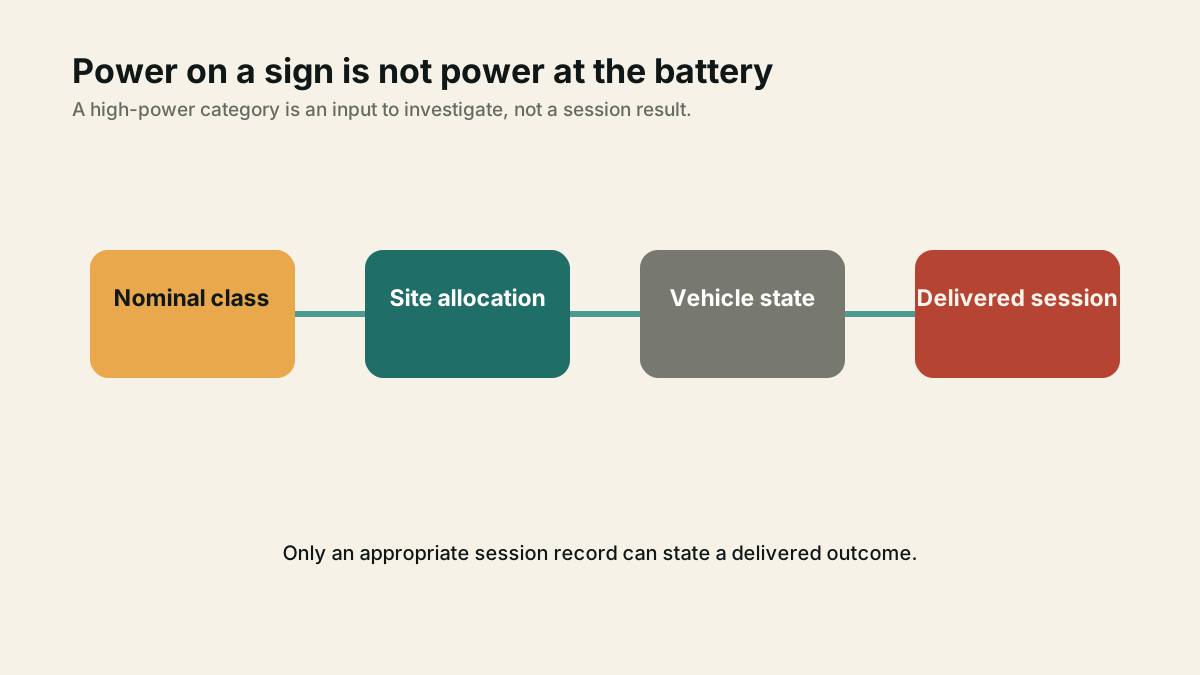
The site-and-power file
Before relying on a high-power claim, define the site-and-power file. It is not an electrical design manual. It is a record that gives the relevant team a way to ask what part of the claim is a policy label, a site capability, a contracted service, a current operating condition or a still-unverified assumption.
The file can include:
- the named location and the use case: roadside, highway, destination, residence, workplace, depot, fleet base or another defined context;
- the relevant station and equipment identity, where available;
- the stated power category and the source that states it;
- the site’s intended operating boundary, including any published access and use conditions;
- the distribution, connection or load-management information that is actually available to the responsible reviewer;
- the vehicle or fleet demand assumption being evaluated; and
- the difference between a planned upgrade, a contracted capacity, a device nameplate and a measured or observed session result.
The last distinction protects both readers and operators. A planned upgrade may be commercially significant. A contracted capacity may be an important site condition. A device nameplate may be relevant to a hardware decision. A measured session is another type of evidence again. Treating them as the same creates false precision. The file should make the difference visible instead of trying to hide it with a single large power number.
For broader China EV market context, see Chinese EV Brands Abroad: The Ownership File. Model and market context can help define which configurations require investigation. It does not establish the charging conditions of a particular station.
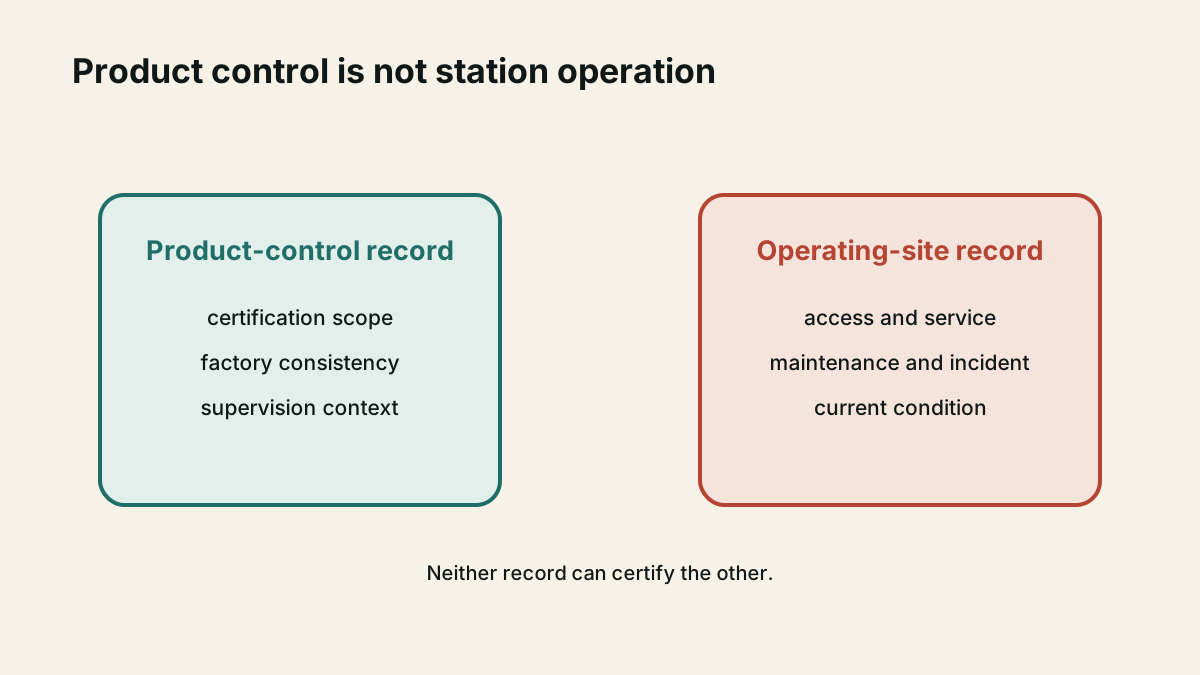
Product control is not station operation
Product-control records are valuable, particularly when the product category has safety and quality implications. But a product-control record and an operating-station record perform different jobs.
On 1 August 2026, the State Administration for Market Regulation and the national certification authority said that mandatory CCC management for EV supply equipment had begun. The announcement describes product testing for safety-related indicators, factory quality-assurance capability and product-consistency inspection. That is a meaningful public description of a product-control system.
It is not evidence that every installed unit is currently working, maintained, publicly accessible, compatible with a named vehicle, connected with adequate site capacity or ready to complete a user’s session. A certified product can exist within a site that has a separate access, service, maintenance or load-management issue. Conversely, an operations team may have a robust maintenance programme that is not established by a reader merely seeing a certification reference.
SAMR’s 2026 product-quality supervision plan offers a related caution. It puts EV charging equipment among product categories receiving strengthened attention in a risk and public-concern context. That public oversight fact should not be inflated into a failure rate for a named charger, brand or station. What it does show is that product quality and safety remain active governance questions. A reader should therefore resist treating a broad network statistic as a universal safety or reliability result.
The maintenance-and-incident file
The maintenance-and-incident file is where a site becomes an operating service rather than a dot on a map. It should identify the records that tell the responsible people what happens when a unit is unavailable, a session fails, an access condition changes, a user reports a problem, a product is updated or a site needs repair.
A practical file may record:
- the identity and scope of the equipment or station covered;
- the operator or responsible-party boundary, without assuming every participant owns every function;
- the maintenance, inspection, update and escalation records that are available;
- a method for recording an incident, exception, session issue or access problem;
- the relevant time boundary: when the information was current and when it must be refreshed;
- the user or fleet communication path for an outage or change; and
- which unresolved issue blocks reliance on the site for the intended use.
This is not a demand that public readers obtain confidential service records. It is a way to classify what they do and do not know. A consumer may only be able to check current operator information and choose an alternative. A fleet may have contractual rights to service information. A property owner may have maintenance records. A procurement or safety team may need qualified review. The public article cannot prescribe the same action for all three, but it can stop them from pretending that a map listing or product certificate answers an operational question.
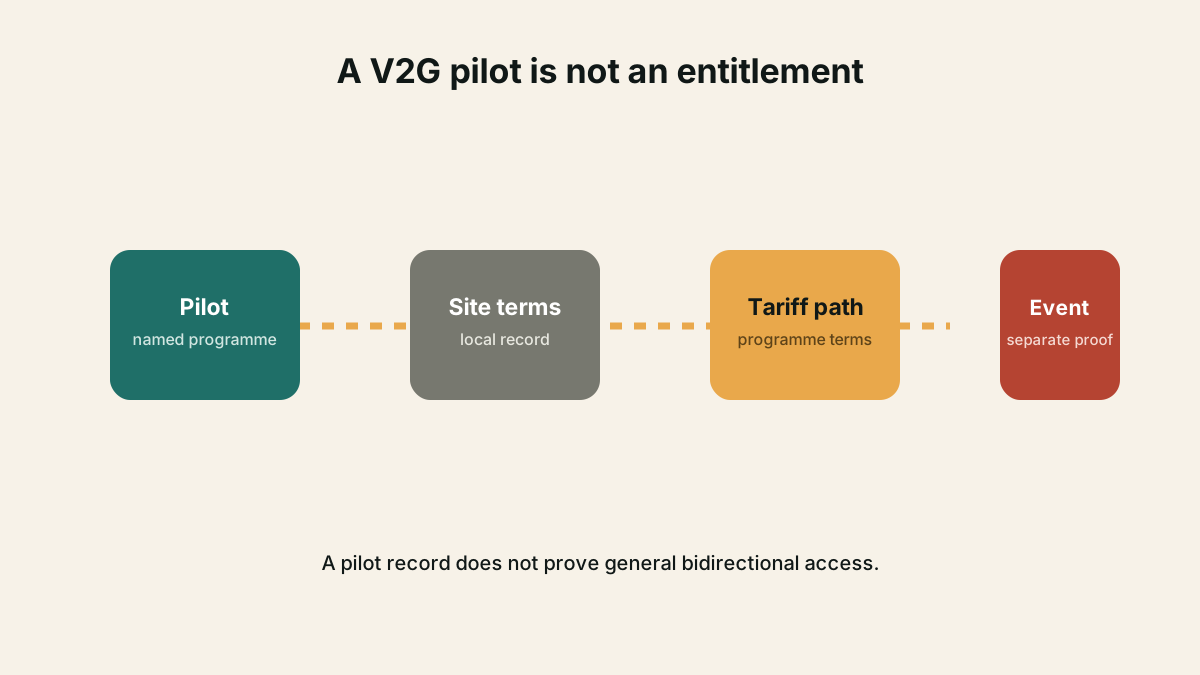
A V2G pilot is not an entitlement to discharge
Vehicle-to-grid discussion can add another layer of confusion. The phrase can refer to physical capability, a vehicle feature, a charging or discharging interface, a site programme, a tariff or price mechanism, an aggregation arrangement, a grid-service rule, a customer agreement or a pilot. These are not interchangeable.
In April 2025, the NEA announced a first group of V2G scale-application pilots including nine cities and thirty projects. This is useful evidence that named pilot work existed. It is not evidence that all vehicles, chargers, accounts or sites have bidirectional functionality, that a reader can export energy, that a given tariff applies, or that a particular project has achieved a stated operational result.
The three-year action plan reinforces the distinction. It calls for expanded V2G pilot application, testing in different city and regional settings, price mechanisms and more than 5,000 additional bidirectional charging/discharging facilities by the end of 2027, together with a target for reverse-discharge energy. Those are programme directions and targets. They do not create a universal right or capability today.
The grid-and-change file should therefore be separate from the session’s immediate compatibility and site-power records. It should identify whether any grid interaction is merely a policy reference, a pilot, a service offering, a contractual arrangement, a physical capability, a measured event or an unresolved question. It should also identify changes that trigger re-review: vehicle software, station equipment, account terms, tariff structure, aggregation arrangement, distribution connection, operating hours or a relevant policy update.
The five-file China charging-session evidence architecture
The framework below is editorial. It is not a statutory form, technical acceptance protocol, safety method, engineering specification or legal checklist. Its purpose is to make a simple rule visible: the record that answers one charging question should not silently answer the others.
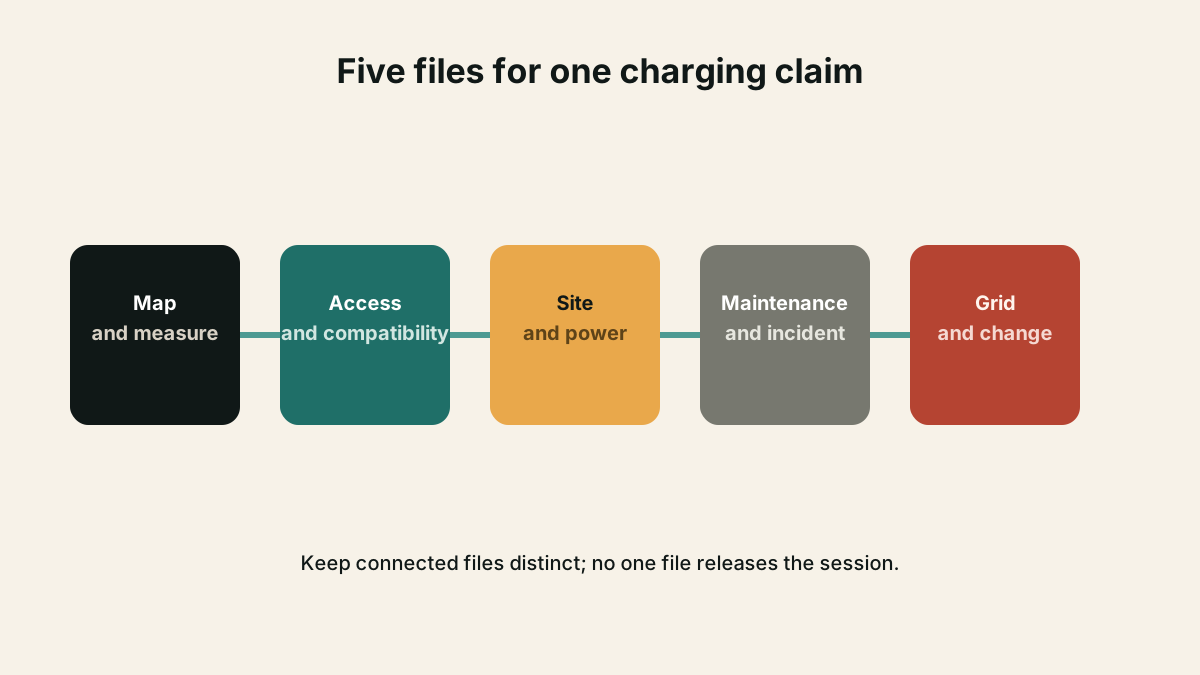
File one: measurement and map
This file contains the country, regional or operator-context material that makes a site or network worth investigating. It may include a dated national statistic, a public/private split, a corridor or locality reference, a map lead and the source and date of every claim. It must also say what the map does not establish. A national count is not a station list. A station list is not live access. A live access indication is not a completed session.
The file’s central question is: what did we use to discover this option, and what did that discovery record actually measure? If the answer is an NEA statistic, record that it counts charging guns at a national date. If it is an operator map, record that it is an operator-facing discovery source. If it is a policy document, record that it is a policy direction. None should be quietly relabelled as a service guarantee.
File two: compatibility and access
This file names the vehicle, interface, software and user-access assumptions. It contains the version boundary and the relationship between the technical reference and the actual configuration. It distinguishes a standard’s existence from implementation, implementation from station configuration, configuration from access and access from a completed paid session.
The file also prevents a common substitution: treating a physical connector discussion as the whole charging question. A session needs more than a mechanical fit. It may require digital communication, operator access, authentication, payment and a working site. If any of those matters to the intended use and is not supported by an appropriate record, label it unknown rather than letting an adjacent technical fact fill the gap.
File three: site and power
This file contains the named location, intended use, published or contracted service boundary, power claim source and the relevant distribution or load-management questions. It separates planning, nameplate, allocation and actual delivery. It can also record whether the station is a discovery lead, a proposed future installation, an existing asset under review or a site with a measured history that the responsible party can inspect.
The practical question is not “is it fast?” It is “what exact statement about the site and vehicle is being made, who owns that statement, when was it true and which record can show it?” That question is less dramatic than a charging-time headline, but it is what prevents a fleet, investor, product team or driver information page from building a promise on an undefined power number.
File four: maintenance and incident
This file names the operating boundary. It keeps product-control information, certification context and station operation distinct. It identifies who sees an outage, who logs a failed or abnormal session, who owns a repair or software update, what a user is told and what record shows the current state. It should also identify the limit of public knowledge when the reader cannot access operational records.
For a live operation, maintenance is not an afterthought. It is part of the claim that a station is a service. A public article cannot prove maintenance quality for a site it has not inspected. It can, however, say that a national product-control announcement does not prove that maintenance occurred yesterday, that a bay is accessible now, or that the software path a user needs is functioning.
File five: grid and change
This file separates static charging from a broader grid-interaction proposition. It records whether the question is only charging, a V2G pilot, a bidirectional service, an aggregation programme, a tariff condition or a future policy target. It links any relevant site, account, vehicle and programme changes to a re-review point.
The stop rule is modest: do not infer a V2G entitlement, delivered charging power, reliable public access or completed session while the material file is missing, mismatched, stale or owned by someone who cannot confirm it. A pause is not a verdict that the network fails. It is a transparent statement that the current evidence does not support the larger claim.
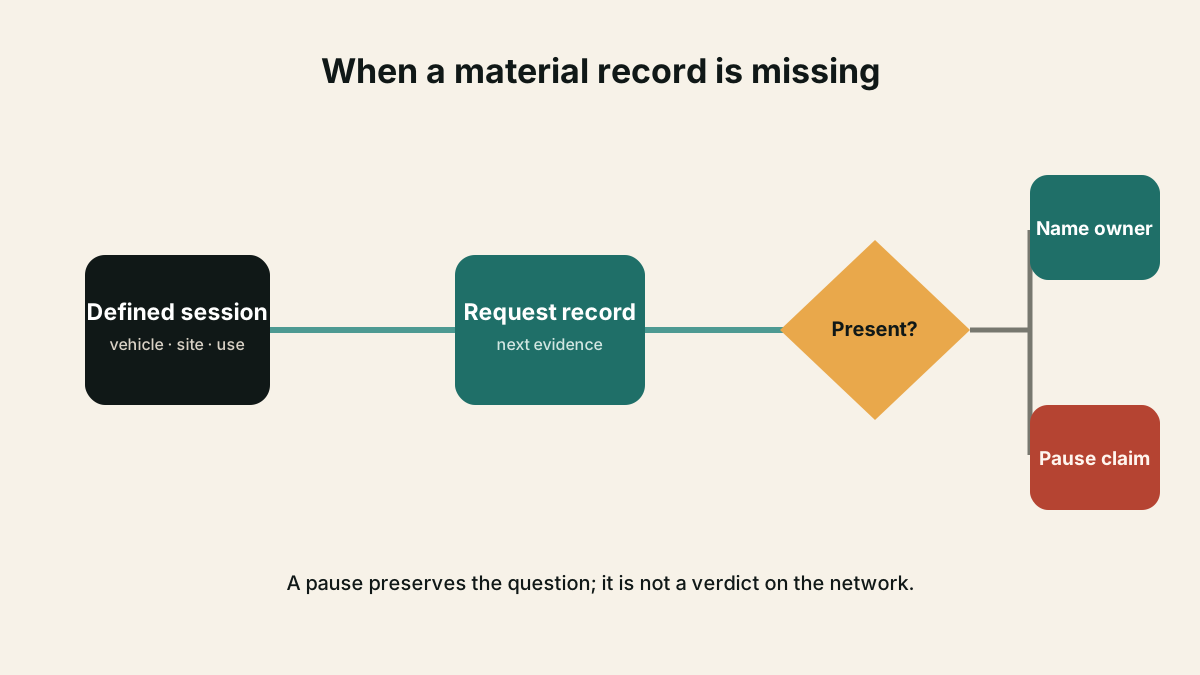
A practical request sequence when a charging claim appears
The five files do not require every reader to perform the same diligence. A driver, fleet, property owner, importer and infrastructure operator have different rights, risks and records. They do provide a sequence that keeps public context useful without letting it become a substitute for the decision.
First: freeze the claim
Write one sentence that states the object, place, use and decision. For example: “We are assessing whether vehicle configuration X can rely on site Y during operating window Z, subject to confirmed access, compatibility and service conditions.” That sentence is not an engineering specification. It prevents a discussion from starting with a national network claim and ending with an implied site commitment.
Second: identify the discovery record
Ask what brought the site, operator, equipment or policy into view. Was it a national statistic, a map, a station page, a contract, a vehicle document, a public programme or a personal report? Record the date and scope. A discovery record can be valuable even if it is not decision evidence. The problem begins only when its scope is forgotten.
Third: request the first non-substitutable record
Every charging decision has a record that cannot be inferred from the rest. It may be a compatibility statement for the vehicle configuration, a site access condition, a current operating record, a maintenance escalation path, a power-service record or a grid-programme term. Find it early. If it is missing, do not compensate with a larger national number, a familiar standard, a charger photo or a high-power label.
Fourth: name the owner and freshness date
Charging information is perishable. A station can change operator, access method, working state, pricing, software or power configuration. A vehicle can change software. A programme can change its eligibility. A file should therefore name who can update the record and when it was last checked. “Current as of a stated time, confirmed by a stated party” is far more useful than “China has a huge charging network.”
Fifth: write the pause condition before commercial pressure arrives
The difficult moment is often not early research but a launch deadline, a fleet deployment, a route announcement or a sales promise. Decide in advance which absence pauses the claim. Perhaps the access route is unconfirmed; perhaps the vehicle configuration is not defined; perhaps a high-power label has no site-service boundary; perhaps the station’s operating status is stale; perhaps V2G is only a pilot reference. The rule is not “do nothing.” It is “state what remains provisional, who owns the next evidence and what would allow the decision to proceed.”
Questions readers ask about China EV charging infrastructure
Does China have the world’s largest EV charging network?
China’s official records describe a very large charging-infrastructure inventory. At the end of June 2026, the NEA reported 23.057 million charging guns, including 5.009 million public and 18.048 million private. That establishes scale and structure at a date. It does not establish that a particular public station is available or compatible for a particular vehicle.
Does a public charging-gun count tell me how many places I can use?
No. A public gun count is not a count of sites, bays, live connectors, available sessions or locations available to a particular account. It is useful for understanding public infrastructure context. A usable-session decision needs the site, access, compatibility, operating and maintenance records that apply to the intended use.
Does GB/T 27930-2023 prove that a vehicle will charge successfully?
No. The standard’s current public record identifies a digital communication-protocol reference. It does not prove the full vehicle, charger, account, payment, site and operating combination. Use it to make a more precise technical request, not as a session receipt.
Does a 250 kW or higher charging label prove the charge I will receive?
No. The NDRC notice treats high-power equipment as part of a wider planning, grid-integration and operations problem. A label is not a measurement of delivered power for a given vehicle, site and moment. This article does not make charging-time or power-delivery claims.
Does CCC certification mean an installed charger is reliable today?
No. CCC is a product-control system with its own safety and consistency scope. It does not prove the current maintenance, access, compatibility or operating condition of every installed site. Product records and operations records should remain separate.
Does a V2G pilot mean I can discharge from my EV to the grid?
No. A named pilot demonstrates a bounded programme, not general availability. A live V2G conclusion would require current vehicle, charger, site, account, programme, tariff and grid facts that this desk-research article does not assess.
Method and limitations
This article is based on public records from the National Energy Administration, the National Development and Reform Commission, the national standards register, the State Council and the State Administration for Market Regulation. It is desk research. The editorial team did not drive an EV, test a charger, visit a station, inspect equipment, use an operator app, complete a payment, audit an operator, review a site contract or assess an electrical installation.
The article intentionally avoids operator rankings, route advice, prices, charging-time promises, adapter guidance, live availability, product approval, reliability ratings, electrical design and legal conclusions. A real session, fleet, product or infrastructure decision requires current records for the exact vehicle, site, account, operating conditions and applicable specialist review.
By China Made & Tech Team. Independent English field guide to China's niche hardware brands, hidden champions, founders, factory towns, and supplier clusters.
Related entries
- China EV Battery Industry: How the Feedback Loop Works — the wider China EV and battery system.
- BYD 5-Minute Charging: What Buyers Can Actually Verify — why a vehicle fast-charging headline remains distinct from public-session evidence.
- Chinese EV Brands Abroad: The Ownership File — China EV model and market context.