

A China packaging quote can look complete long before it is reviewable. It may name an OSAT, a package family, an assembly location and an “advanced packaging” capability. It may arrive beside a perfectly real story of industrial scale: China’s official 2025 series recorded about 484.28 billion integrated circuits produced, up 10.9 percent. That is an important context signal. It is not a package qualification.
The missing distinction is usually practical rather than ideological. The national number does not identify a package mix, a substrate, a thermal path, a test programme, a lot history, a capacity allocation or an application. Nor does it tell an engineering team whether the die on its schematic can be assembled, tested, characterised and supported in the way its product requires. A packaging supplier can be worth investigating without being a proven route for the object in front of you.
That matters more now because the category is getting harder, not simpler. In its 2024 OSAT market summary, TrendForce described continued leadership by ASE and Amkor alongside strong growth at named China-based OSATs, while also pointing to more demanding heterogeneous-integration, wafer-level, die-stacking and test requirements. The useful reading is not “China has won packaging” or “China cannot package advanced devices.” It is that industrial visibility and programme evidence are different things.
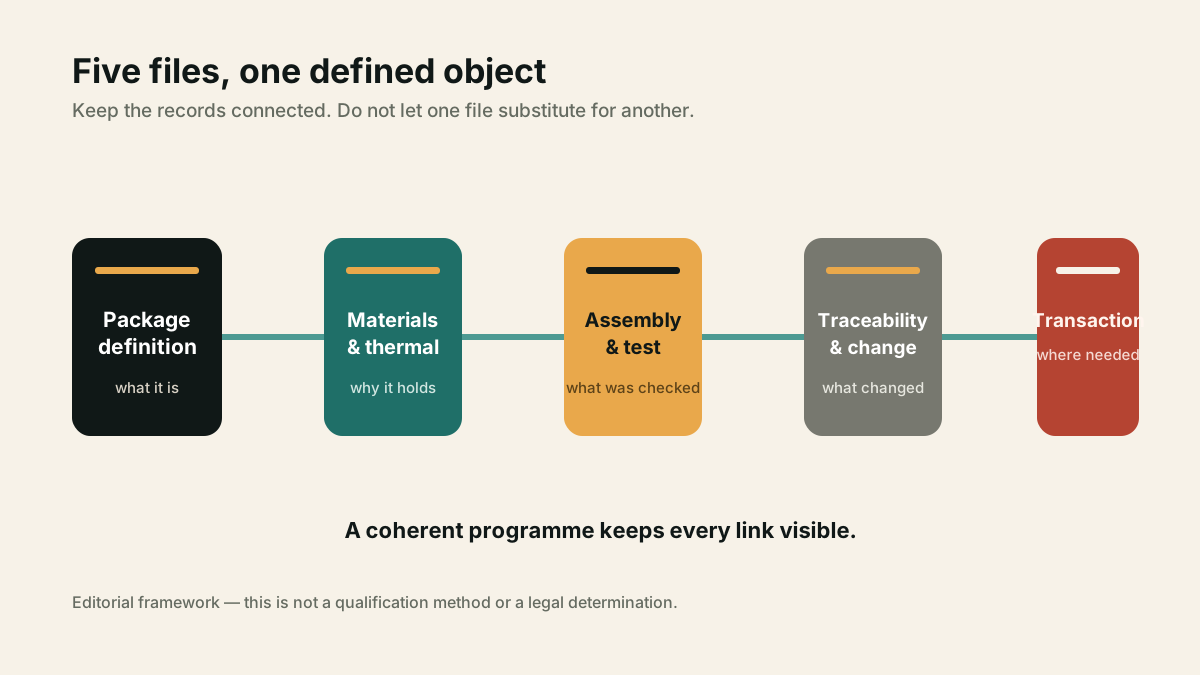
This article turns that distinction into a procurement file. It does not rank Chinese OSATs, certify a package, estimate availability or advise on export controls. Instead, it shows how to keep five records connected for one defined device and revision:
- the package-definition file;
- the materials-and-thermal file;
- the assembly-and-test file;
- the traceability-and-change file; and
- the transaction file, where a transaction has a relevant control boundary.
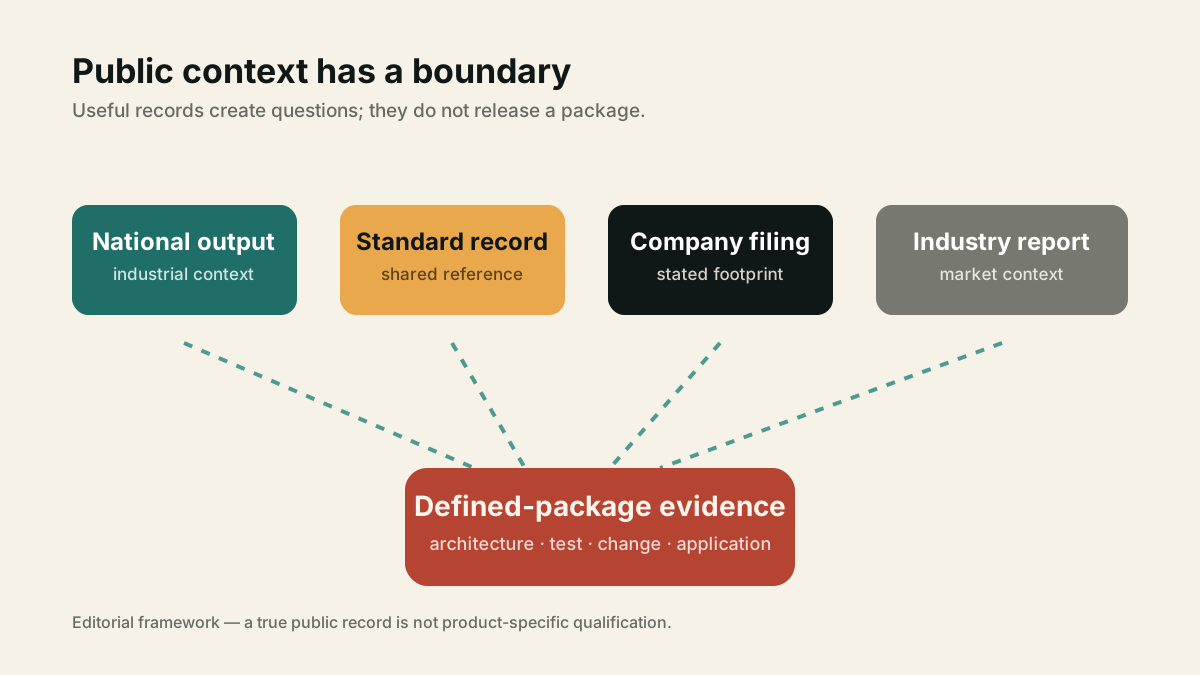
Treat those files as connected, but never interchangeable. A standard can inform a process question. A company annual report can point to a useful conversation. A national output number can show why China belongs on the map. None can answer the question that actually releases a package: does this exact device, in this exact revision and application, have a coherent, evidenced route through assembly, test, change control and—where relevant—the transaction?
This is desk research, not a supplier audit, engineering qualification, product test, capacity check, legal opinion or export-control determination. It uses public records to define evidence boundaries. A live programme needs its own design information, records, current official review and qualified specialists where appropriate.
The short answer: China context is a lead, not a release
“China semiconductor packaging” can mean several different questions at once. A sourcing team may be asking whether there are credible providers to contact. A design team may be asking whether a fan-out, flip-chip, system-in-package, 2.5D or other route is technically sensible. An operations team may be asking who owns test development, outgoing quality, failure analysis and changes. A legal or supply-chain team may be asking whether the die, parties and destination create a transaction review. These are related questions, but they have different evidence.
The most expensive mistake is to make a broad answer carry a narrow decision. “China produces a great many integrated circuits” is broad. “This supplier can assemble and qualify our particular multi-die package for the stated application, on the stated revision, with an identified test flow and traceable lot history” is narrow. The first can lead to a search. The second requires an evidence-bearing programme.
The same distinction applies to a headline about advanced packaging. A phrase like advanced may be commercially useful, but it has no stable procurement meaning until the package is named and its boundaries are fixed. Does the term refer to a multi-die arrangement, wafer-level processing, high-density interconnect, chiplet integration, a substrate choice, a testing problem, or a customer’s classification? Is the claim about a development sample, a qualified production flow, a technology platform, a public demonstration or a booked production slot? Until those questions are answered, “advanced” is a route to investigate, not an outcome.
| Record in view | What it can tell a reader | What it cannot tell a reader by itself |
|---|---|---|
| China-wide IC output | That the country has a large current industrial-output context | The capacity, mix, allocation, yield or reliability of a named OSAT or package |
| An industry ranking or growth report | How an analyst describes the competitive picture in a stated period | Whether a particular package route is compatible with a device and application |
| A package family on a quote | A starting vocabulary for a potential assembly route | The actual stack, materials, thermal behaviour, test coverage or revision status |
| A current standard record | That a named process-and-evaluation reference exists with an official status | A supplier’s conformance, a lot result or a product release decision |
| A company annual report | What the company says about its own business and operations | A customer allocation, programme qualification or comparative supplier verdict |
| An export-control status record | A published regulatory mechanism or current status clue | The classification or legality of a specific transaction |
For a wider map of the industry layers around design, wafers, materials, equipment, assembly and test, see China’s Semiconductor Industry: A Layer-by-Layer Guide. That article is valuable context. It does not establish that a package path fits a particular device. The same warning applies when readers use SMIC Explained: China's Chipmaking Limits (2026) to understand fabrication constraints: a fabrication-node discussion is not a packaging or test qualification.
Packaging is an engineered system, not the last box on the route
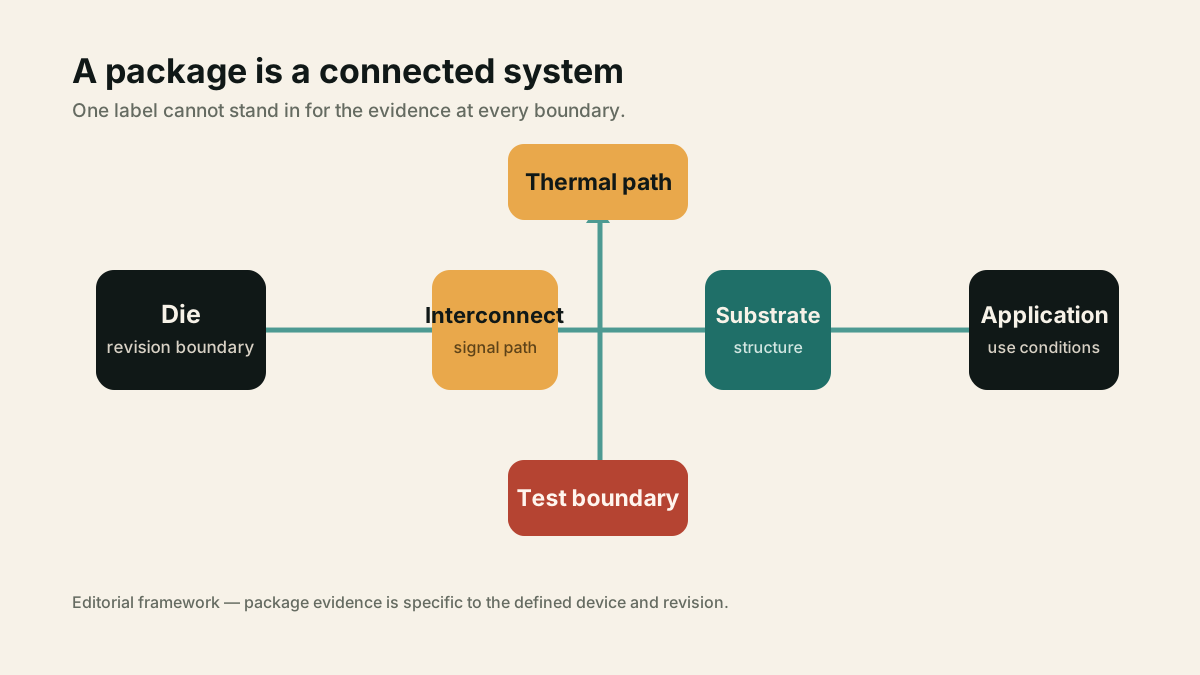
It is common to describe the semiconductor chain as design, wafer fabrication, packaging and test. The sequence is useful, but it can make packaging sound passive: the stage after the important work has finished. In a real product, the package is where die, electrical connections, materials, heat, physical protection, board-level integration, test access and later change management have to coexist. The package changes what can be measured, repaired, cooled, assembled and shipped.
NIST’s National Advanced Packaging Manufacturing Program poses the problem directly. Its public description asks how tightly integrated chips can be designed and assembled, how power can be supplied and heat dissipated, how complex assemblies can be tested and repaired, and how reliability can be assured when conventional visual inspection is not possible at tightly packed dimensions. Those are not China-specific questions; they are why a public industrial footprint cannot settle a device decision. Read the NIST programme’s packaging challenge list as a compact reminder that the “back end” contains its own architecture and verification work.
Start with the object, not the provider label
The first file should be a short, controlled statement of the object being discussed. It does not have to be a complete design dossier before a supplier conversation begins. It does have to stop the conversation from drifting between similar but non-identical things.
A useful package-definition file normally fixes, at minimum:
- the die or die set under discussion, with their relevant revision identifiers;
- the intended package architecture or the package options still being compared;
- the interconnect or interface assumptions that make the route meaningful;
- the substrate, interposer, leadframe, redistribution or other structural elements that are in scope;
- the application environment that makes heat, size, power, mechanical stress, service life or electrical behaviour material;
- the intended test boundary—what is expected before assembly, during assembly, at final test and at system level; and
- the commercial unit being quoted: development lots, qualification lots, pilot production, sustained production or some other clearly named stage.
The purpose is not to force a supplier to disclose confidential process detail before a non-disclosure agreement or technical review. It is to make sure every later claim has an object. If a supplier says it has a package platform, the team can ask: for which die count, dimensional range, interface pitch, power profile, application condition and test boundary? If an internal stakeholder says another supplier is “doing the same thing,” the file gives them a way to compare scopes rather than names.
Materials and thermal evidence are not a materials shopping list
The second file is where package conversations often become too abstract. Teams can list mold compounds, underfill, solder balls, bond wires, substrates, interposers, heat spreaders, lids, adhesives and thermal-interface materials without saying which relationship between them matters. A buyer does not need every raw-material trade name to understand the decision. The buyer needs a record that explains which material and interface assumptions are carrying the relevant risk for the defined package.
The NIST technical perspective on materials and measurement challenges is useful here because it links polymer materials with metrology, moisture reliability, residual stress, warpage, standardisation, reproducibility and qualification. That is a better mental model than “materials are a purchasing input.” In a package, materials sit in a relationship with geometry, cure or assembly conditions, interfaces, thermal path and test method. A substituted material can therefore be a technical and governance event, even if it looks minor in a purchasing system.
For a specific programme, the materials-and-thermal file should answer four questions in plain language:
- Which material or interface choices are assumed by the package definition?
- Which operating or environmental conditions make those choices material?
- What measurement, characterisation, model, test or review is being relied on—and what is its scope?
- What change would invalidate the existing conclusion and require a new review?
This file is deliberately not a recipe. There is no universal list of tests or pass values that an article can safely prescribe across power devices, automotive parts, mobile electronics, memory, sensors, chiplets, radio-frequency modules and other package types. The file’s job is more disciplined: it records why the project believes a particular material-and-thermal story applies to the exact object, and who must re-open the question when the object changes.
Test is a product argument, not a final tick box
Test is sometimes treated as the easiest part of the quote: wafer probe, final test, perhaps burn-in, perhaps system-level test. The label is not the evidence. A useful test file needs to make the coverage boundary visible. What does this flow observe? At which state? What can it reject? What can it not see? How are binning, limits, retest and exception handling controlled? Which result follows the unit or lot into the next decision?
That is why NIST includes both testing and repair in its advanced-packaging questions. Tightly coupled assemblies may place different limits on inspection and fault isolation than a simpler package. A test programme can be technically competent and still be unsuitable for a buyer’s product if it does not line up with the application’s failure modes, interfaces, reliability hypotheses or field-return process. Conversely, a broad claim that a provider offers “advanced test” tells a buyer very little until it is connected to a device and defined coverage.
The correct early procurement question is not “Do you test this package?” It is closer to: what is the intended verification sequence for this device and revision, who owns programme development and changes, which results are released to us, and which boundaries remain ours to validate? The answer may be confidential, staged or conditional. That is acceptable. An unanswerable question is not an acceptance signal.
China’s visible footprint can make a route discoverable without making it equivalent
China’s industrial context is not imaginary. The National Bureau of Statistics table reports 4,842.8 hundred-million integrated circuits in 2025. The Ministry of Industry and Information Technology’s 2025 electronics-manufacturing update reports a closely matching 4,843 hundred-million figure and the same 10.9 percent growth rate. Those are real signals about activity. They also demonstrate the limit of a national statistic: neither release names the mix of packages behind the number, an OSAT’s available line, a technology node, a customer allocation or a reliability result.
The right response is neither to dismiss the number nor to stretch it. Use it to justify a map: China has sufficient semiconductor activity that a global team should understand its assembly-and-test ecosystem and locate potentially relevant providers. Then return to the object. If the product is a mature, high-volume package with known interfaces, the evidence path may be relatively familiar. If it is a tightly integrated multi-die arrangement, a thermally demanding power device, a long-life application, a safety-sensitive product or a package with unusual test access, the records become more specific, not less.
TrendForce’s 2024 summary provides a related caution. It describes continued leadership by ASE and Amkor, strong growth at named China-based OSATs and increasing requirements around heterogeneous integration, wafer-level packaging, die stacking and advanced test. That is a competitive story with several moving parts. It does not support a country score that tells a buyer which programme will work. A capability ecosystem may be broad while the exact substrate, equipment, test development, data interface, engineering ownership or allocation needed for a programme remains constrained.
Where the original “hidden advantage” frame goes wrong
The original premise for this article was that China was building a hidden advantage, perhaps even dominance, in advanced packaging while the world watched fabrication nodes. It contains a useful provocation—packaging does deserve more attention than it often gets—but it asks public evidence to carry too much.
Public output data does not measure advanced-package leadership. A company’s annual report does not prove another programme’s performance. An analyst’s revenue ranking does not compare package quality or engineering fit. A standard’s current status does not show a supplier follows it. And an advanced package cannot be reduced to a country label because its outcome depends on the object, interfaces, materials, test strategy, quality system, change control and application context.
The better conclusion is more useful: China is a meaningful part of the global packaging and test landscape, and that makes disciplined discovery worthwhile. But a buyer gains nothing by collapsing discovery into qualification. In fact, doing so can hide the very Chinese manufacturing depth the buyer is trying to understand: different sites, product families, engineering teams, material sources, test capabilities, local support and customer allocations can matter more than a single national claim.
For a comparable lesson outside semiconductors, How China Manufactures: Inside the World's Factory (2026) explains how industrial scale and supplier density can create a strong operating environment without proving that every factory or product is right for a buyer. Packaging is an unusually exact version of the same principle. Ecosystem strength lowers the cost of finding options. It does not remove the need to prove the option.
A standard is a reference, not a release
Standards can be useful because they give a team a shared vocabulary. They can identify a process boundary, a measurement or evaluation subject, a date and an issuing authority. That makes them valuable in an evidence file. They are dangerous only when a team silently promotes them from reference to result.
China’s public standards register lists GB/T 44796-2024 as Integrated circuit 3D packaging—Requirement for bumping-wafer-sawing process and evaluation. The register describes it as current, gives a publication date of 26 October 2024 and an implementation date of 1 May 2025, and identifies the relevant Chinese authorities. That is a concrete and useful record. It lets a reader ask whether the named process and evaluation reference is relevant to a supplier’s stated flow.
It does not answer the next question for free. The register does not show whether a particular factory uses the standard in the quoted programme; whether the device and revision fit the scope; which deviations or customer specifications apply; whether a lot has passed any agreed qualification; or whether the resulting product meets a buyer’s application need. Those gaps are not defects in the register. They are different records.
How to use a standard without turning it into a badge
Ask a narrow sequence of questions.
First, is the reference actually relevant to the process being proposed? The answer may be yes, no, partial or conditional. It is better to record “not applicable to this package configuration” than to include an impressive-looking standard number that governs nothing in the programme.
Second, what does the project use the reference for? It may define a vocabulary, frame a process step, inform an internal control, support a customer requirement or become one input to a qualification plan. Write that purpose down. “Supplier has the standard” is not a purpose.
Third, what evidence demonstrates the stated relationship? That might be a controlled procedure, a mapping, a certification record with its scope, a test plan, a product-specific report, a change document or an agreed exception. The exact answer varies; the point is that the evidence must bind the reference to the object.
Fourth, what remains outside the reference? A standard may not cover the application environment, proprietary design choices, customer-specific criteria, software interaction, system-level behaviour, field reliability expectation or supply commitment. These exclusions are as important as the coverage statement because they stop the team from misusing a real reference later.
This approach also improves supplier communication. Instead of asking a vague “Are you compliant with 3D packaging standards?” a buyer can ask the supplier to describe the relationship between the quoted route, the named standard, its internal flow and the product-specific qualification or acceptance evidence. The supplier can answer with relevant detail or explain why the reference does not apply. Both outcomes reduce false certainty.
A company filing is a clue, not a capability release
Named companies belong in a China packaging discussion, but their role needs discipline. A company website, investor presentation or annual report can help a reader identify business scope, locations, application focus, reported investments, company language and likely questions for a technical discussion. It can reveal a real industrial protagonist. It cannot act as a customer’s qualification report.
Consider JCET’s 2025 annual report, filed through the Shanghai Stock Exchange system in April 2026. The record is useful because it is an attributable, date-stamped company disclosure about the company’s own assembly-and-test business and operating context. It is not evidence that the company has allocated capacity to a reader, that a proposed package has completed a buyer’s qualification, that a particular line is appropriate, or that its performance is equivalent to another provider’s.
That distinction may sound obvious, but it is exactly where many sourcing discussions fail. A diligence deck can list an OSAT’s revenue, site count, package families and strategic applications. A design team then assumes the provider has the needed process. A procurement team assumes there is capacity. A quality team assumes the test route is mature. Each inference is possible. None is supplied by the filing.
Use the public company record for a different job: turn it into targeted questions. If a company says it serves a relevant application field, what package architecture and test boundary does it offer for the device in question? What site or team owns the development? Which data can be shared at this stage? How are engineering changes controlled? What is the escalation route for qualification, yield, test correlation, failure analysis and field support? If the company cannot answer, the annual report has done its job by showing where public context ends.
The same rule applies to a start-up, state-linked project, local-government announcement or equipment supplier release. Each may contain a valuable lead. Do not erase the source’s interest. Record whose claim it is, what period it covers, what object it names and what it leaves unproven. Then ask for the next file.
The five-file China semiconductor packaging evidence architecture
The article’s framework does not claim to replace a quality system, a customer specification, a technical review or legal advice. It is a way to prevent a project from losing its question as it moves between engineering, purchasing and supply-chain teams. The files can be lightweight in early discovery and more formal later. What matters is that the project can say which file establishes which proposition.
File one: package definition
This file names the object. It should establish a stable identity for the product under discussion before anyone interprets capability claims. In a preliminary phase, that may be a controlled requirement summary. In a mature project, it may connect to drawings, bills of materials, package design data, specifications and revisions.
The file should let a reviewer answer:
- What die or dies are included, and which revisions are in scope?
- What architecture is proposed, and which alternatives are still open?
- What interfaces, dimensions, power assumptions, environmental conditions and application requirements matter?
- What is the product boundary: package only, module, board-level assembly, system-in-package or another defined unit?
- Which statements are customer requirements, which are supplier proposals and which are still hypotheses?
The last question is crucial. In many programmes, an early supplier discussion is exploratory. That is normal. The risk arises when a hypothesis migrates into a purchase order, drawing, test plan or marketing claim without anyone marking the change. A clear package-definition file distinguishes “we are considering this” from “this is frozen for qualification.”
It also prevents the word same from doing damage. Two packages can share a family name while differing in die revision, interconnect arrangement, substrate, dimensions, thermal load, package-on-package relationship, test access or end application. If the definition cannot show the difference, the rest of the evidence cannot be reliably mapped.
File two: materials and thermal path
The materials-and-thermal file exists because a package has physical interfaces. It need not expose proprietary formulation or supplier-sensitive details to every stakeholder. It must give the responsible review group enough controlled information to understand the relationships that drive the programme’s material and thermal claims.
Start by recording the relevant material categories and interfaces that the package design assumes. Then record the application envelope that makes them relevant: operating profile, power, temperature, stress, moisture exposure, cycling or another appropriate condition. The language should remain as specific as the evidence permits. “Designed for reliability” is not a condition. “The current evidence applies to this defined revision and stated operating envelope” is a boundary.
Next, map the evidence. Is the programme relying on a material-characterisation report, a supplier specification, a model, an internal review, a sample build, a qualification plan, a customer requirement or a combination? What does each input cover? What does it omit? Which party owns an update if the material, cure condition, geometry, heat spreader, interface or application assumption changes?
The point is not to make every sourcing manager become a packaging scientist. It is to make the evidence legible across functions. A buyer can see whether a component change has a defined review path. A quality lead can see whether a material substitution is hidden inside a purchasing change. An engineering manager can see whether a thermal claim belongs to the current geometry or an older version. And a supplier can understand what the customer needs before the conversation becomes an argument about labels.
File three: assembly and test
Assembly and test should be treated as one connected story even when different facilities, teams or commercial entities are involved. Assembly changes the physical object. Test generates the evidence used to decide what moves forward. When the two records are separated carelessly, teams can lose the link between a manufacturing condition, a unit identity and a result.
This file should name the process boundary being proposed, the stage of readiness, the owners of relevant steps, the planned test sequence and the data or reports that the programme expects to receive. It should also identify exception routes. What happens when a test result is outside an agreed band? Who can authorise retest, rework, rebinning, deviation or disposal? How does the decision follow the lot or unit? What does the customer see?
Avoid turning this into an article-defined test checklist. The correct tests, sampling, limits, stress conditions and acceptance criteria depend on the product and agreement. The article’s rule is simpler: do not infer that a package is tested merely because a supplier advertises test services. Connect the exact package and revision to a planned or actual sequence, a scope, ownership, result handling and change control.
If a supplier cannot disclose detail at an early stage, record the limit rather than invent certainty. A project may say, “Test-flow details will be reviewed under NDA before design freeze; no qualification claim is made before that review.” That is far safer than treating the absence of detail as proof that a standard flow exists.
File four: traceability and change
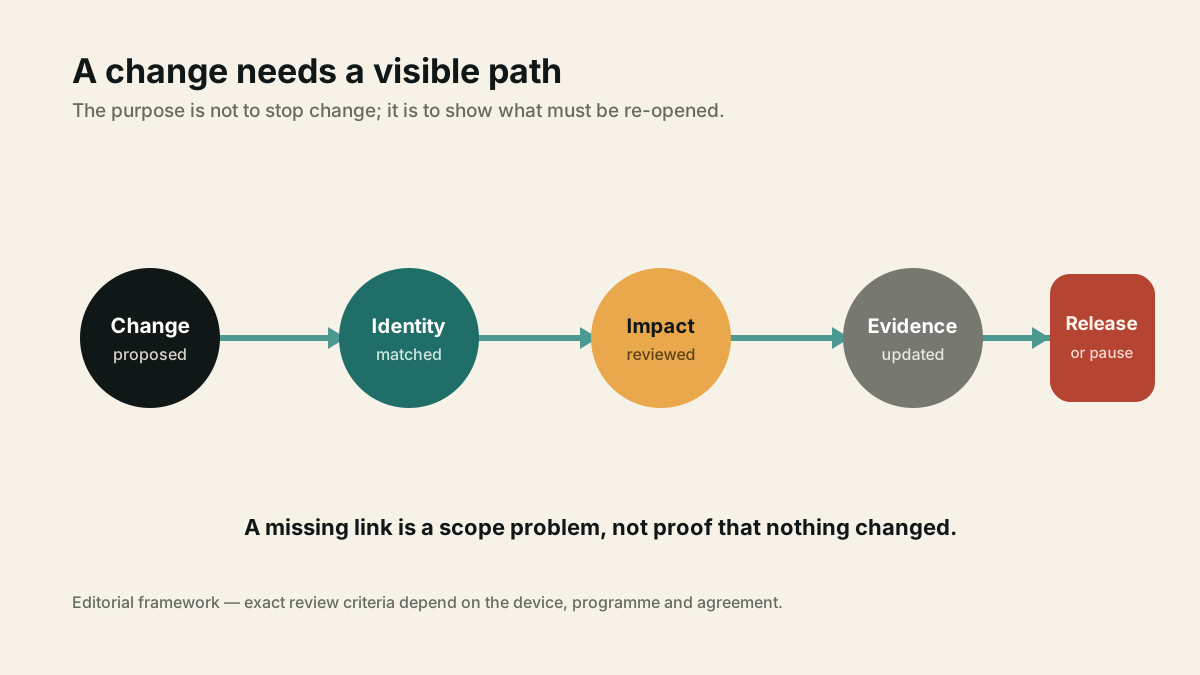
This is the file that makes the other three durable. A package can have a sensible definition, material rationale and test plan at one point in time, then lose coherence after a die revision, assembly-site change, material substitution, test-limit revision, equipment change, package artwork change, firmware interaction, second-source decision or customer request. Change is not evidence of failure. Uncontrolled change is evidence of an unknown scope.
At its simplest, the traceability-and-change file links the package identity, revision, lot or batch references, relevant process or material versions, test record identifiers and the authorisations that define a current state. It also identifies the event that requires re-review. The team should be able to ask: if this product is returned, questioned or revised, can we reconstruct which package definition, material set and test flow applied?
That question is broader than a serial-number system. A good traceability record does not merely retain identifiers; it makes them meaningful to a decision. A lot identifier that cannot be connected to the applicable revision and exception records does little for a failure analysis. A change notice that does not say whether it affects thermal, electrical, mechanical, test or transaction assumptions leaves each group to guess. A programme does not need perfect data from day one, but it needs a visible plan for closing the link.
File five: transaction record
The transaction file is deliberately separate because it answers a different kind of question. An engineering package file asks whether the technical object and its evidence are coherent. A transaction file asks, where relevant, whether the items, parties, ownership, destination, end use, end user and current regulatory context have been reviewed through the appropriate process. A technically plausible package is not automatically a cleared transaction; a transaction record is not automatically evidence that the package meets its engineering requirements.
The distinction is especially important for some advanced-computing supply chains. In January 2025, the U.S. Bureau of Industry and Security said its changes included a broader licence-requirement framework for certain advanced chips and listed a route in which an Approved OSAT verifies the final chip’s transistor count among specified conditions. Its notice also described a process for companies to be added as Approved IC designers and OSATs. Those are public programme facts, not a classification for a reader’s item. See the BIS notice for the stated mechanism.
The date matters. BIS’s public homepage says that the timeline associated with certain Authorized IC Designers was extended until 31 December 2026. A status notice can change; a buyer should not preserve it as a timeless slide. More importantly, the notice does not contain the facts needed to decide a specific live transaction. It does not identify a reader’s exact item, classification, parties, ownership, destination, end use, end user, licence history or contractual obligations.
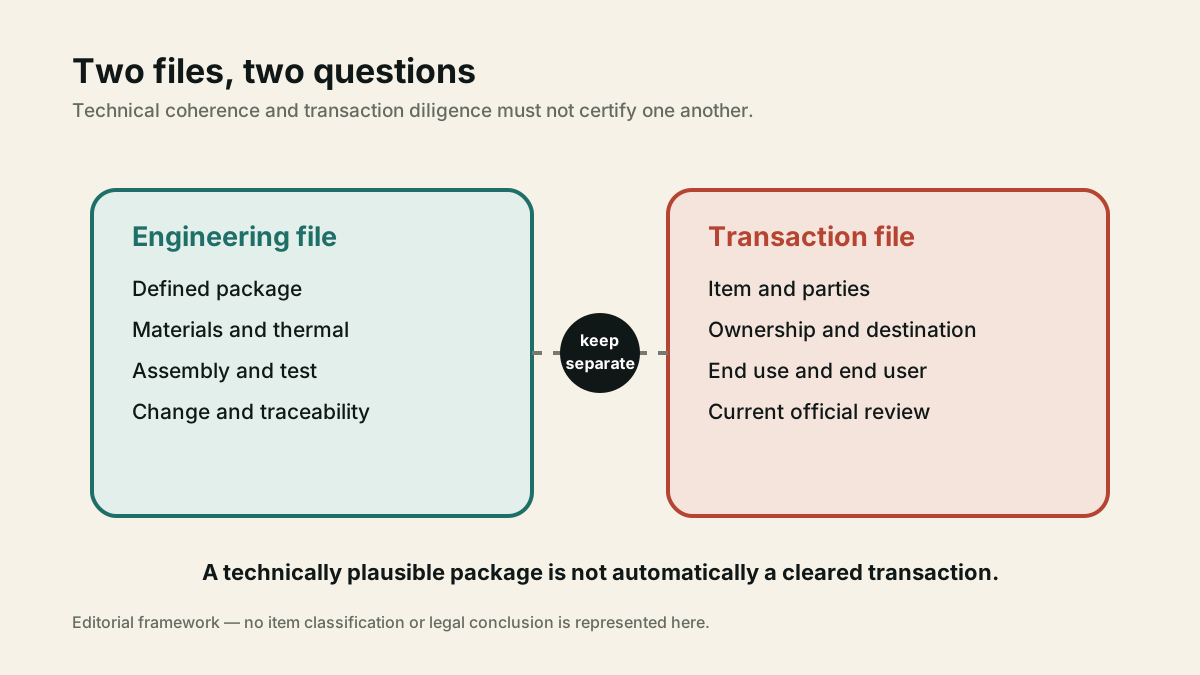
The operational rule is therefore modest: if a programme has a potential control boundary, open a dated transaction file early enough to prevent a late surprise, keep it separate from technical qualification, and use current official information plus qualified review for the actual case. Do not ask an engineering team to give a legal answer, and do not ask a control-status page to certify the thermal, test or reliability story.
A practical request sequence when a China OSAT claim appears
The five files can feel large when a team is only deciding whether to take a first meeting. They are not all equally mature at the start. The key is to request the next record that can change the decision, not every document in existence.
First: freeze the question in one paragraph
Write a compact statement of the object, stage and decision. For example: “We are assessing a possible assembly-and-test route for revision X of a defined device family, for application Y, before design or sourcing freeze. We need to know whether the proposed package scope, test ownership, change path and commercial stage can be evidenced.” This is not a technical specification. It is a guardrail against a conversation that starts with one object and ends with another.
Second: ask for scope, not a marketing capability list
Ask the provider to describe the relationship between the proposed route and the object. Which package architecture is being discussed? Which site or technical group owns it? Is the response a general capability statement, a development proposal or a production programme statement? What package, die, interconnect and test assumptions are being made? What still needs engineering review? A supplier that answers precisely is giving more useful information than one that offers a long catalogue.
Third: find the first non-substitutable record
Every programme has a record that cannot be inferred from the rest. It might be a package drawing, a material-and-thermal review, a test coverage definition, a change procedure, a lot-traceability proposal or a transaction review. Identify it early. If it is missing, do not try to compensate with national statistics, a company profile, a standard number or an analyst report. Those may support context, but they cannot replace the missing boundary.
Fourth: write the pause rule before the pressure arrives
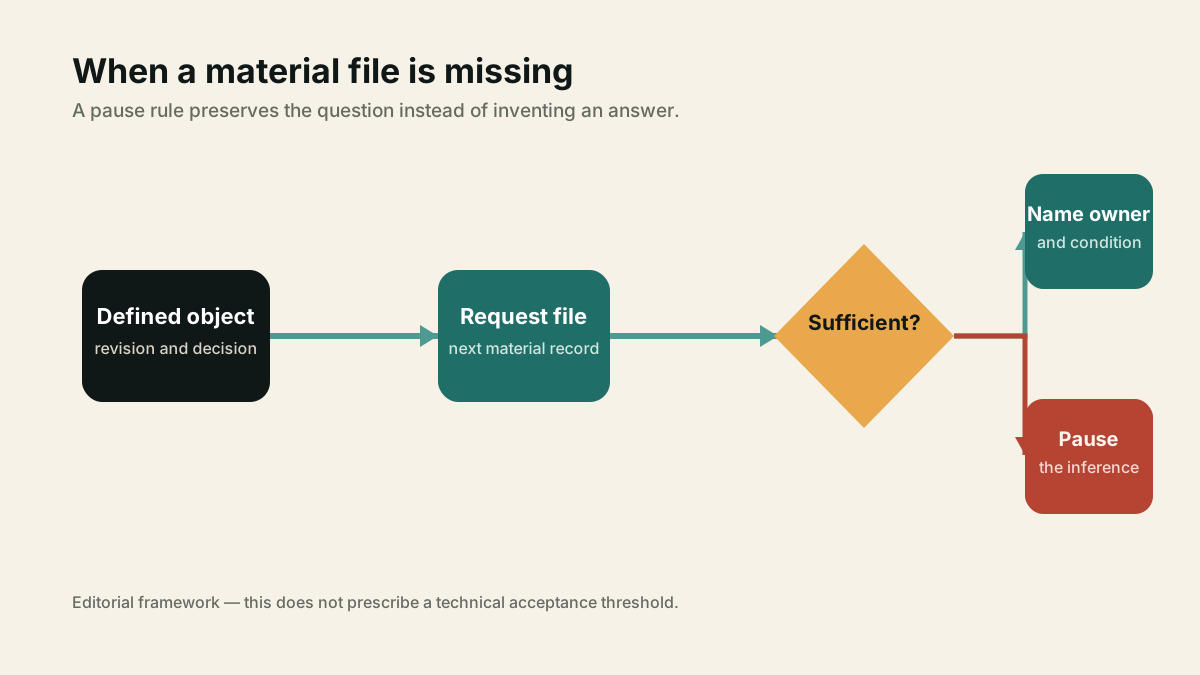
Commercial pressure often appears after a prototype, a customer deadline, a price comparison or a management presentation. That is the worst moment to discover that a change has no owner or a test claim has no defined scope. The team should record a simple pause rule: no release decision is inferred while a material file is missing, materially mismatched or under review. The rule is not “never proceed.” It is “state what is provisional, who owns the next evidence and what condition changes the decision.”
Fifth: separate qualification from supplier discovery
China’s ecosystem can produce many discoverable options. That is a benefit. Do not force every option through a full qualification before basic fit is known, but do not call an option qualified because it appeared on a good list. Discovery narrows candidates. Qualification binds an object to evidence. The two processes need different evidence and different language.
Questions buyers ask about China semiconductor packaging
Is China strong in semiconductor packaging and test?
China has a large semiconductor manufacturing context and multiple visible packaging-and-test companies. Public data and industry reporting can justify investigating that ecosystem. They cannot by themselves establish that a particular OSAT, package family, production slot or test path is right for a defined device. Use scale as a discovery signal, then request package-specific evidence.
Is advanced packaging the same as an OSAT service?
No. An OSAT is a business and service model; advanced packaging is a broad technical and industrial term that can involve multi-die integration, wafer-level work, die stacking, materials, substrate or interconnect choices and demanding test or reliability questions. The exact relationship depends on the package and the provider. Ask which object, process boundary and test scope are actually being offered.
Does a current Chinese packaging standard prove that a supplier is qualified?
No. A current standard record can establish that a named reference exists and can give a project useful vocabulary. It does not prove a supplier’s conformance, a product’s test result, a lot’s quality or an application-specific acceptance decision. Request the record that links the reference to the relevant product and programme.
Can a company annual report prove packaging capacity or reliability?
No. It can document what the company says about its business, strategy and operating context in the stated reporting period. It does not establish a buyer allocation, current availability, yield, technical fit, qualification result or reliability outcome. Use the filing to formulate a more precise request to the company.
Does an Approved OSAT status decide whether a chip transaction is allowed?
No. Published BIS materials describe specific mechanisms and status processes, but a live conclusion depends on current rules and the complete facts of the item, parties, ownership, destination, end use and end user. Keep transaction diligence separate from package engineering, consult current official material and obtain qualified review for the actual case.
Method and limitations
This article is based on public records from the National Bureau of Statistics of China, China’s national standards register, NIST advanced-packaging research, an attributable JCET annual report, current BIS material and bounded independent industry reporting. It is a desk-research framework. The team did not inspect a factory, test a package, audit a supplier, verify a capacity allocation, review a live design or assess a transaction.
The framework intentionally avoids technical acceptance thresholds, vendor recommendations, price or lead-time claims, package performance comparisons and legal advice. A product-specific conclusion requires the actual design, package definition, materials and thermal evidence, test plan and results, traceability record, supplier agreement and—where relevant—current transaction facts.
By China Made & Tech Team. Independent English field guide to China's niche hardware brands, hidden champions, founders, factory towns, and supplier clusters.
Related entries
- China’s Semiconductor Industry: A Layer-by-Layer Guide — a layer-by-layer view of China’s semiconductor system.
- SMIC Explained: China's Chipmaking Limits (2026) — fabrication context and its constraints.
- Chinese Semiconductor Equipment: The Buyer File — why the equipment chain requires its own evidence file.
- How China Manufactures: Inside the World's Factory (2026) — how industrial scale becomes useful only when connected to a buyer’s actual proof.