
By China Made & Tech Team. This is desk-researched procurement analysis, not firsthand factory audit, engineering, testing, inspection, legal, customs, or field-performance work.
"Are Chinese solar panels good quality?" is too broad to produce a useful answer. China produces a vast range of modules across factories, product families, years and commercial channels. A buyer does not install "Chinese quality." They install a named configuration, from a documented production path, on a site with its own wind, hail, heat, mounting and operating conditions.
The better question is: what does the evidence for this exact module prove, and what does it leave unproven? Jinko's Tiger Neo 3.0 documentation page is a useful concrete example. It identifies a 650-670 W N-type, dual-glass family and separates data sheets, product certificates, factory certificates, manuals and warranty material. That tells a buyer that a real document system exists around a product family. It does not prove that a different seller's shipment, factory lot or project will deliver the same outcome.
This article is a quality-reading framework, not a ranking of Chinese brands or a verdict on Jinko. It explains how to test five different claims that are often compressed into one word: product qualification, manufacturing consistency, site fit, shipment condition and lifetime performance.
The Quick Answer: Quality Has Five Evidence Layers
Every layer is useful. None is a substitute for the other four.
| Claim a seller or buyer makes | Evidence that can support it | What it still does not prove |
|---|---|---|
| "The module is certified" | certificate, scope, model/configuration match and issuer | suitability for a particular hail, wind, fire or corrosion exposure |
| "The factory has quality systems" | factory certificate, audit scope, controlled product/factory identification | that the buyer's exact shipment was made under an unchanged process |
| "The module is robust" | stated mechanical/environmental test evidence tied to the configuration | long-term performance at the buyer's site |
| "The shipment is good" | release, packing, serial/lot, inspection and receiving records | absence of future degradation or installation damage |
| "The module will perform for decades" | warranty terms, field data, controlled measurement and O&M records | a guaranteed project-level energy result |
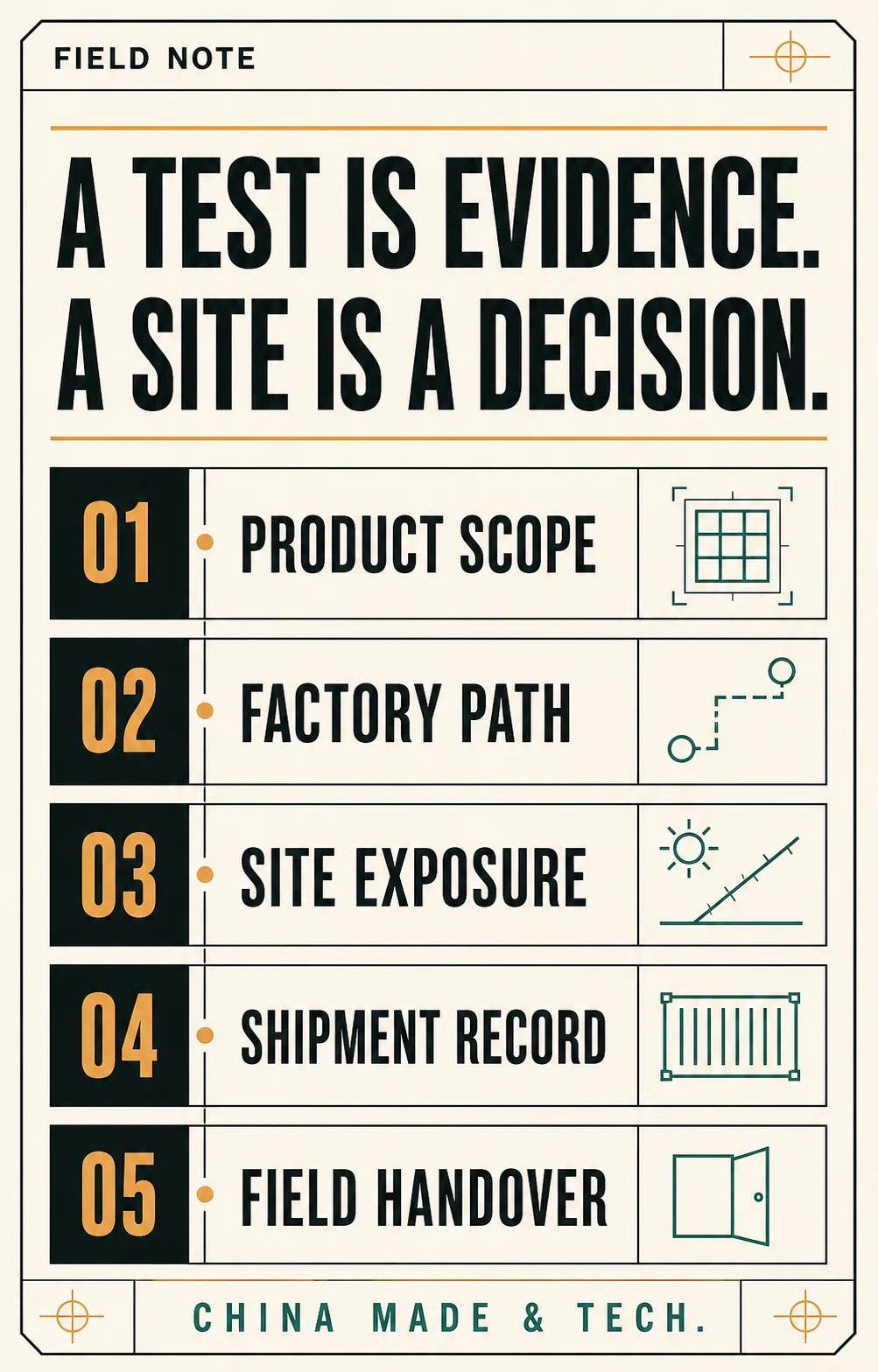 Field Note: the evidence for a test and the decision about a site are different layers.
The bad myths sit at opposite ends. One says Chinese modules are inherently low quality because they are Chinese. The other says a big brand, certificate or Tier 1 label proves a specific module is right for every site. Both erase the actual object of due diligence: product version, factory path, test boundary, site conditions and evidence at delivery.
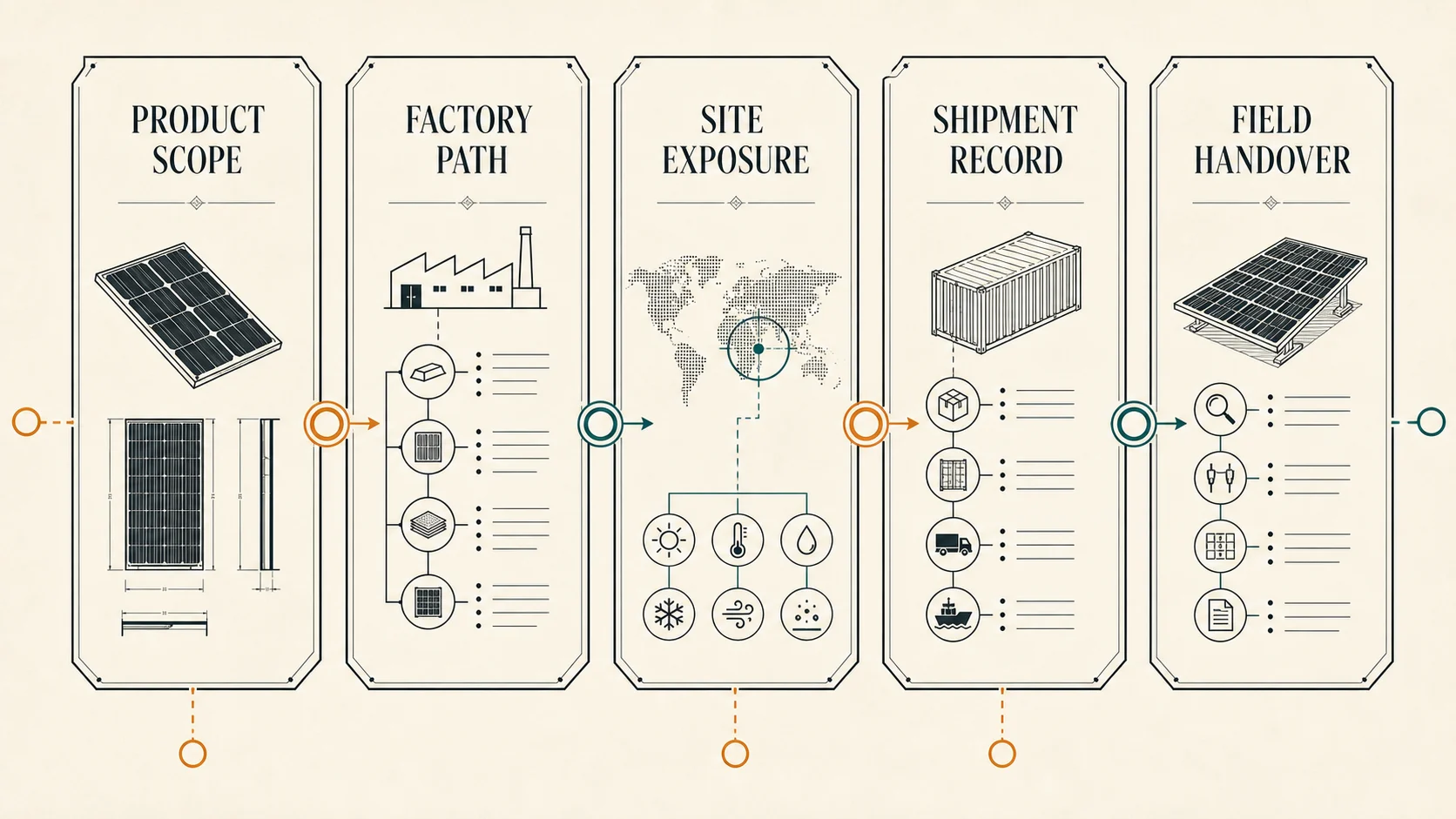 Each layer adds information; none can stand in for the others.
1. A Certificate Is a Boundary Marker, Not a Lifetime Forecast
Module qualification and safety documents matter. They demonstrate that a configuration was evaluated against a stated standard and scope. Buyers should obtain the certificate itself, identify the issuer, check the named product/configuration and save the version in the technical schedule. A generic PDF, a logo on a brochure or a certificate for a different suffix is not the same evidence.
But certificate language is commonly over-read. It can show that a module meets a defined test requirement; it cannot, by itself, answer whether the module is right for a site with unusual wind, hail, snow, fire, salt, heat, racking or electrical conditions. Nor can it demonstrate that the dealer's actual shipment will be built to the exact configuration reviewed.
DOE's 2026 procurement guidance puts technical specifications through the project lifecycle: award, submittal review, delivery and commissioning. That is a better buyer standard than a document hunt. The relevant question is whether the exact test/certificate evidence remains connected to the product the engineer approved and the project will accept.
Read the Scope Before You Read the Badge
For each certificate or test claim, make a scope note:
- What was tested or certified? Record the full model, construction and revision, not the product family headline.
- Who issued it and what standard/scope applies? Capture the certificate number, date and any conditions or limitations.
- What site risk is it intended to address? Safety, electrical performance, mechanical load, fire, corrosion, hail or another exposure are not interchangeable.
- Does the offered module match it? Compare dimensions, glass construction, frame, connector, power class and product suffix where relevant.
- What remains a project decision? Mounting interface, wind/snow design, tracker behavior, cable management, installation and O&M are not answered by the module certificate alone.
This is not bureaucratic purity. A product change can be commercially routine and technically material. If the supplier proposes a new module revision, factory or construction after bid, the buyer should re-run the scope note rather than assume the old certification package survives unchanged.
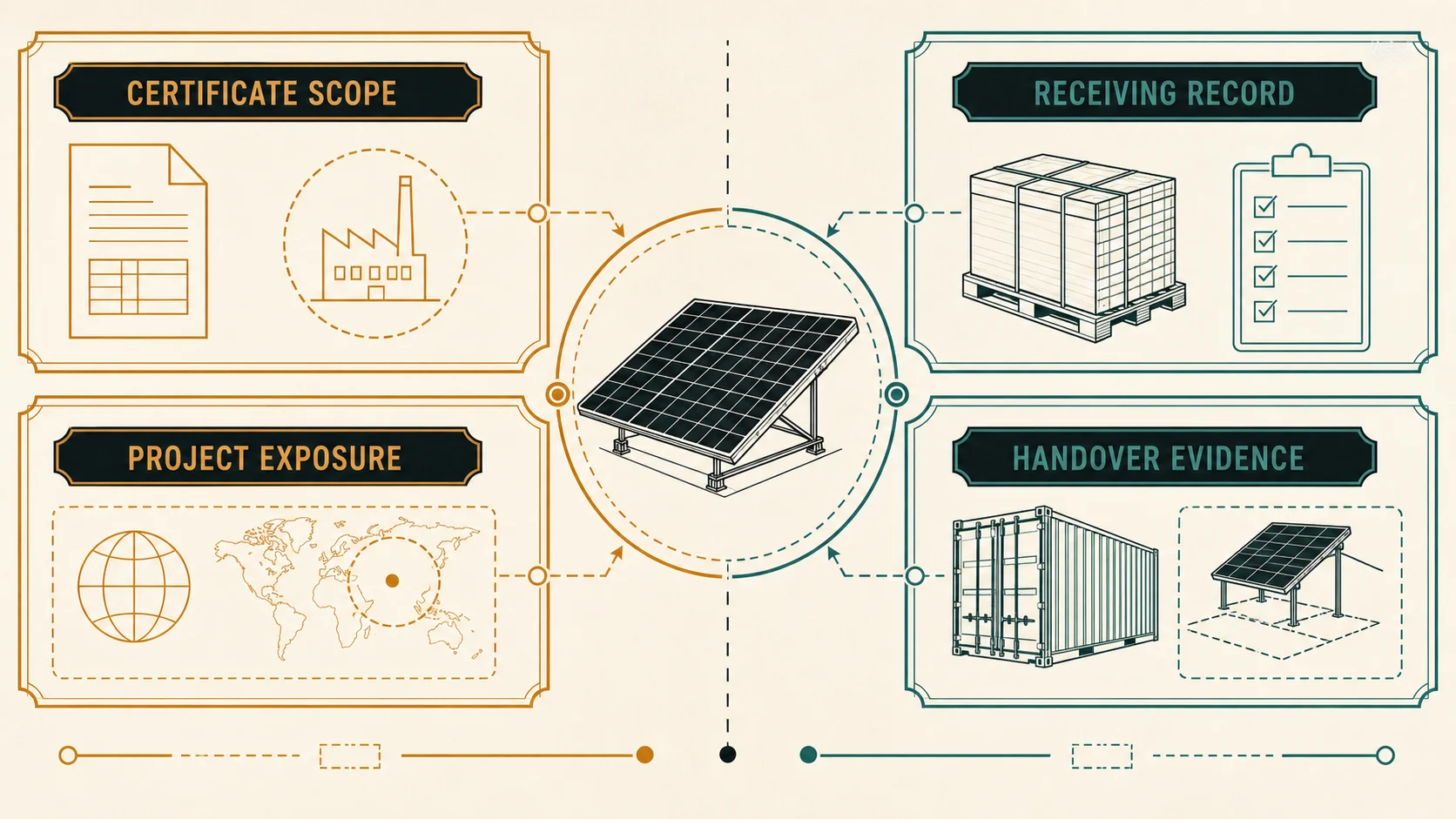 A certificate boundary does not automatically become a project acceptance boundary.
2. Basic Hail Qualification Is Not a Severe-Hail Procurement Plan
Hail makes the limit of a generic quality claim unusually clear. A module can satisfy a basic qualification condition and still not be the buyer's appropriate choice for a site with severe hail exposure.
DOE's hail-damage guidance says that the basic IEC 61215 hail test is not sufficient for severe or very severe hail-prone areas. It notes that the basic test uses 25 mm ice balls and that higher thresholds are optional; buyers may need to specifically request proof of higher-threshold testing. It also warns that hail can cause cell cracking without visibly breaking the glass.
That changes the procurement conversation. Instead of asking "is it hail certified?", ask:
- What is the project's actual hail exposure and insurance assumption?
- Which test method, hail size, velocity and configuration are relevant to that exposure?
- Does the evidence apply to this exact glass, frame and module format?
- What design mitigations exist beyond the module, such as tracker stow strategy, tilt or spare/repair plan?
- Who will record baseline condition and inspect after a damaging event?
DOE's severe-weather design guidance goes further: wind pressure can create cell microcracking and glass fracture, and it recommends that higher-risk sites place additional test requirements in solicitations and contracts. The practical insight is not that every project needs the highest available specification. It is that a site hazard should become a named contract requirement rather than a late dispute about whether a standard certificate was enough.
3. Factory Quality Is a System Claim That Needs a Shipment Link
Factory certificates and quality-system credentials can be meaningful. Jinko's current portal lists separate factory certificate material alongside product documentation. A buyer should expect a serious manufacturer to be able to explain which factory system and product controls it maintains.
The limit is equally important: a factory-system certificate is not a production record for the buyer's module. It cannot identify the serials in the container, prove the production date, show that a proposed substitute came from the approved facility, or explain a later discrepancy between labels, documents and packing.
Treat factory-quality evidence as three connected layers:
| Layer | Buyer question | Useful record |
|---|---|---|
| System | Does the proposed production facility operate under a stated quality-management framework? | facility-specific certificates, audit scope, expiry and issuer |
| Product | Is the exact model/configuration supported by current technical/certificate/warranty material? | controlled document pack tied to model/revision |
| Transaction | Did this approved product come from the permitted factory path and reach the order intact? | production/release record, serial/lot allocation, packing and receiving reconciliation |
Buying Chinese Solar Panels: Build a File for the Exact Module sets out the broader purchase-order and release file. The quality-specific rule is simple: a supplier's factory reputation is a signal; transaction-linked records are the evidence that lets the buyer use that signal.
4. Field Reliability Is Climate- and Measurement-Dependent
Quality discussions often leap from a factory photograph to a 25- or 30-year claim. Field performance does not support that leap. It depends on module design, production consistency, climate, installation, system design, maintenance, measurement method and the definition of failure.
The U.S. National Renewable Energy Laboratory's Regional Test Centers exist precisely because climate-specific performance and reliability factors matter. Their work examines whether output can be predicted accurately, how stable performance is and what reliability factors appear under different conditions. That is a useful corrective to any single universal quality score.
NREL's 2025 PV Lifetime Project report makes a second point that buyers often miss: accurate characterization of early field degradation requires controlled, high-accuracy indoor measurements at standard test conditions. A project dashboard can show that something is wrong or worth investigating. It does not automatically establish the module-level measurement required for a warranty or a comparative durability claim.
This does not make monitoring unimportant. It changes its role. Preserve two evidence streams:
- Operating evidence: commissioning results, irradiance/weather context, inverter data, cleaning/O&M history, string/site comparison, visual and thermal inspections.
- Module evidence: exact model, serial, production/shipment chain, applicable warranty curve, controlled test plan and documented custody of any module removed for investigation.
The first stream helps the owner decide whether a problem exists and where. The second makes it possible to prove or disprove a module-specific claim without confusing system underperformance with a manufacturing defect.
5. Shipment and Installation Can Create Their Own Quality Failures
A well-qualified module can arrive with physical damage, get mixed with a different lot, be stored badly, be installed contrary to its manual, or lose its label/serial traceability. Those are quality outcomes for the project even when the factory's original production was sound.
Build a condition record at three handoffs:
| Handoff | Minimum evidence | Purpose |
|---|---|---|
| Factory release | final model/revision documents, serial/lot export, packing hierarchy, condition/label records | establishes what left the production path |
| Delivery/receiving | seals, container condition, visible packaging damage, counts, scan/reconciliation and exceptions | distinguishes transport damage and shortages from later issues |
| Installation/commissioning | as-built location, installation checks, acceptance/commissioning record and warranty registration | connects the physical module to operating site and future claim path |
There is a related human factor: a buyer may see a label issue, an unreadable serial, carton damage or product-document mismatch and waive it to protect the schedule. That can be commercially rational in rare cases, but the waiver should be explicit. Record the observed condition, affected units, reason, technical/commercial owner, accepted risk and follow-up action. An undocumented exception is how a manageable condition becomes an unprovable warranty argument.
6. Compare Tests Only When Their Conditions Match
Marketing claims often make test results look directly comparable when they are not. A supplier may cite a laboratory result, a field comparison, an internal white paper, a public case study or a third-party scorecard. Each can be useful, but they answer different questions. A buyer should not reduce them all to "Module A is better than Module B."
Use a comparison sheet that records the test's object, boundary and decision use:
| Evidence type | What it can illuminate | Questions before using it in a selection |
|---|---|---|
| Qualification/certification test | whether a named configuration met a stated test requirement | which exact configuration, standard, laboratory and revision? |
| Extended stress or reliability test | how a module behaved under a defined harsher sequence | was the method disclosed and does the stress match the site risk? |
| Controlled field comparison | relative behavior at a named site and period | what climate, mounting, irradiance, sample size and measurement method were used? |
| Fleet or company performance claim | a supplier's stated commercial/operating experience | what population, time period and verification boundary are included? |
| Project monitoring data | whether the owner's system needs investigation | can system variables be separated from a module-level defect? |
The same caution applies to an external scorecard. An independent source may raise confidence in the measurement process, but it still has a population, date, inclusion rule and test boundary. A score does not prove that a later shipment is identical or that a project will reproduce the same climate and installation conditions. Strong due diligence uses independent evidence to interrogate the transaction file rather than to avoid building one.
The Most Useful Question Is Often "Compared With What?"
When a seller says its module has higher bifaciality, lower degradation, superior low-light output, better shading behavior or greater mechanical strength, ask five follow-up questions:
- What precise configuration was compared and how does it match the proposed model?
- What was the control product and was the method designed to favor a particular technology?
- Which operating condition produced the result, and is that condition material at our project?
- Who conducted, funded and reviewed the work, and can the underlying method be examined?
- What contract, acceptance or lifecycle decision would change if the claim is true?
The final question prevents technical detail from becoming a sales ornament. A claim that will not change equipment selection, warranty wording, site design, monitoring plan or price should not dominate the procurement review.
7. Translate Quality Evidence Into Contract Requirements
Quality controls fail when they remain slides in a bid deck. Put the few evidence points that materially affect the project into the purchase order, technical schedule and acceptance plan.
For example, a site with significant hail exposure may require a named higher-threshold test or certification route, a specified module construction, a tracker stow strategy and a baseline/post-event inspection plan. A site with severe wind or snow exposure may require design approval, mounting/load documentation, a specified frame/support arrangement and controlled substitution. A lender-driven project may require serial traceability, warranty-provider identity, long-term document retention and a process for technical changes.
Each requirement should have four parts:
| Contract component | What to state | Why it matters |
|---|---|---|
| Baseline | approved module, revision, factory scope and evidence documents | creates a measurable reference instead of a vague quality promise |
| Acceptance method | review, inspection, test, sampling or commissioning record | says how the buyer will decide whether the requirement was met |
| Change control | events that need notice, new evidence and written approval | stops a substitution from bypassing the original technical decision |
| Remedy/hold | what happens if evidence is late, conflicts or fails | makes a quality finding commercially actionable before cargo disperses |
8. Investigate a Performance Concern Without Jumping to a Module Verdict
When a project underperforms, teams often begin with the module because it is visible and expensive. That can be appropriate, but it is not a diagnosis. Output may be affected by irradiance, weather, soiling, shading, tracker behavior, inverter operation, cabling, curtailment, installation, degradation, damage or a mixture of factors.
Use a staged investigation:
- preserve the triggering data and site context instead of overwriting dashboards or maintenance history;
- compare affected strings, blocks or serial ranges against relevant controls rather than only against an annual budget;
- inspect for safety issues and visible damage, and document the condition before removal;
- review commissioning, installation, module identity and warranty terms;
- agree a controlled diagnostic/test approach with the responsible technical and warranty parties; and
- preserve chain-of-custody, images, measurements and communications if a module is removed.
DOE's hail guidance is a useful specific example. It says severe hail can create invisible cracking and recommends appropriate visual/electrical inspection, including IR, UV or EL techniques where relevant. The lesson is broader: a post-event or performance investigation should be designed to distinguish possible causes, not to produce the quickest supplier accusation.
This approach also protects the buyer. A manufacturer may rightly ask for a serial, installation history, site data and approved test procedure before accepting a claim. If the owner has kept the product/shipment/site chain and the diagnostic record, it can make that request without reconstructing years of decisions from email.
9. Use a Quality Gate, Not a Myth
A purchase should have a short, staged quality gate. It keeps the analysis specific and makes it possible to stop when evidence loses its product link.
At bid and technical selection
- Define the site exposures and the exact technical constraints.
- Normalize offers to model, construction, document revision and commercial scope.
- Request certificates and test evidence that match the proposed configuration.
- Ask what is public corporate/product evidence and what the seller is asserting about the actual order.
Before production and release
- Freeze the approved model and permitted factory path in the purchase order.
- Attach certificate, data-sheet, manual and warranty revisions to the baseline.
- Require written notice and buyer approval for a material product, factory or document change.
- Obtain serial/lot, packing and release records that can join the product to the shipment.
At receiving and commissioning
- Preserve condition, count, serial/lot and exception evidence at delivery.
- Verify the installed product against the approved schedule and retain as-built allocation.
- Complete commissioning documentation and define who owns the long-term quality/warranty archive.
- Keep a site-specific inspection and incident response path for hail, wind or other material exposure.
The gate does not guarantee zero failure. It does something more practical: it turns a broad claim about Chinese quality into a set of product- and site-specific facts that a buyer can verify, accept, price or reject.
It also makes supplier comparison fairer. A manufacturer willing to identify its product scope, test boundary, factory path and exceptions may look less effortless than a reseller offering a simple assurance. For a long-lived asset, that transparency is usually the more useful quality signal.
The buyer's aim is therefore not to eliminate uncertainty. It is to know which uncertainty has been tested, which remains site-dependent, who owns it contractually and when new evidence must reopen the decision.
That is a durable procurement discipline for long-lived assets.
Method and Limits
This article uses public manufacturer documentation, DOE guidance and NREL materials to distinguish source-bounded quality evidence. It does not verify an actual manufacturer, test, certificate, factory, shipment, project, installation, warranty, field measurement, or performance outcome. The offered configuration, site conditions, contract, delivered records and qualified reviewers control the decision.
What This Article Does Not Claim
Chinese module quality cannot be inferred from nationality, a single brand name, public product pages or one certificate. The public Jinko and DOE/NREL sources used here illustrate evidence types and their limits. They do not certify a factory, rate a manufacturer, determine project suitability or predict the life of a buyer's exact modules.