
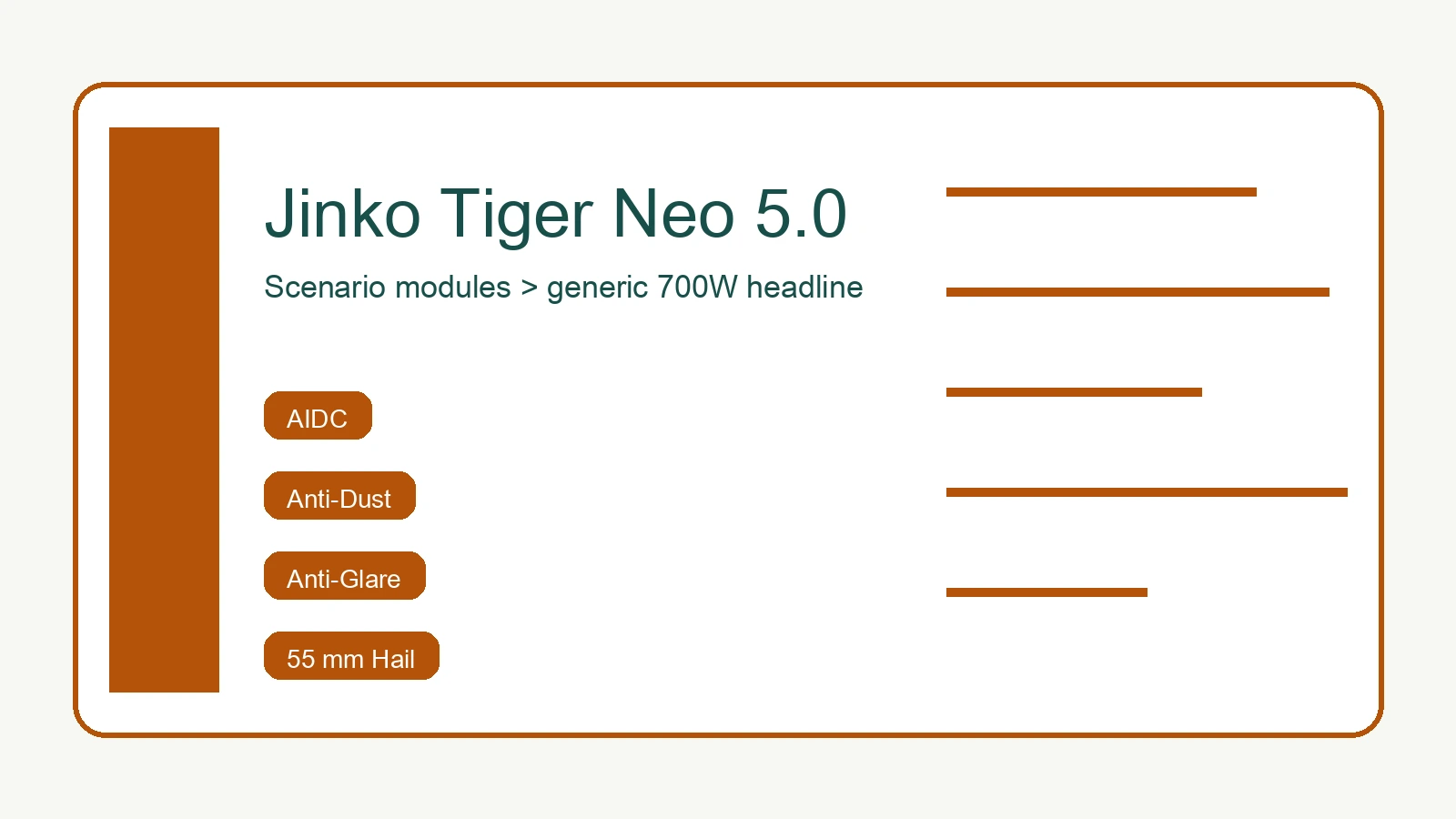
JinkoSolar's June 2 SNEC launch gave the market an easy headline and a more useful subtext.
The easy headline was straightforward: the company said its new Tiger Neo 5.0 reached 700W in the same module size, with 25.91% module efficiency and power density above 259 W/m². The more useful subtext was in the rest of the launch. Jinko did not stop at a bigger nameplate. It also pushed a six-part scenario portfolio for dust, AI data centers, fire and hail risk, anti-glare siting, lightweight rooftops, and desert conditions. That is a different kind of competition. It is no longer only about lowest module price per watt. It is about who can show a cleaner procurement file for a difficult site. Jinko's launch note made that strategy explicit, and the company's AIDC product page shows how specific the scenario pitch has become.
That matters because the next phase of Chinese solar competition is not just “bigger module, lower cost.” It is “better fit for the site constraint the buyer actually has.”
Source File
This article was reviewed on 2026-06-30 against JinkoSolar's 2026-06-02 SNEC launch note, JinkoSolar's AIDC module product page, JinkoSolar's Q1 2026 results, and related site work in China Solar Dominance: Supply Chain Power, Profit Crisis, Chinese Solar Brands: LONGi vs Jinko vs Trina (2026), and importing solar panels from China. The article treats Jinko's 700W, AIDC, low-irradiance, glare, hail, and rooftop claims as product-positioning and diligence prompts, not as automatic site-specific yield or bankability proof.
Quick Answer
| Buyer question | Practical answer |
|---|---|
| Is Tiger Neo 5.0 mainly a 700W story? | No. The wattage matters, but the more important signal is Jinko's move toward scenario-specific procurement. |
| What changed at SNEC? | Jinko bundled TOPCon module performance with named use cases: AIDC, anti-dust, anti-glare, fire, hail, lightweight roofs, and harsh environments. |
| Who should care most? | EPCs, C&I developers, AI data center energy teams, industrial rooftops, and sites with insurance or permitting constraints. |
| What should buyers verify first? | Site fit, backside gain assumptions, structural limits, fire and glare requirements, cleaning profile, and warranty documentation. |
| What is the evergreen bridge? | This launch belongs inside China Solar Dominance: Supply Chain Power, Profit Crisis and should be cross-checked against Chinese Solar Brands: LONGi vs Jinko vs Trina (2026) and importing solar panels from China. |
What Jinko Actually Announced
The launch had three relevant layers.
| Layer | What Jinko said | Why buyers should care |
|---|---|---|
| Flagship module | Tiger Neo 5.0 at 700W and 25.91% efficiency | Higher nameplate and power density can reduce balance-of-system pressure on constrained sites. |
| Scenario modules | Dust-Resistant, AIDC, Safety Guardian, Anti-Glare, Light Diamond, Mount Tai | The company is segmenting for site constraints instead of selling one generic flagship into every project. |
| Technology path | TOPCon improvements plus perovskite/TOPCon tandem record claims | Buyers get a signal about where Jinko wants to preserve margin and differentiation in an overbuilt market. |
That is why this article links back to China Solar Dominance: Supply Chain Power, Profit Crisis. Chinese solar leaders already won scale. The next task is defending margin and bankability with better packaging of application risk.
The AIDC Angle Is The Clearest Procurement Signal
The strongest specific signal was the AIDC module pitch.
Jinko's AIDC page says the module platform targets artificial-intelligence data centers with front-side efficiency of at least 24.8% and maximum power of at least 670W on the Tiger Neo 3.0 scenario base. It also claims bifaciality up to 85% plus or minus 5%, an 844W illustrative comprehensive output case, and 8.93% better performance in the 100-200 W/m² low-irradiance range. Those are not generic rooftop talking points. They are aimed at sites where land, load shape, uptime expectations, and self-consumption economics all matter.
That does not mean data centers should simply accept the pitch. It means the buyer should ask a different set of questions than the usual “what is your price per watt?”
| AIDC claim | Buyer diligence question |
|---|---|
| Higher comprehensive output from bifacial design | What ground reflectivity, row spacing, rack height, and albedo assumptions are embedded in the model? |
| Better low-irradiance response | Does the site's actual morning/evening load shape benefit, or is the gain mostly theoretical in this climate? |
| More power under same floor area | Is the bottleneck really module area, or is it transformer, roof loading, interconnection, or cooling equipment shadowing? |
| Lower system risk cost | Which cost bucket is falling: insurance, clipping, energy purchase, redundancy spend, or maintenance? |
Scenario Modules Mean Solar Procurement Is Getting More Vertical
The broader SNEC message is that Chinese PV vendors are no longer satisfied selling one flagship into every geography and asset type.
Jinko named six scenario modules. Each one maps to a different buyer pain point.
| Scenario module | Problem it tries to solve | Buyer type |
|---|---|---|
| Dust-Resistant | Soiling and cleaning cost | desert, mining, dusty industrial, dry climates |
| AIDC | land constraint, low-light output, energy profile matching | AI data centers, industrial users with stable high loads |
| Safety Guardian | fire, hail, insurance, extreme weather | schools, warehouses, logistics parks, harsh-weather regions |
| Anti-Glare | permitting and light-pollution concerns | airports, transport corridors, sensitive urban or roadside sites |
| Light Diamond | roof load constraint | aging roofs, light industrial, retrofits |
| Mount Tai | harsh terrain and heavy mechanical exposure | desert, wasteland, high-wind, high-sand environments |
That is also why Chinese Solar Brands: LONGi vs Jinko vs Trina (2026) becomes more useful when read as a procurement map, not a popularity contest.
Buyers Should Stop Paying For Generic Over-Specification
One hidden implication of Jinko's launch is that too many buyers still overpay for the wrong performance.
A site with glare constraints does not benefit much from a module marketed mainly on desert toughness. A load-limited rooftop does not benefit from a heavier module optimized for harsh wind zones. A dusty plant site may save more from cleaning reduction than from an incremental cell-efficiency improvement.
The procurement rule should be simple: pay for the performance dimension that removes the real bottleneck.
| If the site bottleneck is... | Prioritize... | Do not overpay for... |
|---|---|---|
| Roof load | mass per square meter, structural compatibility | generic high-wind framing you will not use |
| Hail / insurance | impact resistance, fire certifications, claims history | pure nameplate gain alone |
| Dust / O&M | soiling behavior, cleaning cycle, coating durability | brochure-only yield claims with no site cleaning model |
| Glare | reflectance profile and permitting fit | standard utility-scale specs that complicate approvals |
| AI data center footprint | power density, low-light response, self-consumption profile | generic utility assumptions unrelated to behind-the-meter load |
The Warranty File Matters More Now
Scenario products also make warranty diligence more important, not less.
Once a supplier sells a module for dust, glare, lightweight roofs, or hail survival, the buyer should map the claim to a warranty and documentation file.
| Claim category | Minimum document buyers should request |
|---|---|
| Hail resistance | test standard, hail size, impact condition, exclusions, and field-claim process |
| Fire safety | exact certification scope and whether BOS design assumptions affect compliance |
| Anti-glare | reflectance method, angle assumptions, and siting limitations |
| Dust resistance | cleaning assumptions, coating durability, and degradation sensitivity |
| Lightweight design | static and dynamic load assumptions, frame treatment, mounting constraints |
| AIDC yield gain | energy model inputs, bifacial assumptions, and site-class boundaries |
What Jinko's Q1 Numbers Add To The Story
The SNEC launch would matter less if Jinko were a niche vendor looking for attention. It matters more because the company still has real scale.
In its Q1 2026 results, Jinko said it shipped about 13.7 GW of modules in the quarter, with more than 80% shipped to overseas markets. It also said it became the first module maker to exceed 400 GW of cumulative deliveries, with Tiger Neo series shipments reaching about 240 GW. Those figures do not prove that every scenario module claim will hold in every site. They do show that Jinko is trying to move a very large installed base and channel footprint into a more segmented selling model.
That is a meaningful shift for installers and developers. When a top-tier Chinese supplier starts naming vertical scenarios this explicitly, it usually means two things:
- price competition has become too brutal to rely on generic flagship selling alone
- customers are asking more site-specific questions before awarding projects
Both are true in 2026.
A Practical Buyer Checklist
Before treating Tiger Neo 5.0 or any of the scenario modules as an automatic upgrade, buyers should force the product through a site-specific file.
| Diligence area | Minimum answer |
|---|---|
| Site constraint | One named bottleneck: glare, dust, hail, structural load, AI data center footprint, or harsh weather. |
| Yield model | Inputs for albedo, low-light behavior, degradation, clipping, and actual load profile. |
| Structural fit | Module weight, mounting compatibility, and front/back load assumptions. |
| Safety | Exact fire, impact, and weather test scope plus insurer acceptance if relevant. |
| O&M | Cleaning frequency, replacement workflow, and coating or glass durability assumptions. |
| Warranty | Which scenario-specific claims are contractual versus only marketing language. |
| Alternative | What lower-cost standard module the buyer would use if the scenario premium fails payback review. |
Why This Matters For Chinese Solar More Broadly
Chinese solar firms are still operating inside a market shaped by overcapacity, pricing pressure, and growing trade and localization friction. That makes this launch more than product theater.
It is a margin-defense strategy.
TOPCon leadership is no longer enough by itself. Buyers increasingly want named answers to difficult project questions: Can the module fit an older roof? Can it survive 55 mm hail? Can it reduce glare near transport infrastructure? Can it align better with AI data center power demand? Can it cut cleaning on dusty sites? The supplier that answers those questions with product, documentation, and warranty language has a better chance of keeping business that would otherwise become purely price-driven.
That is the commercial meaning of this SNEC release.
Buyer Takeaway
Jinko's Tiger Neo 5.0 matters less because it hit 700W and more because it shows where Chinese solar competition is heading.
The next fight is not only module efficiency. It is scenario fit. Buyers should read the launch as a prompt to tighten their procurement files: define the site bottleneck, request the test and warranty documents that map to that bottleneck, and compare the scenario premium with a standard-module fallback. If the product removes a real engineering, O&M, insurance, or permitting problem, it can justify itself. If not, 700W is just a headline.
Methodology
This article is based on JinkoSolar's 2026-06-02 SNEC launch note, JinkoSolar's AIDC module product page, and JinkoSolar's Q1 2026 results. It is framed through prior site work in China Solar Dominance: Supply Chain Power, Profit Crisis, Chinese Solar Brands: LONGi vs Jinko vs Trina (2026), importing solar panels from China, and Chinese solar brands compared.
Claim Confidence File
| Claim | Confidence | Evidence boundary |
|---|---|---|
| JinkoSolar Tiger Neo 5 AIDC claims matter because AI data-center demand changes module screening priorities | Medium-high | Based on the article's product/source file; buyer relevance depends on project load profile and procurement constraints. |
| AIDC branding proves superior project economics in all cases | Low | The article treats the label as a prompt for verification, not a bankability conclusion. |
| Buyers should connect module choice to warranty, degradation, temperature coefficient, bankability, traceability, and origin risk | High | This is the checklist logic of the article. |
| The article independently verifies every performance claim under field conditions | Low | It relies on public product/certification context and buyer due-diligence framing. |
FAQ
Is Jinko Tiger Neo 5.0 mainly a 700W module?
No. The 700W headline matters, but the more useful buyer signal is Jinko's segmentation around AIDC, dust, glare, hail, fire, lightweight rooftops, and harsh environments.
What should an AI data center buyer verify first?
Verify site-specific albedo, row spacing, low-light assumptions, roof or land constraints, interconnection limits, and warranty language. The buyer should model whether the AIDC module changes actual power economics, not just brochure output.
When is a scenario-specific solar module worth paying for?
It is worth paying for when it removes a real site bottleneck such as roof load, glare permitting, hail insurance, cleaning cost, or land constraint. If the site does not have that bottleneck, a standard lower-cost module may be the better baseline.