
AI-generated editorial illustration by China Made & Tech. It depicts no real battery, supplier, factory, QR code, passport record, certificate, country, or compliance outcome.
By China Made & Tech Team. Independent English field guide to China’s niche hardware brands, hidden champions, founders, factory towns, and supplier clusters.
The European Union’s battery-passport deadline is close enough to change a quotation conversation, but not close enough to make a vague claim useful. A Chinese cell maker can say it has traceability data. A pack maker can show a dashboard. An importer can mention a QR code. An OEM can say it is building a passport. None of those statements, by itself, answers the question a European-facing buyer actually needs answered: which finished battery, which accountable economic operator, which fields, which version of the rules, and which remedy does this transaction establish?
The official date matters. The European Commission says that from 18 February 2027, each electric-vehicle battery, light-means-of-transport battery, and industrial battery with capacity above 2 kWh that is placed on the market or put into service must have a battery passport. The Commission’s August 2026 preparation guidance is a precise record of that scope. It is not a badge awarded to every company in the battery supply chain.
That distinction matters especially for China-linked supply chains. A finished battery can incorporate cells, modules, pack integration, battery-management software, contract manufacturing, imported materials, local EU assembly, an OEM brand, a distributor, and a data service provider. These are all commercially important roles. They are not automatically the same legal or operational role in the passport record. The passport is best understood as an evidence architecture with an owner and a versioned product boundary, not as a feature that travels automatically with a cell supplier’s sales deck.
This guide is not legal advice, a conformity assessment, a supplier audit, or a list of passport-ready Chinese brands. It is a desk-research field guide for an importer, OEM buyer, procurement manager, battery supplier, or advisor who wants to make a more useful next request. The practical output is five separate handoffs: the finished-battery file, the accountable-operator file, the upstream-data file, the data-status file, and the transaction-remedy file.
When does the EU battery passport become mandatory?
The Commission says the relevant passport requirement begins on 18 February 2027 for each EV battery, each light-means-of-transport battery, and each industrial battery over 2 kWh that is placed on the EU market or put into service. That sentence has named categories, a threshold, a date, and a market context. It should not be shortened to “all Chinese batteries need a passport in 2027.” The Commission’s published scope is the stronger starting point.
Who is responsible for a battery passport?
The Commission says the obligation to create and maintain the passport lies with the economic operator placing the finished battery on the market, rather than with suppliers of individual components or modules. That does not eliminate upstream data work. It does mean that a component supplier, data-platform vendor, distributor, or OEM statement should be connected to the finished-battery operator before it becomes a credible transaction claim. The Commission’s battery-passport overview draws that boundary.
Does “71 data points” mean every supplier needs the same 71-item checklist?
No. The Commission’s August 2026 announcement says its guidance brings together 71 data points and indicates whether a point is mandatory, optional, applicable only in particular circumstances, or not required to be completed or displayed as of February 2027. The count is a map of category-specific data applicability, not a universal pass/fail score. The guidance announcement and its Version 2.0 data-point document both make that limitation important.
Does a QR code prove that a battery is compliant?
No. The Commission says a battery passport will be linked to a battery through a QR code, but it also says detailed battery information is maintained in a decentralised system by the responsible economic operator. A visible code can be part of an access path; it cannot by itself prove who owns the obligations, whether the data apply to the exact battery, whether fields are current, or whether a commercial counterpart will stand behind the record. The Commission overview supports the first part of that distinction, not an individual product result.
The 2027 date changes the question, not the answer
A regulatory date creates a strong temptation to ask the wrong yes-or-no question. “Is your company ready for the EU Battery Passport?” sounds efficient because it can be sent to a supplier in one line. It is also broad enough to receive an answer that cannot be tested. A supplier may respond that it has blockchain capability, lifecycle data, QR-code labels, a carbon-footprint project, an internal material database, an EU customer, or a planned integration. Each response may be relevant. None identifies the final battery, the party responsible for the passport, the applicable field status, or the right to rely on the answer in the buyer’s transaction.
The Commission’s stated date provides a better starting point. It identifies a category-and-market boundary. A buyer should therefore begin with an exact product question: is the proposed item an EV battery, an LMT battery, or an industrial battery within the stated scope? If it is an industrial battery, what capacity and intended market placement does the party rely on? Is the quote for a cell, a module, a pack, a replacement battery, or an integrated vehicle battery? Is the finished battery already placed on the market, or is the buyer considering an offer for a future finished battery? These questions do not decide legal status. They stop a generic deadline from being attached to an undefined product.
The same method applies to China origin. A Chinese company can be the cell producer, the pack integrator, the exporter, a contract manufacturer, an OEM supplier, an EU importer, or a data provider. “Chinese supplier” is a useful search phrase. It is not a passport role. A company that manufactures a cell in China might have a sophisticated data system and still not be the operator that places the finished battery on the EU market. Conversely, the party that places the finished battery on the market may require information from several China-based suppliers but may not manufacture the cell itself. The buyer needs to locate the transaction’s real handoffs.
This is why a deadline should create a document request, not a market slogan. Record the exact proposed battery, the intended product category, the destination, the contract party, the party naming itself as responsible for the final passport, the source and version of the data map they are using, and the remedy if one of those elements turns out to be wrong. The buyer may still decide to proceed with open items. But they should not call an open item “passport ready.”
A date is not a supplier score
There are two ways to misuse the 18 February 2027 date. The first is complacency: a buyer assumes the date is far away and ignores the data relationships that take time to establish. The second is false urgency: a seller presents an approaching date as evidence that its own solution has already been accepted. Both move from a public deadline to an unverified private result.
The stronger statement is deliberately narrower: the Commission has published a date and category scope, and the proposed transaction needs an evidence path that fits them. This keeps a buyer’s attention on the work that actually changes risk. Does the final-battery operator know which version will be sold? Does it have a source of record for each information family it says it will provide? Do the China-side supplier’s records match the final product identity? Does the data-status statement explain which fields are applicable now, which are optional, and which are not yet meant to be completed or displayed? Is there a written allocation if the information cannot be supplied or is challenged?
The date also needs a freshness label. The Commission’s data-point document is Version 2.0 dated 15 August 2026. That is useful because it gives the buyer a document version to preserve beside a supplier answer. It is not permission to freeze the project at that version. The document itself says it may be developed further. A credible buyer request therefore includes both a current answer and a trigger for rechecking it before the battery is placed on the relevant market.
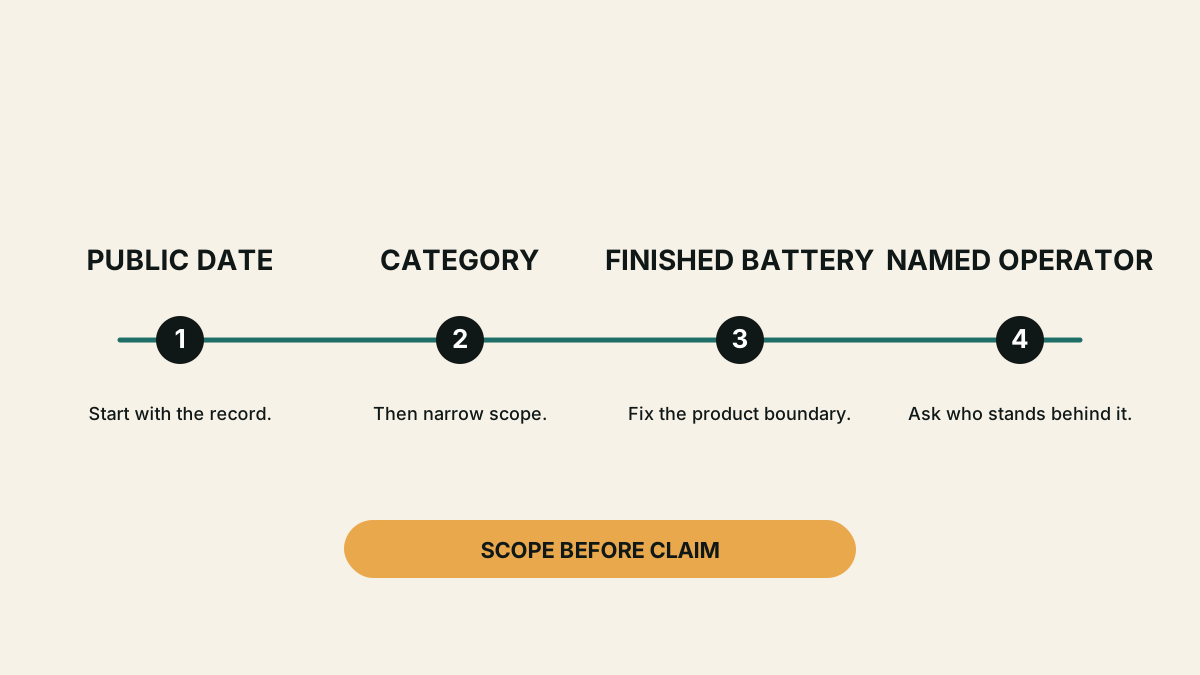
Editorial scope model. It does not classify a real battery, assign an economic operator, or determine an EU market-access outcome.
A QR code does not name the accountable party
The passport’s visible access layer is easy to describe. The Commission says that the passport will be linked to a battery through a QR code and will provide access to information defined under the Batteries Regulation. That is a meaningful technical and user-facing feature. It is not the whole system. The same Commission overview says that detailed battery information is maintained by the responsible economic operator in a decentralised arrangement. The article’s central practical consequence follows from those two official statements: a code and a data display do not by themselves tell a buyer who is accountable for the record.
The Commission makes the responsibility boundary even clearer: the obligation to create and maintain the passport lies with the economic operator placing the finished battery on the market, rather than suppliers of individual components or modules. Its official description of who is affected is the relevant source. It should not be broadened into a verdict about which Chinese company is compliant, who bears every commercial cost, or which party will be liable in every contract. Those issues can depend on the exact product and agreement. But the source is strong enough to tell a buyer that the final-battery question cannot be skipped.
Start with the finished battery
The first file is the finished-battery file. It identifies the item that will actually be placed on the relevant market or put into service. It should include the commercial and technical name used in the transaction, its claimed category, its version or model boundary, the entity selling or importing it, the intended destination, and the condition in which it will be delivered. If a seller offers a cell, a module and a finished pack under one family name, the buyer should not let a statement about one become evidence for another.
This is not bureaucracy for its own sake. Every later statement needs somewhere to attach. A stated manufacturing location, a product identifier, a durability record, a material declaration, a repair instruction, a QR-code link, or a passport account has meaning only when it describes a defined item. If the item changes late in a project—from one cell source to another, from a China-built pack to a locally integrated pack, from an original battery to a remanufactured battery—the original data conversation may no longer describe the thing the buyer will receive.
The buyer should also identify whether the final battery is being sold as part of a larger product. A vehicle, e-bike, stationary system, or industrial machine can introduce a second commercial identity and another party with information or handover responsibilities. That does not create a universal answer about who owns the passport. It does make the phrase “the battery supplier will handle it” too vague to close the file.
Then name the economic operator, not just the data provider
The second file is the accountable-operator file. Ask the contractual counterpart to name the economic operator that it says will place the finished battery on the market. Record the legal entity name, its stated role, the relationship to the buyer, and the document or agreement in which the role is described. If the answer changes by market, version, or delivery route, record that variation rather than forcing a one-company answer.
This distinction becomes important when a sophisticated China-side producer sends a thorough data package. The package may be excellent evidence of that producer’s own process. It may be an input to the final passport. It may not show that the producer is the economic operator responsible for creating and maintaining the final-battery record in the buyer’s EU-facing transaction. The buyer should thank the supplier for the data and then ask the next question: who combines it with the rest of the finished-battery record, keeps it current, and answers if the final passport is incomplete?
Do not resolve uncertainty by assuming that the biggest name in the chain owns every obligation. A large cell maker, pack maker, vehicle OEM, importer, service provider, or distributor can all have an important role. The Commission’s record tells the reader where the general responsibility boundary sits. The buyer’s job is to locate the specific party in the transaction. If nobody will name that party in writing, a QR-code demonstration does not repair the gap.
The role can change; the record must not become anonymous
Battery products do not necessarily have one static life. They can be sold new, repaired, reused, repurposed, remanufactured, or integrated into another system. The official regulatory record contains provisions for responsibility in such contexts, but this article does not interpret them for a particular business model. The operational lesson is narrower: a buyer should not accept a generic answer that assumes the original producer is automatically the responsible party forever.
Ask the seller to identify the product state and the handover point that applies to the offer. Is this a new finished battery? Is it an original part in a new system? Has it been prepared for re-use or remanufacturing? Who will keep the record available if the original commercial entity leaves the relationship? Which named party updates the record after a material change? An honest answer may be “we are still defining that path.” That is more useful than an anonymous assurance that the information will be handled.
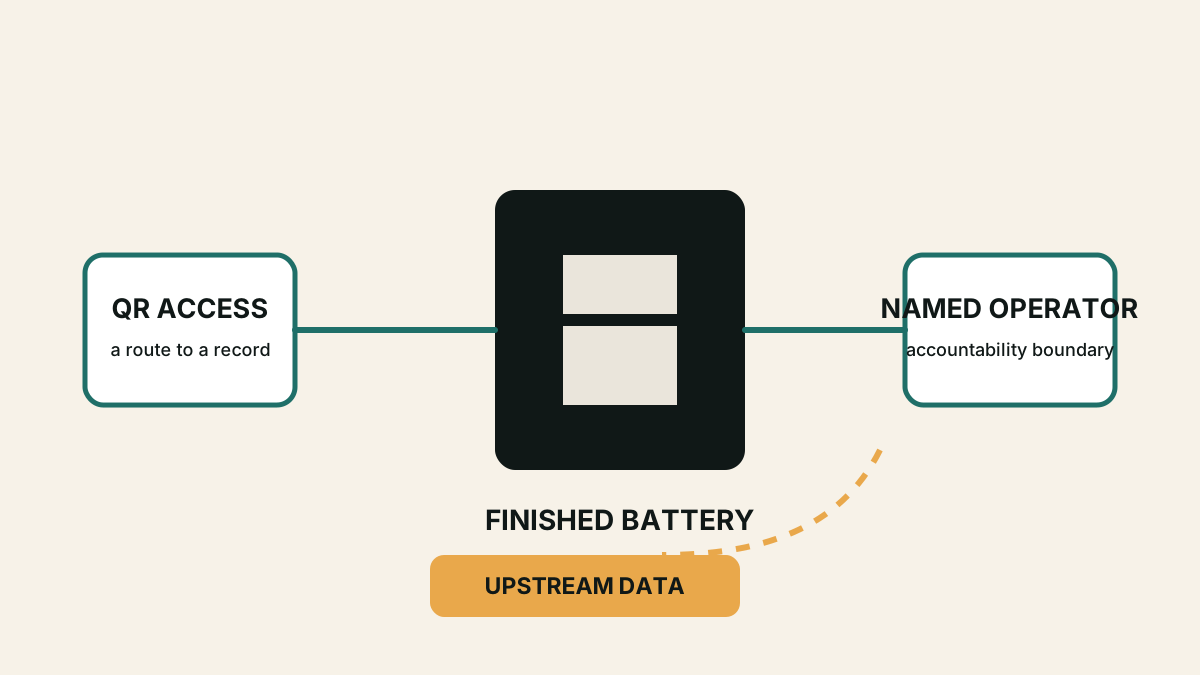
Editorial accountability model. It does not show a real QR code, passport, supplier, legal entity, or allocation of liability.
The data map is not a universal checklist
The number 71 is useful because it reveals scale. It is dangerous when it becomes a score. The Commission’s 21 August 2026 announcement says the updated guidance brings together 71 data points for EV, LMT and industrial batteries. It says the document identifies whether points are mandatory, optional, applicable only in specific circumstances, or do not have to be completed or displayed as of February 2027. The announcement should therefore lead a buyer to ask about applicability and status, not merely whether a supplier has a spreadsheet with 71 rows.
The underlying Version 2.0 document gives the same direction. It is designed to help stakeholders understand which information may need to be collected, assessed and made available, and it maps applicability across battery categories. The guidance document is a preparation aid. It does not add legal requirements, and it says that future updates may add detail or clarify reporting units and formats. A responsible buyer uses it as a versioned question map rather than as a substitute for applicable law, a contract, or an assessment.
Read field status before field content
Many weak procurement questionnaires begin with a long list of data requests. They ask a China-side supplier to complete every available data field, then treat the length of the reply as proof of readiness. This can create two bad outcomes. The supplier may provide information that is not applicable to the category or the current stage. Or it may omit a field that is not meant to be filled or displayed yet, and the buyer may mistake that omission for a failure.
Start instead with a status statement. For the exact proposed finished battery, ask the party responsible for the final record to identify the guidance version it uses, the product category it has selected, and the status it assigns to each information family that matters to the transaction: mandatory, optional, conditional, or not yet to be completed or displayed. Then ask what source supports that status. A useful answer does not need to contain every underlying data value in a sales email. It needs to make the boundary auditable.
That sequence changes the conversation from “send us all the data” to “tell us which data are relevant to this product and who owns the current record.” It also protects legitimate commercial confidentiality. A buyer does not need to demand every upstream process detail merely because a guidance document refers to a broad information family. The buyer needs enough documented clarity to determine whether the product and transaction can proceed, and a route to obtain the information that the relevant party is entitled to access.
Five information families, five different questions
The Commission overview says passport information may include battery identity and technical characteristics; manufacturer and economic-operator information; performance and durability data; information supporting repair, reuse and recycling; and sustainability and circularity-related information, depending on category and applicable requirements. Those listed domains are useful as a memory structure. They do not say that every data point in every family will be public, applicable, final, or available from the same supplier.
Identity asks: what exact battery does this record describe, and how is it differentiated from a related cell, module, or pack? Operator information asks: which entity is named and what is its relationship to the final battery? Performance and durability ask: which claims and methods are connected to this version, rather than to a different prototype or product family? Repair, reuse and recycling ask: what information is relevant for a later lifecycle stage and who may access it? Sustainability and circularity ask: which data are in scope now, in which format, and under what stated status? These are separate questions because they can involve different records, rights, suppliers, dates, and commercial sensitivities.
The buyer should keep the answers in separate folders. A technical data sheet should not silently become a legal-operator file. A sustainability report should not become an identity record. A disclosure by a cell producer should not become a statement by the finished-battery operator. A possible future data point should not become a missing current requirement. This is a simple organisational discipline, but it prevents a complex value chain from being collapsed into a single, attractive PDF.
Guidance is a preparation map, not a certificate
The Commission expressly says the guidance should be read together with Regulation (EU) 2023/1542 and relevant delegated or implementing acts. It says the document does not introduce additional legal requirements, should not be treated as an authoritative interpretation of the Commission’s position, and may be developed further. The limitations section is not a footnote to ignore. It is the reason a buyer should record the document version and resist any “we meet the guide, therefore we are compliant” statement.
This does not make the guidance less useful. It makes it useful in the right way. It lets a supplier, importer, OEM and buyer align on the data questions that must be resolved. It tells them that some fields are category-specific or time-specific. It provides a common language for identifying an open point. What it cannot do is turn a planned data collection process into a final market-access outcome or decide a dispute between commercial parties.
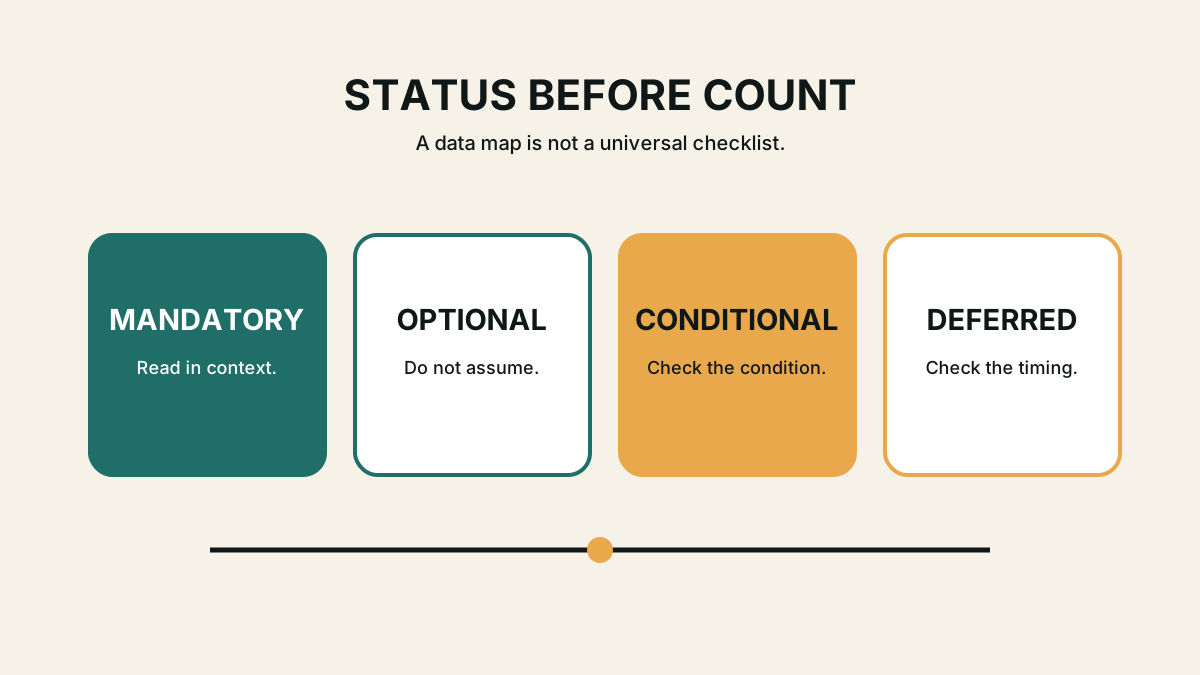
Editorial data-status model. It does not reproduce a legal checklist, disclose any battery data, or determine a supplier’s current compliance status.
The five files behind a credible supplier claim
The following five-file model is editorial. It is not a legal test and does not certify any battery. Its purpose is more practical: it stops a buyer from accepting one kind of evidence as proof of another. A strong supplier may be able to fill every file. A new or complex supply arrangement may leave some files incomplete. The buyer’s decision then becomes visible rather than accidental.
File one: the finished-battery file
This file describes the exact item whose passport question is being discussed. Preserve the product name used in the contract, the claimed category, model or version boundary, relevant identification, condition, delivery route, and intended destination. Keep the quotation, data sheet, order specification, and any version-control reference together. If the battery will be integrated into a product after the China-side supplier’s handoff, record that integration step rather than assuming the supplier’s product name continues unchanged.
The finished-battery file should answer one modest question: can a reader tell which actual final battery the other files refer to? If not, pause. A supplier can have excellent organisation-wide data and still be unable to connect it to the proposed final battery. A buyer who wants to make a public or contractual passport statement needs a more precise object than a corporate capability presentation.
File two: the accountable-operator file
This file names the economic operator that the transaction identifies as placing the finished battery on the market. It should include the legal entity, the basis for its stated role, the market and route in which the role applies, the person or function responsible for the passport conversation, and the evidence that this party will create and maintain the record. It should also state any party authorised to act on that operator’s behalf, if the transaction relies on one.
The purpose is not to force a China-side supplier to assume an obligation it does not hold. It is to prevent a buyer from being handed from cell maker to pack integrator to importer to data vendor without a named endpoint. If the seller says the importer, OEM, or local distributor will own the final relationship, ask for the handoff and the contact. If it says the battery manufacturer will own it, ask which exact finished battery and market placement the statement covers.
File three: the upstream-data file
The upstream-data file records what the China-side cell, module, material, pack, or software supplier is actually providing into the final-battery record. It should state the input’s identity, applicable version, source system, collection date, responsible contact, and any limitation on reuse or disclosure. It should not silently assume that upstream data are complete, current, shareable, or identical to final-battery data.
The commercial reason for this distinction is visible in independent implementation work as well as in the official responsibility boundary. A CIRPASS roadmap describes an illustrative situation in which a pack maker or OEM issues a passport that can contain confidential cell-producer information. This is a stakeholder roadmap observation from 2024, not a legal allocation and not evidence about any named Chinese supplier. It is still a useful warning: data handoff, access rights, and commercial confidentiality must be designed rather than assumed away.
Ask simple questions. Which fields can the China-side supplier provide directly? Which must be calculated, verified, or completed later by another party? Which information is confidential? Which party may see it? How will an upstream revision be propagated to the finished-battery operator? What happens when the source data and the commercial specification disagree? The buyer does not need every answer on day one. They need a named process for the answers that will change the decision.
File four: the data-status file
This file records applicability rather than just content. For the exact product category and current guidance version, it should show which information is being treated as mandatory, optional, conditional, or not yet required to be completed or displayed. It should attach the date of that interpretation and the source that the responsible party relies on. If a field is not available, write whether it is not applicable, not yet required, pending, confidential, or genuinely unknown. These are different states with different commercial consequences.
The data-status file is where a buyer catches misleading completeness claims. “We have all data” may mean that the supplier has fields in its internal database. “We have a passport” may mean that a prototype record exists for a related product. “This field is blank” may be a correct reflection of the guidance’s current status, or it may reveal a missing source. The file turns each vague sentence into a concrete question that can be answered, challenged, and rechecked.
File five: the transaction-remedy file
The fifth file is the one most likely to be omitted from a technical discussion. It states what happens if the records do not join. Identify the contractual seller, the party responsible for supplying each promised document, the delivery milestone at which the buyer can check it, the process for correcting an inaccurate or incomplete statement, and the commercial remedy if the promised handoff is not made. This is not a prediction that something will go wrong. It is the difference between a technical aspiration and a transaction the buyer can manage.
Do not assume that an EU regulatory role, a commercial warranty, a data-service agreement, and a purchase contract are identical. They may overlap. They may not. A supplier can be technically capable and still refuse responsibility for a downstream integration choice. An importer can have a market-facing role and still need upstream data before it can complete the record. A buyer should map those interfaces before payment or before making a compliance claim to a customer.
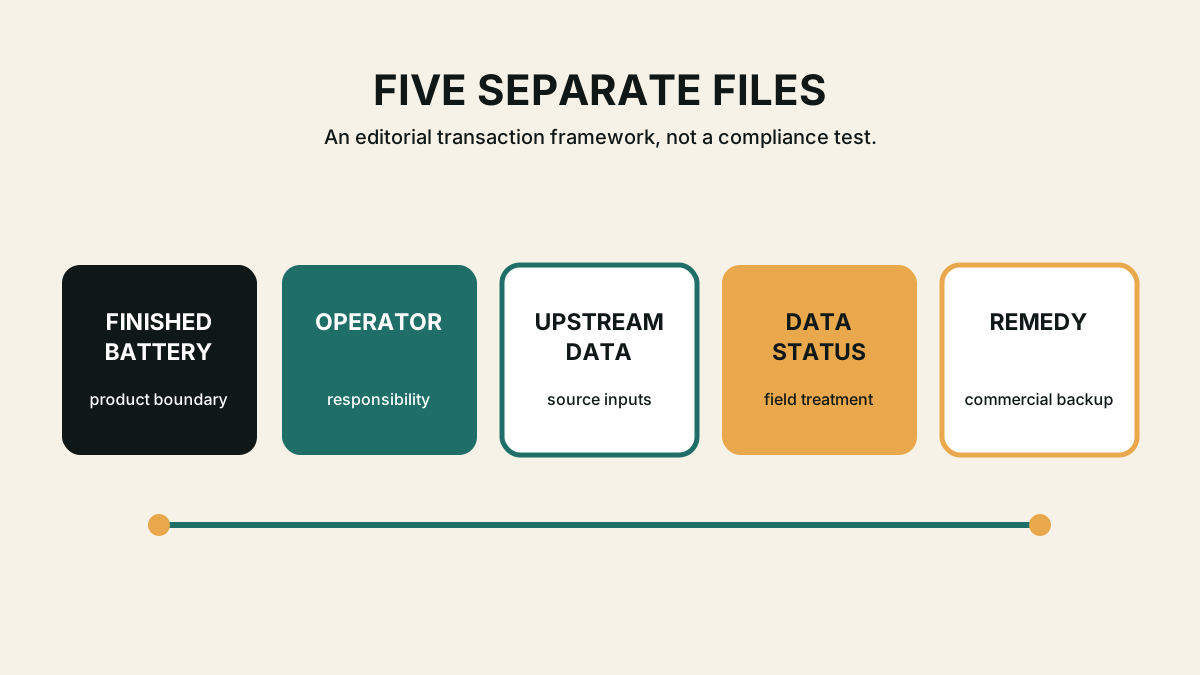
Editorial handoff framework. It does not allocate legal responsibility, disclose a real battery passport, or validate any supplier’s data.
Turn “passport ready” into five questions
When a seller uses the phrase “battery passport ready,” do not challenge it with a demand for a grand promise. Ask for a narrower answer that has an owner, an object, a source, and a date.
First: Which exact finished battery does this statement cover? Ask for the category, model or version, intended EU-facing product route, and commercial document that ties the answer to the offer. A company capability statement is not enough.
Second: Which economic operator is expected to create and maintain the passport for that finished battery? Ask for the entity name, market route, and handoff contact. If the answer is “our customer” or “the importer,” ask how that party receives and validates the required upstream data.
Third: Which guidance and rule version does the party use? Record the Version 2.0 guidance date, the stated application status of relevant data families, and the review trigger. Do not accept “the EU rules” as a version-controlled source.
Fourth: What are the upstream-data boundaries? Ask what the China-side supplier provides, what it does not provide, what is confidential, what needs a separate access route, and how changes are communicated. The best answer is not necessarily the most detailed one. It is the one that does not confuse a supplier input with a final product record.
Fifth: What happens if the record is incomplete, mismatched, or later challenged? Ask who corrects it, by when, at whose cost, and what commercial relief the buyer has. This is a contractual question that cannot be answered by the QR code, the guidance count, or a generic statement about traceability.
These five questions create a useful stop rule. If a supplier can answer only the first two, the buyer has learned that the project is early. If it can answer four but not the remedy, the buyer knows where contract work is needed. If each answer points to a different entity without a written handoff, the buyer knows that the chain is not yet a final-battery file. A simple red-amber-green score is less helpful because it hides the particular missing record.
A pre-contract evidence pack
For a buyer preparing a quotation, request for proposal, supply agreement, or internal approval, create a small evidence pack rather than a giant unstructured data room. Include the exact finished-battery identification; a role map naming the supplier, integrator, importer, OEM and claimed responsible operator; a table of relevant data families with status and source; the current guidance and regulation references; a register of restricted or confidential data; and a list of commercial remedies or open questions.
Make the pack dated. State which documents were received from which party and which statements are the supplier’s self-description rather than independently verified facts. Preserve the source links, because policy pages and guidance versions can change. Mark the items that need a legal, conformity, technical, or contractual review by a competent party. The objective is not to make a procurement manager pretend to be a regulator. It is to ensure the right specialist sees an exact question instead of a vague request for “passport compliance.”
The pack also improves communication inside a China-side supplier. Engineering may own material and performance data. Quality may own test and version records. Sustainability teams may own lifecycle information. Export staff may own the customer and delivery route. A commercial manager may own the contract. The final-battery operator may be outside the supplier altogether. A shared file makes these dependencies visible without requiring one team to know every answer.
Common shortcuts that create false confidence
“We can generate QR codes.”
That can be a useful implementation capability. It is not proof that the code identifies the right battery, that the right economic operator maintains the detailed record, or that the underlying information has the required status for the product category. Ask which final battery and responsible party the demonstrated code represents.
“Our China factory has traceability data.”
Factory traceability may be valuable upstream evidence. It does not alone decide final-battery passport responsibility, downstream data completeness, confidential-information access, or contractual remedy. Request the data handoff and its link to the finished-battery file.
“There are 71 fields, and we have filled them.”
The Commission’s guidance does not frame 71 as a universal completion score. It distinguishes mandatory, optional, conditional, and not-yet-displayed fields by category. Ask for the category, status logic, document version, and source rather than a raw field count.
“The guidance says this is enough.”
The guidance explicitly says it does not introduce additional legal requirements and may be developed further. It is a strong preparation map, not a private certificate. Keep the regulation, applicable acts, final-battery role, and transaction terms in their own files.
“The OEM will handle it.”
Maybe. But “the OEM” is not a document. Name the legal entity, the exact product, the market route, the data recipient, and the commercial handoff. If those records do not exist yet, record the dependency instead of treating it as solved.
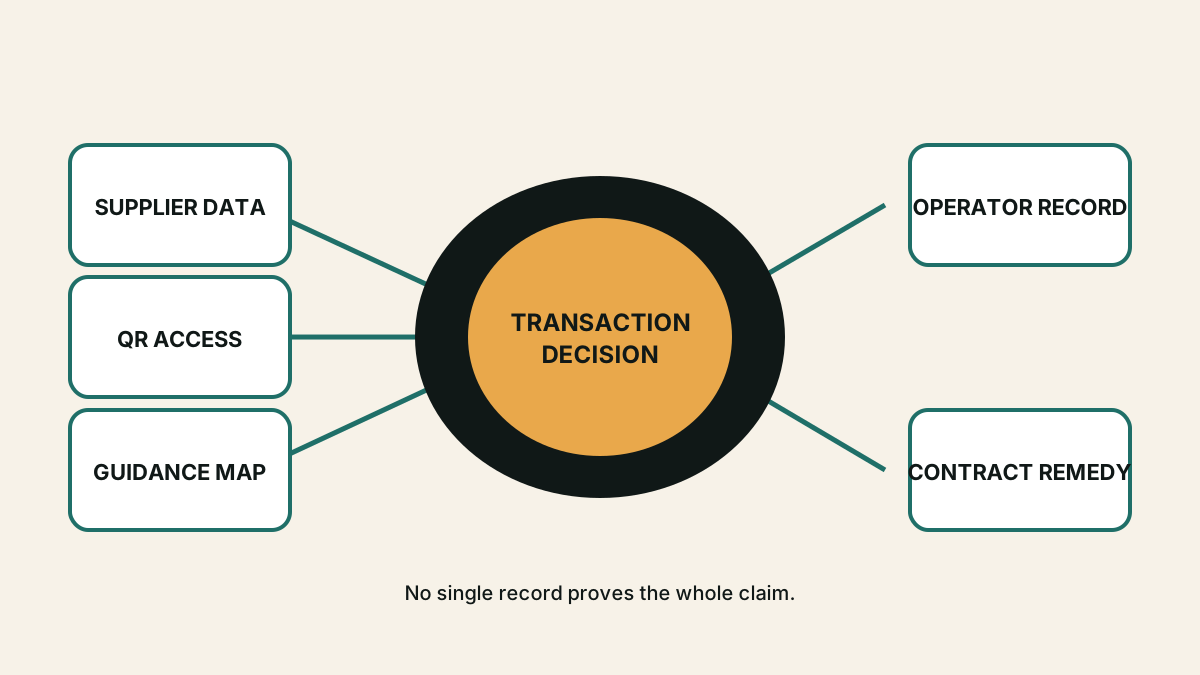
Editorial claim-boundary model. It reports no actual supplier readiness, passport status, QR-code result, legal allocation, or EU market-access outcome.
Method and limitations
This article is desk research based on current European Commission guidance, the EU Batteries Regulation reference it names, and one clearly labelled CIRPASS implementation roadmap. It is not legal advice, a conformity assessment, a supplier audit, a battery test, a data-system review, a QR-code scan, or a finding about a named company’s readiness. The Commission guidance itself says it does not introduce additional legal requirements and may be developed further, so a reader should check the original current materials before making a commitment.
The article intentionally does not rank Chinese battery companies or publish a list of “passport-ready” suppliers. Public records can establish a date, a category, a responsibility boundary, a data-map structure, and the limits of a guidance document. They cannot establish that any individual supplier’s data are accurate, complete, current, contractually available, or sufficient for a particular transaction. The five-file framework is an editorial way to turn that uncertainty into a better question.
Frequently asked questions
Does the EU battery passport apply to every battery made in China?
No blanket conclusion follows from origin. The Commission’s published scope refers to specific EV, LMT, and industrial battery categories above 2 kWh when placed on the EU market or put into service from the stated date. Match the exact finished battery and transaction route to the current official material rather than applying a country label.
Can a cell supplier create the final battery passport?
The Commission assigns creation and maintenance responsibility to the economic operator placing the finished battery on the market, rather than individual component or module suppliers. A cell supplier may provide vital inputs, but the buyer should identify the final-battery operator for the exact transaction.
What should a buyer request first?
Request the finished-battery identity and category, the named responsible economic operator, the source and version of the data-status map, the upstream data handoff, and the contract remedy if a promised record is incomplete. This is more useful than asking whether the company is generally ready.
Is a QR code enough for an EU customer to rely on the passport?
No. A QR code can link to passport access, but it does not itself prove the final-battery identity, data status, operator responsibility, or commercial remedy. Treat it as one access element within a larger record.
Will the guidance remain unchanged until 2027?
Do not assume so. The Commission says the guidance may be developed further and should be read alongside the Regulation and relevant acts. Preserve the version used in the transaction and set a review trigger before market placement.