
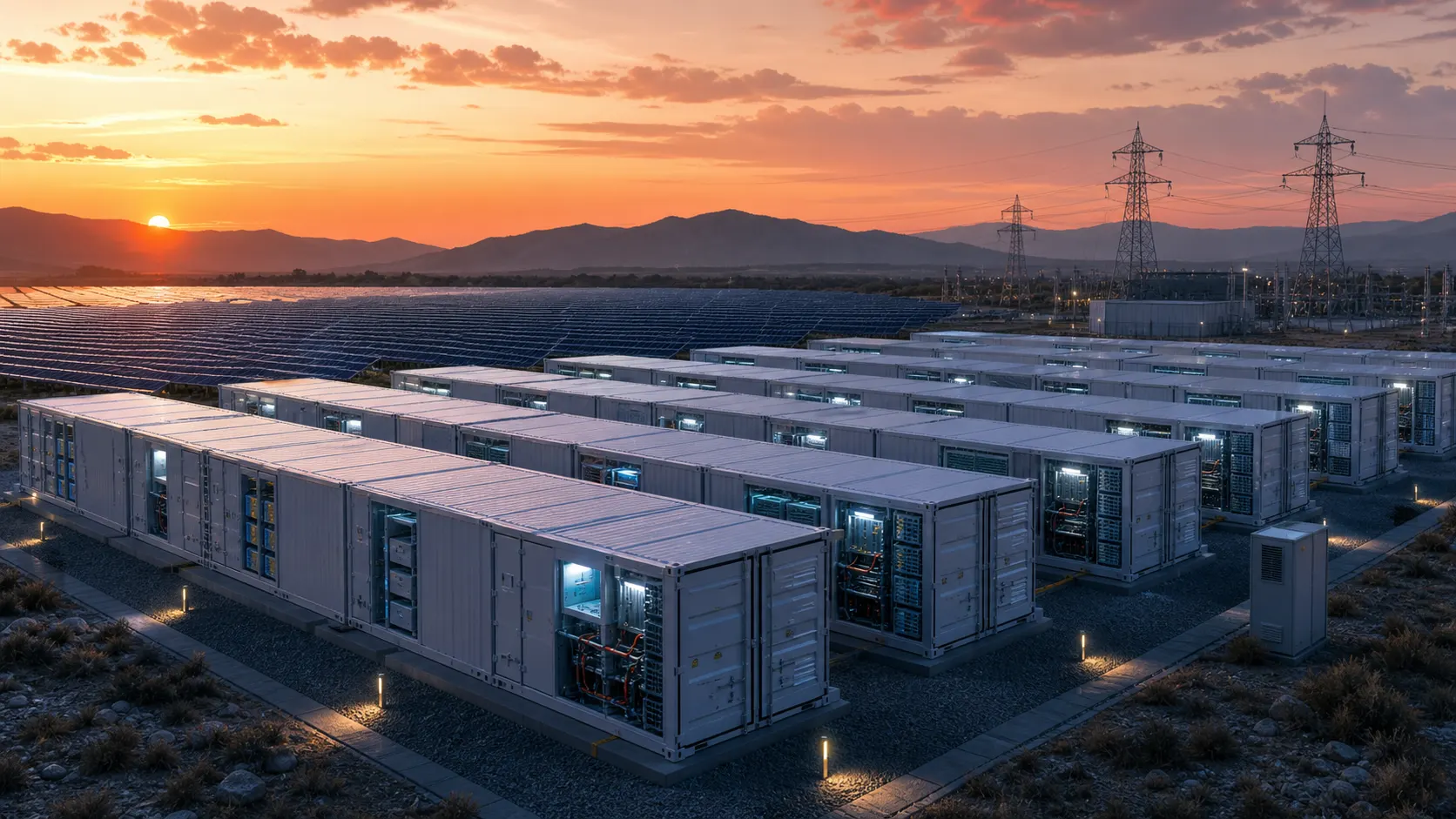
The important part of HiTHIUM's SNEC 2026 launch is not that another Chinese storage supplier used the phrase "long-duration."
It is that HiTHIUM is trying to make 8-hour duration look like a native product architecture rather than a project-level workaround. That difference matters for utilities, developers, lenders, EPCs, and land-constrained storage buyers because an 8-hour storage project is not just a bigger version of a 2-hour project. It changes the cell, the container, the cooling system, the land plan, the dispatch case, the safety file, and the financing questions.
The company used SNEC to show the `Power 6.9MWh` 8-hour LDES system, a `1300Ah` LDES cell, a new `650Ah` cell, and a `10+MWh` product direction. HiTHIUM's SNEC announcement, distributed through PRNewswire, says the 6.9MWh system is built around a dedicated 1300Ah cell, targets stable 8-hour output in a standard 20-foot container, claims up to 25 years of design life, and supports side-by-side and back-to-back deployment to reduce land and civil costs.
That is a buyer file. The key question is not whether HiTHIUM can write "8-hour" on a booth wall. The key question is whether its cell-to-container design can survive site design, permitting, warranty review, lender diligence, and delivery schedules.
Source File
This article was reviewed on 2026-06-30 against HiTHIUM's SNEC 2026 announcement distributed through PRNewswire, HiTHIUM's earlier WFES 2026 8-hour LDES article, PV Magazine's June 2026 coverage of the 1300Ah cell and 6.9MWh system, and related site work in China Battery Storage Boom: Grid-Scale BESS Explained and HiTHIUM Fire Test: The LDES Buyer File for 2026. Vendor duration, design-life, density, and safety claims are treated as claims until a buyer verifies test reports, certifications, project references, warranty terms, and local permitting acceptance.
Quick Answer
| Buyer question | Practical answer |
|---|---|
| What changed at SNEC 2026? | HiTHIUM moved its 8-hour LDES story from concept framing toward a named 6.9MWh system, 1300Ah cell, and larger-format roadmap. |
| Why does it matter? | Native 8-hour design changes land use, container density, safety review, grid-dispatch assumptions, and financing diligence. |
| What numbers matter? | 6.9MWh, 8-hour output, 1300Ah cell, standard 20-foot container, up to 25-year design life, 650Ah cell, and 10+MWh roadmap. |
| What remains uncertain? | Public information on the 650Ah and 10+MWh products is still limited, and delivery timing must be checked against bankability claims. |
| Evergreen bridge | Read this with China Battery Storage Boom: Grid-Scale BESS Explained, HiTHIUM Fire Test: The LDES Buyer File for 2026, Sungrow PowerTitan 3.0: Utility BESS Buyer File for 2026, and CATL's Xiamen Storage Testbed Is a Bankability Signal. |
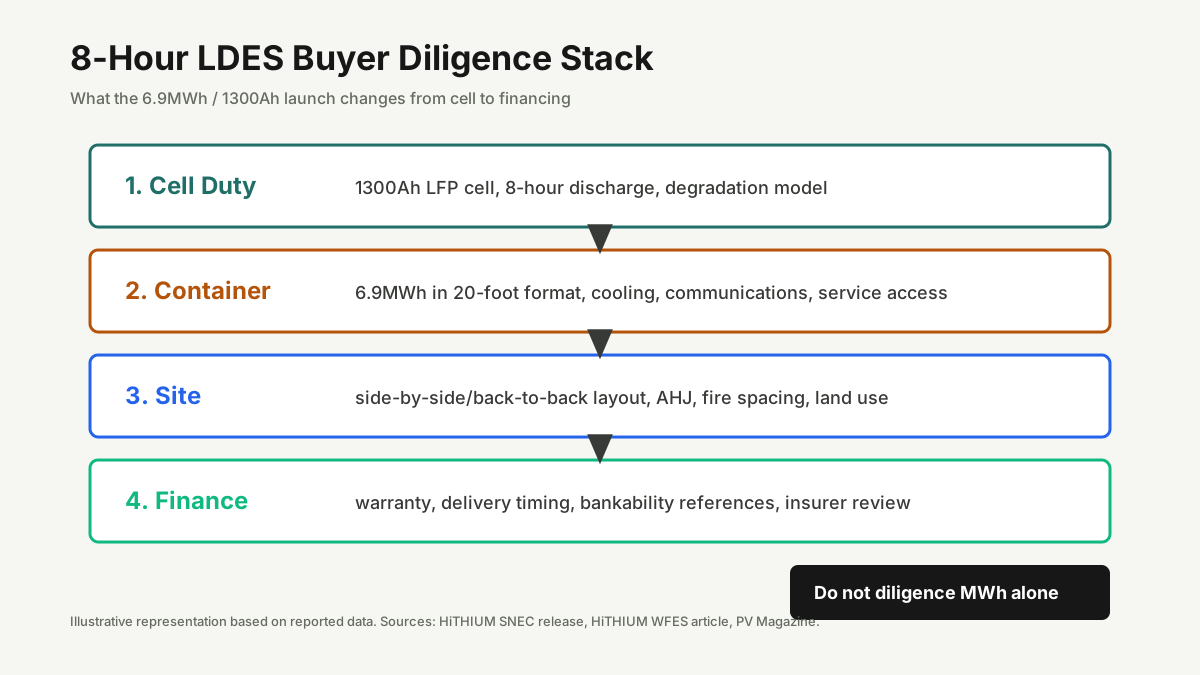 Source: China Made & Tech analysis based on HiTHIUM SNEC 2026 release, HiTHIUM WFES 2026 materials, and PV Magazine reporting.
The Protagonist Is A Storage Supplier Trying To Own The Duration Problem
The protagonist is HiTHIUM, a Chinese energy-storage company trying to move from large-format battery supplier to long-duration system counterparty. Its desire is to make 8-hour storage look standardized enough for mainstream utility procurement. Its obstacle is that long-duration storage is a harsher diligence category than short-duration BESS.
A 2-hour or 4-hour battery can often be evaluated around energy capacity, PCS sizing, safety certification, augmentation strategy, and basic revenue assumptions. An 8-hour battery pushes deeper questions: can the cell handle the duty cycle, does the container remain financeable, how does thermal management behave under long discharge, how much land is saved by density, and whether the project can still meet permitting and insurance expectations.
HiTHIUM's January 2026 WFES article already framed the 6.9MWh system and 1300Ah cell as a response to day-and-night power balancing and high-temperature grid needs. SNEC was the next turning point: the company brought the same logic back to Shanghai and positioned the 8-hour system beside a broader product portfolio, including 650Ah and 10+MWh directions.
That sequence matters because it shows a movement from trade-show concept to market packaging. HiTHIUM is trying to make the buyer see a repeatable product line rather than a one-off engineering claim.
Why "Native 8-Hour" Is Different From Stretching Runtime
The most important distinction in the launch is between a storage system that happens to run longer and a storage system designed around 8-hour duty from the cell level upward.
HiTHIUM's release says the 6.9MWh product is powered by a dedicated 1300Ah cell and designed at the cell level for 8-hour output in a 20-foot container. PV Magazine's June 2026 coverage added useful detail: it reported the 1300Ah LFP cell has nominal capacity of 1300Ah, gravimetric energy density of at least 190 Wh/kg, volumetric energy density of at least 406 Wh/L, and design life above 25 years. The same report said the system uses a 4 x 1P416S configuration, liquid cooling, CAN, RS485, and Ethernet communications, and is designed to comply with NFPA 855.
Those details make the buyer question more concrete:
| Diligence item | Why it matters for 8-hour storage | What to verify |
|---|---|---|
| Cell design | Long duration stresses energy density, temperature rise, and cycle economics | Cell datasheet, warranty conditions, duty-cycle limits, and degradation assumptions |
| Container density | 8-hour projects can become land-heavy if density is poor | MWh per 20-foot container, spacing rules, access lanes, and fire-code layout |
| Thermal management | Long discharge and high ambient conditions affect degradation and safety | Cooling design, temperature delta, auxiliary load, and site derating |
| Safety file | Large-format cells and dense containers face stricter permitting review | NFPA 855 alignment, fire detection, propagation testing, and emergency plan |
| Financeability | Lenders need confidence in delivery, warranty, and degradation | Bankability references, insurance review, parent support, and installed project data |
Land Use Is The Hidden Economic Claim
HiTHIUM's SNEC release explicitly links the 8-hour product to side-by-side and back-to-back deployment. That is not an aesthetic detail. It is a land-use claim.
Long-duration storage often competes with the physical footprint of the project. More containers require more foundations, cable runs, fire separations, access roads, auxiliary equipment, civil work, and land negotiations. If a supplier can make a higher-duration system fit into a denser layout without creating unacceptable safety or thermal penalties, the value is not only MWh. It is lower balance-of-plant complexity and potentially faster project development.
The buyer should therefore translate the headline number into a site plan:
- How many containers are needed for the target MWh and MW?
- What clearances are required by local code, insurer, AHJ, and fire authority?
- Does back-to-back deployment remain allowed under the buyer's jurisdiction?
- What auxiliary-load assumption is used for long-discharge operation?
- Does the cooling system derate under local heat, altitude, dust, or humidity?
- How does container density change emergency response access?
This is where China Battery Storage Boom: Grid-Scale BESS Explained gives the broader context. China's storage boom has created suppliers that can move quickly on cell format, system integration, and manufacturing scale. But project economics outside China still depend on local permitting, fire-code interpretation, grid interconnection, and financing. Dense Chinese product design must pass non-Chinese project reality.
The 10+MWh Signal Is About Packaging Pressure, Not Just Bragging Rights
HiTHIUM also used SNEC to show a new 650Ah cell and 10+MWh product direction. The company said those products are intended to improve project returns through higher energy density and better system integration. PV Magazine was careful to note that public information on the 650Ah cell remains limited and that delivery is expected to begin in 2027.
That caution matters. A buyer should treat the 10+MWh message as a roadmap signal, not a procurement-ready proof point.
The industry direction is still meaningful. Storage suppliers are under pressure to put more energy into fewer containers while keeping safety, serviceability, and bankability intact. The risk is that each step toward larger cell formats and denser systems raises the consequences of weak thermal design, unclear fire testing, or immature field data.
The practical buyer view is:
| Product signal | Useful read | Buyer caution |
|---|---|---|
| 6.9MWh 8-hour system | More concrete product architecture for long duration | Still needs project references and jurisdiction-specific safety review |
| 1300Ah cell | Cell-level attempt to design around 8-hour duty | Large cell format requires strong degradation and safety evidence |
| 650Ah cell | Portfolio expansion for large-format systems | Public specs remain limited; do not overstate readiness |
| 10+MWh system | Packaging direction toward higher density | Delivery timing, serviceability, and code acceptance remain open questions |
| Sodium-ion portfolio | Shows broader duration matrix | Use case and cost position must be compared against LFP and project needs |
Vietnam Makes The Story More Than A Booth Display
HiTHIUM's SNEC release also said the company and DSS Solar signed a three-year 1GWh strategic cooperation agreement for Vietnam's residential, C&I, and energy-storage markets. That matters because it gives the launch a regional channel signal.
Vietnam is not simply a footnote. Southeast Asia is a practical test for Chinese storage suppliers because buyers often need a mix of C&I backup, solar self-consumption, grid support, and distribution-channel reliability. If HiTHIUM can convert a trade-show system story into channel execution, it strengthens the case that the company is building more than a product catalog.
But the buyer should not confuse a cooperation agreement with delivered projects. The useful questions are:
- Which products are included in the 1GWh agreement?
- Are the systems residential, C&I, utility-scale, or mixed?
- What installation, warranty, and after-sales responsibilities sit with DSS Solar versus HiTHIUM?
- Are the batteries shipped as cells, cabinets, or integrated systems?
- What local safety and grid standards apply in Vietnam?
The agreement is a signal of market intent, not evidence of long-duration field performance.
Safety And Validation Are The Same Story As Duration
This article also belongs next to HiTHIUM Fire Test: The LDES Buyer File for 2026. Long-duration storage buyers should not separate duration from safety. If the project stores more energy per container and expects longer discharge, the safety case becomes part of the economic case.
HiTHIUM's SNEC release describes a multi-layer protection architecture covering cell safety, active and passive battery-container protection, and intelligent BMS management. PV Magazine reported the system's fire detection and protection details, recyclable structural elements, low-GWP refrigerant, and NFPA 855 design alignment.
Those are useful claims. They still need verification. The buyer should ask for test reports, third-party witnessing, fire-code documentation, and insurer feedback. A vendor safety statement is not the same as an accepted project safety case.
The same logic applies to design life. A 25-year design-life claim is economically important only if degradation, augmentation, warranty exclusions, and operating assumptions are visible. If an 8-hour project is financed on a long asset-life thesis, the warranty file must be more specific than the brochure.
Delivery Timing Is Part Of The Technology Claim
The buyer should also treat delivery timing as part of the technology file. A long-duration product is not bankable just because the cell format is impressive. It becomes bankable when the buyer can see how product qualification, factory capacity, certification, transport, commissioning, warranty support, and service coverage line up with the project schedule.
PV Magazine's June 2026 coverage reported that HiTHIUM expected first delivery of the 1300Ah cell and 6.9MWh system in 2027. That makes the SNEC story useful but not yet the same thing as a mature procurement lane. A developer bidding a 2026 or early-2027 project should not assume the system can be substituted into a live EPC schedule without checking availability, country certification, fire-code acceptance, and spare-part support.
This is also why the Vietnam agreement matters. A 1GWh purchase signal from DSS Solar is more concrete than booth language, but it is still a market signal until buyers can see installed projects, acceptance tests, operating records, and service response. The correct diligence question is not "does HiTHIUM have a roadmap?" It is "which part of the roadmap is orderable, financeable, insurable, and supportable in my jurisdiction by my commercial-operation date?"
What Buyers Should Not Assume
Do not assume 8-hour native design automatically means lower delivered cost. It may reduce container count or civil complexity, but the final economics depend on PCS sizing, project layout, grid services, revenue stack, degradation, financing cost, and installation environment.
Do not assume a 20-foot container solves site constraints by itself. Local fire spacing, access requirements, and AHJ interpretation can erase some density benefits.
Do not assume the 10+MWh direction is ready for the same procurement process as the 6.9MWh system. Treat it as roadmap evidence until detailed public specifications and delivery references are available.
Do not assume Chinese manufacturing scale removes bankability work. It helps on cost and delivery, but buyers still need warranty language, balance-sheet review, project references, insurance comfort, and service coverage.
Do not assume long duration is always the best duration. Some markets still pay better for 2-hour or 4-hour flexibility. The case for 8 hours depends on the grid problem, tariff design, renewables profile, and capacity value.
Buyer Checklist: What To Verify Before Believing The LDES Pitch
For developers, request a layout pack before treating the land-use claim as real. The pack should show container spacing, access lanes, fire boundary, cable routing, auxiliary systems, and the precise assumptions behind side-by-side or back-to-back deployment.
For EPCs, request installation and commissioning documentation. The 8-hour label is not enough; the EPC needs lifting plan, foundation requirements, coolant handling, controls integration, communication protocols, and maintenance access.
For lenders, request warranty and degradation models under the intended duty cycle. The key issue is whether the financial model matches the actual operating assumptions, not whether the datasheet looks advanced.
For insurers and AHJs, request safety test reports, NFPA 855 alignment evidence, fire-detection logic, propagation data, emergency response guidance, and details about gas venting, coolant, and thermal barriers.
For buyers comparing suppliers, build a duration matrix rather than a brand ranking. Compare HiTHIUM's 6.9MWh 8-hour architecture against 4-hour LFP systems, flow batteries, sodium-ion products, pumped storage alternatives, and hybrid designs on land, delivery, safety, degradation, and service.
Reader Judgment
HiTHIUM's SNEC 2026 launch is worth attention because it makes long-duration storage more concrete. It names the cell, the container architecture, the system capacity, the 8-hour use case, and the roadmap pressure toward larger systems.
But the correct takeaway is disciplined, not promotional. HiTHIUM has made the 8-hour buyer file easier to inspect. It has not removed the need for inspection.
If you are a buyer, the next step is not to ask whether HiTHIUM has an 8-hour product. The next step is to ask whether the product's cell design, safety case, land-use claim, delivery schedule, and warranty package survive your actual project boundary.
Methodology
This article uses HiTHIUM's SNEC 2026 announcement distributed through PRNewswire, HiTHIUM's earlier WFES 2026 8-hour LDES article, and PV Magazine's June 2026 coverage of the 1300Ah cell and 6.9MWh system. Vendor claims are treated as claims unless separately validated by test reports, project references, certification documents, or lender-accepted due diligence.
Claim Confidence File
| Claim | Confidence | Evidence boundary |
|---|---|---|
| Hithium's 8-hour LDES positioning is relevant for buyers evaluating Chinese long-duration storage offers | Medium-high | Based on cited company/SNEC materials; project economics and dispatch value are site-specific. |
| An 8-hour product label proves bankable long-duration project performance | Low | The article separates product positioning from EPC guarantees, warranties, degradation, financing, and reference projects. |
| Buyers should ask for cell chemistry, warranty curves, safety test evidence, EMS/PCS integration, and service coverage | High | This is a practical due-diligence conclusion. |
| The article forecasts LDES market share or revenue with precision | Low | It is a buyer file, not a market forecast model. |
FAQ
Is HiTHIUM's 8-hour LDES system commercially ready in 2026?
Public information supports a product launch and roadmap signal, not a universal procurement-ready conclusion. Buyers still need delivery timing, certification, warranty, project-reference, and local safety-code evidence before treating it as bankable for a specific site.
Why does an 8-hour battery need different diligence from a 4-hour BESS?
An 8-hour system changes cell duty cycle, thermal behavior, container density, fire-code layout, degradation modeling, and revenue assumptions. The buyer file should test the full cell-to-project architecture, not only the MWh number.
Does a 6.9MWh 20-foot container reduce land cost automatically?
Not automatically. Higher density can help, but local fire spacing, access lanes, auxiliary systems, insurer rules, and AHJ interpretation can reduce or erase the layout advantage.