
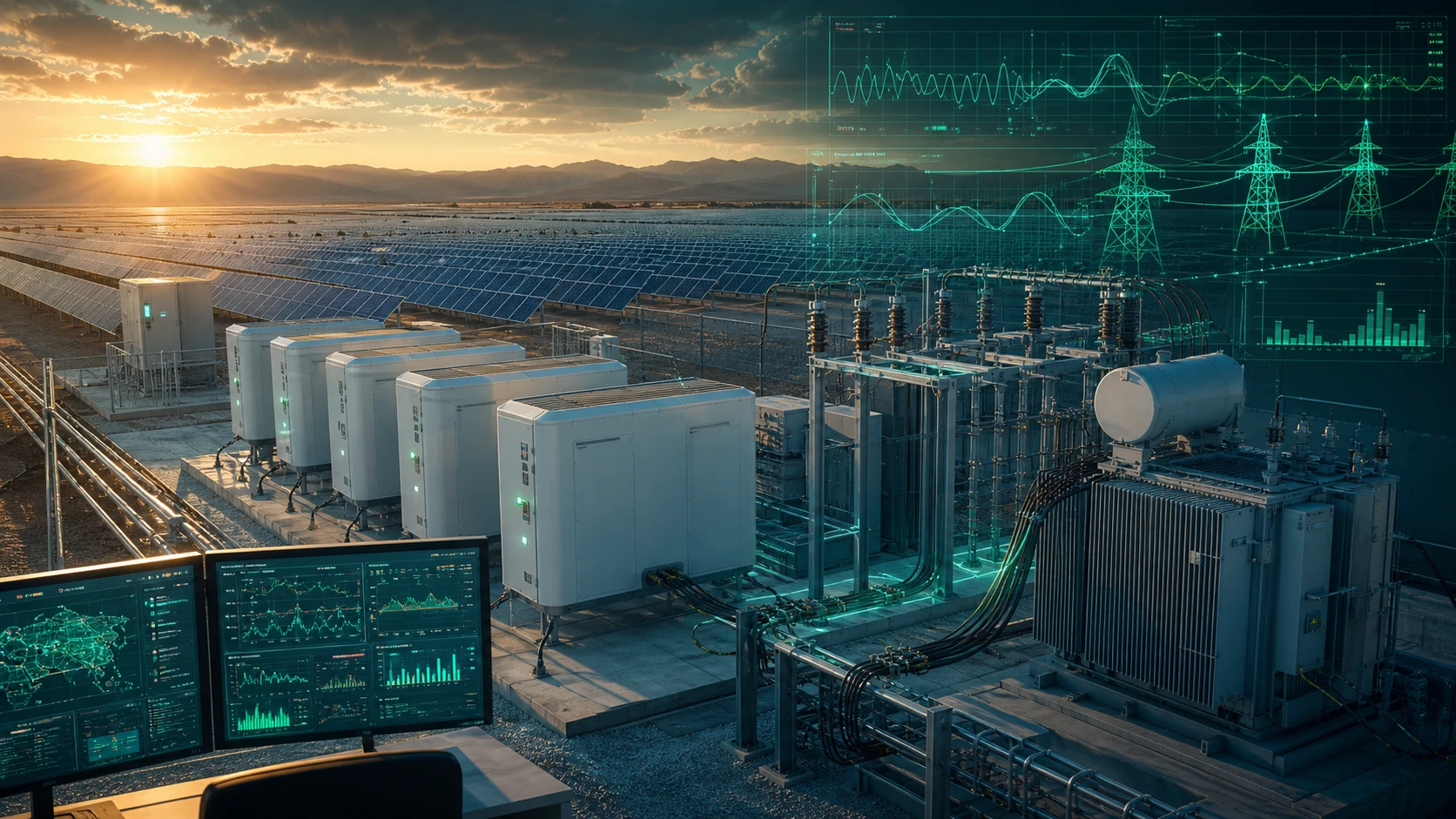
The strongest signal in Huawei's latest solar push is not market share. It is role expansion.
For years, grid-forming was mainly storage language. It lived in the battery and power-conversion conversation. Huawei is now trying to drag that capability directly into utility PV architecture. In its April 29, 2026 Europe launch, Huawei said FusionSolar 9.0 includes the industry's first `1000V AC PV system`, the world's first `grid-forming string inverter`, and Europe's largest `11MW Smart Transformer Station`. It also said the platform can cut BOS cost by `0.27-0.55 euro cents/Wp`, save roughly `70,000 euros per 200MW project` during commissioning, and deliver reactive-power support within `10 ms`. Huawei said more than `10GW` of projects globally were already under construction using the solution.
That is product marketing, but it is also a bid to change how utility PV gets bought. If grid-forming really moves from the storage block into the inverter and transformer-station logic of the PV plant itself, then the buyer can no longer evaluate the inverter as a commodity electrical box. The inverter becomes part of the grid-behavior file.
Source File
This article was reviewed on 2026-07-06 against Huawei's FusionSolar 9.0 Europe launch release, Huawei's pre-launch utility PV inverter framing, and Huawei's SNEC 2026 event page. The source stack is intentionally labeled as supplier-led: Huawei's claims about grid-forming, response time, commissioning, BOS savings, and utility behavior remain supplier claims unless confirmed in the buyer's target grid-code, certification, EPC, and utility-interconnection file. Internal links connect the story to China Solar Dominance: Supply Chain Power, Profit Crisis, Sungrow's Grid-Forming Proof and Europe Factory Matter for Buyers, Sungrow PowerTitan 3.0: Utility BESS Buyer File for 2026, and Deye Inverter Buyer Risk: Warranty and Sol-Ark.
Claim Confidence File
| Claim | Confidence | Evidence boundary |
|---|---|---|
| Huawei FusionSolar grid-forming claims matter for PV-plus-storage procurement files | Medium-high | Based on cited Huawei/product materials; project-level grid performance still needs utility, EPC, and interconnection validation. |
| Grid-forming branding proves bankable performance in every market | Low | The article treats vendor claims as inputs to due diligence, not final engineering acceptance. |
| Buyers should verify model/SKU, certification, grid-code fit, cybersecurity, service entity, and warranty path | High | This is the article's operational checklist and does not depend on predicting future market share. |
| The article independently validates multi-year field performance for every FusionSolar configuration | Low | The evidence boundary is public product/source material and buyer-risk analysis, not a private fleet dataset. |
Quick Answer
| Buyer question | Practical answer |
|---|---|
| What is actually new here? | Huawei is pushing grid-forming from ESS into PV-inverter architecture, not only adding another larger inverter. |
| Why does this matter for utility buyers? | It changes BOS design, commissioning logic, grid-code positioning, and how developers frame project resilience. |
| Is this only a Europe story? | No. Huawei says the solution has been deployed in China since October 2024 and has more than 10GW under construction globally, but Europe is where the commercial pitch is currently sharpest. |
| What should buyers verify first? | Whether the claimed grid-forming value holds in the target market's actual grid code, commissioning plan, and lender expectations. |
| Evergreen bridge | This belongs inside China Solar Dominance: Supply Chain Power, Profit Crisis, with nearby context from Sungrow's Grid-Forming Proof and Europe Factory Matter for Buyers and Sungrow PowerTitan 3.0: Utility BESS Buyer File for 2026. |
Why This Is A More Important Signal Than Another Product Launch
The global solar market already knows China dominates scale. China Solar Dominance: Supply Chain Power, Profit Crisis lays that out clearly: Chinese firms rule modules, cells, wafers, and a large share of the inverter business. Huawei does not need another event to prove it belongs in the supply chain.
What it does need is a higher-value role.
The challenge in 2026 is that utility PV economics are no longer decided only by module cost or inverter conversion efficiency. High-renewable grids have weaker inertia, more curtailment pressure, tighter interconnection questions, and more scrutiny on what happens during faults, voltage excursions, and commissioning windows. That means utility buyers increasingly care about whether a plant can actively support the grid, not just feed electrons into it.
Huawei's move matters because it is trying to make the PV side responsible for part of that answer.
The Core Claim: Grid-Forming Moves Upstream Into PV
Huawei's Europe launch said three things that matter together:
| Claimed feature | Why buyers should care |
|---|---|
| 1000V AC PV system | Larger arrays and lower BOS complexity can change project economics |
| Grid-forming string inverter | Grid support is no longer framed as storage-only capability |
| 11MW smart transformer station | Higher-power architecture reduces plant-level equipment count and interface points |
That is a much bigger commercial ask, because redesign authority changes who matters in the project file:
- electrical design engineers,
- interconnection specialists,
- EPC contractors,
- commissioning teams,
- lenders and technical advisers,
- operators who will live with the system for twenty years.
The Commissioning Angle Is Underrated
One of Huawei's most interesting numbers is not about operating efficiency. It is about commissioning.
The company said FusionSolar 9.0 can save about `70,000 euros per 200MW project` by using PV-generated power through grid-forming capability to replace diesel gensets during commissioning. That is not a headline most solar launch articles will lead with. It is still one of the most practical signals in the whole release.
Why? Because commissioning costs are where many "advanced" architectures discover whether they are genuinely easier or only more impressive on slides.
| Old solar mindset | New buyer question |
|---|---|
| Commissioning is an EPC problem after procurement | Can the inverter architecture reduce temporary-power and fault-recovery complexity before COD? |
| Grid support comes later, maybe through storage | Can the PV plant itself do more of the stabilization and startup work? |
| Inverter is a component | Inverter becomes part of the plant-level construction and energization strategy |
Reactive Power In 10 ms Is Only Valuable If The Grid Actually Rewards It
Huawei said FusionSolar 9.0 can deliver reactive power within `10 ms` in response to voltage instability, which it described as three times faster than conventional grid-following inverters. It also highlighted smart virtual inertia and automatic nighttime reactive-power recovery after fault clearance.
Those claims matter. They still need to be translated into a buyer language that is more demanding than "faster is better."
The right questions are:
| Question | Why it matters |
|---|---|
| Does the target grid code value this behavior explicitly? | A technically elegant feature can have weak commercial value if the market does not pay or prioritize it |
| Will the lender's technical adviser treat it as de-risking? | Financing impact matters more than conference applause |
| Does the EPC team know how to commission and document it? | Advanced control behavior is only useful if the site can prove it cleanly |
| Does it reduce curtailment, redesign, or penalty exposure in the actual market? | That is where the feature becomes money |
Why Huawei Is Different From A Module Story
A module supplier usually wins on cost, delivery, efficiency, degradation, and service. An inverter-led architecture supplier can influence much more:
| Layer | Module supplier influence | Huawei-style architecture influence |
|---|---|---|
| Module row design | high | moderate |
| BOS design | limited | high |
| Commissioning workflow | limited | high |
| Grid-code behavior | low | high |
| Plant controls story | low | high |
| Long-term service lock-in | moderate | high |
This Is Also A China Solar Story
It is tempting to read FusionSolar 9.0 as a Huawei-only event. It is better understood as a Chinese solar-industry signal.
Chinese solar leaders are under pressure to defend margins in a market where simple hardware scale is not enough. One path is geographic localization, as Jinko's recent manufacturing story shows. Another path is control-layer elevation: sell not only hardware but system logic, grid support, and project economics. Huawei is pushing hard on the second path.
That matters for global buyers because the competitive question is changing from:
"Which Chinese supplier is cheapest?"
to:
"Which Chinese supplier can change my full project file in a way that survives lender, grid, and operations review?"
A Better Buyer Checklist For FusionSolar 9.0
Anyone considering Huawei's new utility PV architecture should demand a project-specific file covering:
| Check | Minimum evidence |
|---|---|
| BOS savings | Project model showing where the `0.27-0.55 euro cents/Wp` reduction actually appears |
| Commissioning logic | Site plan demonstrating how diesel replacement or temporary-power reduction works in practice |
| Grid-code fit | Country-specific proof that grid-forming features map to the local interconnection regime |
| Transformer-station tradeoff | Clear view on equipment-count reduction versus concentration risk |
| O&M model | How diagnostics, fault isolation, and firmware governance work over time |
| Bankability | Independent technical review or lender comfort, not only vendor presentation slides |
What Buyers Should Not Assume
Three assumptions are too generous.
First, do not assume "industry first" automatically means market-winning. Utility power markets reward validated workflows, not only pioneering claims.
Second, do not assume reactive-power speed by itself guarantees project value. What matters is whether the local grid, EPC, and financing structure can use that capability.
Third, do not assume this erases the role of storage. Grid-forming PV expands the toolkit. It does not make ESS irrelevant in weak-grid or renewable-heavy systems.
Buyer Takeaway
Huawei's FusionSolar 9.0 matters because it tries to move utility PV procurement one layer up the stack.
Instead of selling an inverter as a component, Huawei is selling it as an argument about plant architecture, commissioning, and grid behavior. That makes the opportunity larger, but it also means buyers need a stricter proof file. In 2026, the utility PV winner may not be the supplier with the best standalone inverter specs. It may be the supplier whose inverter lets the whole plant pass through design, commissioning, financing, and grid review with fewer surprises.
Methodology
This article is based on Huawei's FusionSolar 9.0 Europe launch release from April 29, 2026, Huawei's pre-launch utility PV framing, and Huawei's SNEC 2026 event page. It is connected to prior site work in China Solar Dominance: Supply Chain Power, Profit Crisis, Sungrow's Grid-Forming Proof and Europe Factory Matter for Buyers, Sungrow PowerTitan 3.0: Utility BESS Buyer File for 2026, and Deye Inverter Buyer Risk: Warranty and Sol-Ark. Company claims are treated as supplier claims unless independently verified in the buyer's target market.
Frequently Asked Questions
Is grid-forming PV valuable for every solar project?
No. Grid-forming capability matters most where the grid needs voltage, frequency, or inertia-like support from inverter-based resources. A small rooftop project may not receive any commercial value from features that a utility-scale or weak-grid project cares about.
What should buyers ask Huawei or integrators to prove?
Ask for tested operating modes, grid-code compliance, response-time evidence, commissioning requirements, firmware-update process, data access, warranty boundaries, and who owns the control settings after handover.
Why is this also a China solar story?
The solar module story is only one layer of China's energy-technology position. Inverters, EMS, grid-forming controls, and digital O&M can become higher-value layers where Chinese suppliers compete on system intelligence, not just hardware cost.
By China Made & Tech Team. Independent English field guide to China's niche hardware brands, hidden champions, founders, factory towns, and supplier clusters.