

By China Made & Tech Team
AI-generated editorial illustration. It depicts no real supplier, contract, filing, product, dispute, factory, or legal result.
The question is usually phrased too late: “Do we have an NDA?” By the time a supplier has the drawings, bill of materials, firmware build, customer list, tooling file, or Chinese product name, the better question is whether you can still reconstruct the hand-off. Which entity owned the material? What exact version went out? Who received it? For what purpose? What access was actually granted? What changed after the quotation became production?
That is not paperwork for its own sake. China’s revised Anti-Unfair Competition Law, effective October 15, 2025, describes trade secrets as non-public commercial information with commercial value for which the right holder has taken corresponding confidentiality measures; it also prohibits specified improper acquisition, disclosure, and use. The statutory text is the right starting point, but it does not turn a generic agreement into an answer for a particular product, supplier, or dispute.
For a manufacturing buyer, the workable unit is an information-control file. It sits beside commercial due diligence, quality planning, and the factory-selection work in finding a Chinese factory. It separates the asset, the owner, the disclosure path, the recipient, the version, the permitted use, the record, and the point at which a qualified PRC lawyer or patent/trademark professional must take over.
This is not legal advice, a contract template, or a conclusion about any right or relationship. It is a way to arrive at professional advice with the facts in order—and to avoid making a sensitive supplier hand-off impossible to explain later.
The asset is not the file
An “IP clause” is a label for several different questions. A product name, a logo, a mechanical design, a production fixture, a PCB layout, a tolerance stack, a firmware branch, a supplier list, a yield record, and a customer forecast may have very different ownership, disclosure, and protection paths. Some may be public by design; some may be sensitive because they are not public; some may need a filing decision; some may only need to be kept out of an unnecessary quotation package.
Start by naming the object before deciding how to protect it. A useful first sheet has five columns:
| Field | What the buyer records | Why it changes the next hand-off |
|---|---|---|
| Asset | The drawing, source file, name, tooling specification, commercial list, or process instruction | Stops “the design” from becoming an untraceable bundle |
| Owner | The legal entity that owns or controls the asset, plus any inventor, affiliate, customer, or licensor involvement | Keeps a commercial brand name from being confused with a contracting or rights-holding entity |
| Status | Public, confidential, already filed, intended for filing, licensed, or still unknown | Prevents a public document and a sensitive build file being sent under the same assumption |
| Disclosure | Exact version, recipient entity and individuals, purpose, date, channel, and allowed onward sharing | Creates a factual route rather than a vague assertion that material was “shared in confidence” |
| Next decision | What must be checked before quotation, prototype, tooling release, pilot, launch, or a change order | Creates a pause point before an irreversible disclosure |
China’s Anti-Unfair Competition Law makes the basic trade-secret boundary concrete: the information must be non-public, commercially valuable, and subject to corresponding confidentiality measures by the right holder. Article 10 then lists improper acquisition, disclosure, and use. That is a useful reason to record what the information is and how it was handled; it is not a test you can self-certify with a stamped PDF. Read Article 10 in the official law text.
The same caution applies to evidence. Article 39 describes a civil-procedure rule after a trade-secret holder supplies preliminary evidence of confidentiality measures and reasonably indicates infringement. It does not say that a label, an NDA, or an access log wins a case. The practical buyer lesson is narrower: if a control matters, make it real enough to identify later. Preserve the disclosure list, version history, access route, approvals, and any return or deletion confirmation rather than relying on collective memory. Article 39 is in the same current statutory text.
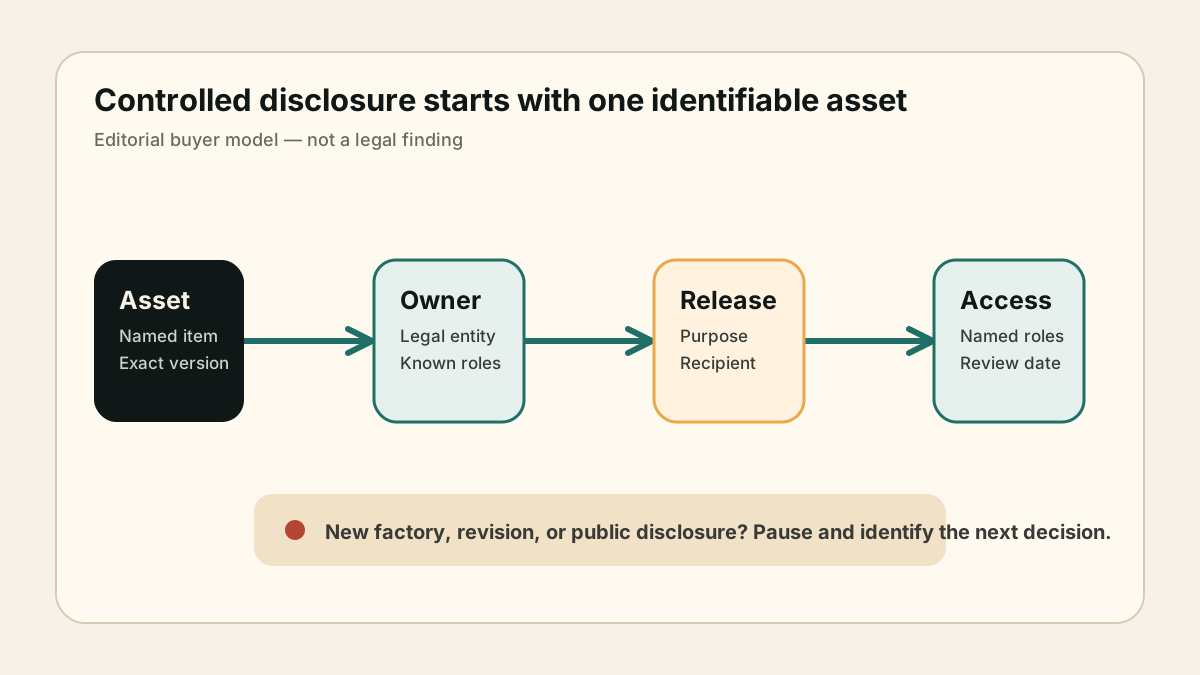
Editorial asset map. It is an information-governance model, not a legal validity or ownership finding.
A contract is a hand-off point, not a substitute for control
A well-scoped agreement can be important. It can also conceal a weak process when it is signed after the sensitive CAD package, customer forecast, or test recipe has already moved through personal inboxes and informal chat groups. The operational question is simple: can the buyer show the path of the material before, during, and after the signature?
China’s Civil Code contains a relevant but limited fact for the pre-signature stage. Article 501 says that parties who learn trade secrets or other confidential information while concluding a contract must not disclose or improperly use it, whether or not the contract is formed. The provision appears in the official Civil Code text. That does not tell you whether your proposed document works, what an individual clause means, or what remedy follows from any facts. It does reinforce why the period before a formal production agreement deserves its own record.
Make the pre-contract file small enough that people will use it. For each disclosure, preserve the recipient’s full legal entity name and the people or systems given access; the source and version; the stated business purpose; the channel; whether onward sharing is allowed; and the next time the permission is reviewed. If a sales contact changes employer, an engineering team opens a new shared drive, or a prototype moves to a different site, update the file rather than silently assuming the original scope followed it.
This is compatible with ordinary sourcing discipline. The same entity matching that helps you verify a factory’s quotation, payment instructions, and production address in the China manufacturing guide also helps avoid sending valuable information to a brand label, sales office, or affiliate when the intended recipient is a different legal entity. It is not a verdict on any group structure; it is a reason to ask the next factual question before you send more.
The minimum hand-off record
Use a living record, not a one-time intake form. A simple system can include:
- a rights-and-entity map that distinguishes brand, seller, contracting party, design owner, inventor or creator, customer, and any license holder;
- a release register with a unique file name or version, the approver, recipient legal entity, named team, purpose, and transfer channel;
- an access list that shows who can view, edit, export, print, or pass on the material—and when that access ends;
- a change log for new factories, subcontracting requests, new tooling, revised firmware, new sales channels, or a change in customer involvement;
- a return, deletion, archival, or retention record at the end of the relevant work; and
- an escalation note that records what has happened without asking a sourcing manager to decide a legal question.
The principle is proportionate control. A broad product photo in a public catalogue does not need the same treatment as an unreleased calibration tool. A supplier who only needs a form factor to quote may not need the full source package. A factory building a pilot may need different material than a repair partner. The aim is not to create a surveillance system; it is to make disclosure purposeful, limited, and traceable.
Separate the asset from the legal route
The file should prompt three different conversations rather than forcing all assets into a single “IP” bucket.
Confidential information and process know-how. Ask what is non-public, why it has commercial value, who is allowed to know it, and how the team will show that the boundaries were actually used. The statutory trade-secret definition makes those questions relevant; it does not resolve them for your facts.
Patentable technical work. Ask who created the technical work, where it was accomplished, whether development continues in China, and whether there is a proposed filing or overseas disclosure date. CNIPA’s reference translation of the Patent Law says a foreign enterprise without a habitual residence or business office in China must entrust a legally established patent agency for patent matters. The same text’s Article 19 says an invention or utility model accomplished in China must go through confidentiality examination in advance before filing abroad. See CNIPA’s Articles 18 and 19. Those are procedural facts, not a direction to file—or proof that a particular design qualifies. Treat them as a reason to bring qualified patent advice in before publication, overseas filing, or technical disclosure locks the team into a path.
Names, logos, and product identity. List the English name, Chinese characters, transliterations, logo variants, legal owner, intended goods or services, markets, and first commercial use separately from the product drawings. CNIPA’s guide states that China adopts a first-to-file trademark rule, while noting limited protection for certain earlier-used marks. The guide’s explanation is here. That is why brand naming should not wait until a container is ready to ship. It is not a finding that your mark is available or that an exception applies.
For a foreign company without a business domicile in China, CNIPA’s March 2026 guidance says it must entrust a lawfully established trademark agency for Chinese trademark registration and other trademark matters. Read CNIPA’s current foreign-applicant guidance. Put that statement next to the entity and naming map—not in a checklist labeled “file now.” A qualified professional needs the actual owner, names, intended categories, territories, timing, prior use, and commercial plan to advise on a route.
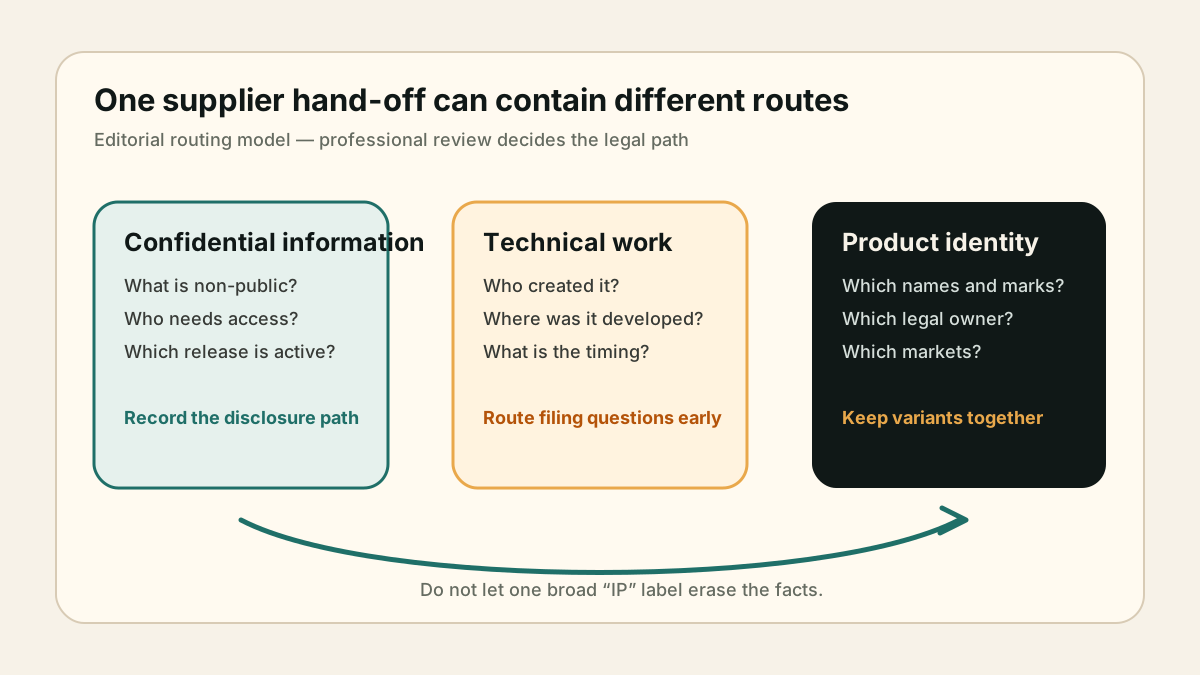
Editorial routing map. It does not determine an asset’s legal status, filing availability, or enforceability.
Build the controlled disclosure file
The best operational control is usually the one a busy product and sourcing team can repeat. WIPO’s trade-secret management guidance gives useful examples: marking sensitive material, keeping access records, using controlled storage, managing the document lifecycle, and using confidentiality obligations with internal and external parties. Its detailed management guide is here. WIPO also says that what counts as reasonable depends on the information and circumstances, and that exact protection can vary by country and contract. Its shorter protection overview makes that limitation explicit.
That is a better model than copying a long list of restrictions into every supplier email. Choose controls that match the material and leave a coherent trace:
- Decide before you disclose. Give the material an owner, version, sensitivity level, recipient, purpose, and expiry or review date. If a technical question is still open, send the minimum needed for the next decision instead of the whole archive.
- Release by role, not by relationship label. “Our factory” can include sales, engineering, production, procurement, tooling, contract manufacturers, repair partners, and subcontractors. The file should identify who needs access and which onward sharing, if any, is authorized. A relationship title is not an access rule.
- Keep the version tied to the commercial event. Link the file release to the RFQ, prototype build, tooling approval, pilot, change order, or shipment milestone it supports. If the design changes, do not let an old share link silently become the operative document.
- Treat tools and data as their own categories. A physical fixture, test script, cloud credential, source repository, production dashboard export, and approved sample may each require a different owner, custodian, access rule, and return path. Do not make a single “tooling is ours” statement carry every one of those meanings.
- Close the loop. When a quote ends, a supplier changes, a pilot is stopped, or a project moves to production, record what remains in use, what is returned or deleted, what must be retained, and what has not been confirmed. A missing confirmation is a reason for a follow-up—not a basis to invent certainty.
This file also makes quality and IP controls easier to keep distinct. A nonconforming sample may trigger the defect-control and containment path described in quality control for Chinese factories. It does not by itself prove misuse of a drawing or a right. Conversely, a concern about access to a sensitive file does not establish that a shipped product has a quality defect. Separate the facts first; qualified advisers can then assess the relevant path.
Make the file work at RFQ, pilot, and production
The file becomes useful when it follows the product through ordinary decisions. At RFQ stage, the commercial team may only need a controlled product brief, a dimensional envelope, expected annual volume, and a high-level quality requirement. If a supplier needs a detailed tolerance stack, full firmware image, customer list, or a unique test method to quote accurately, record why that higher-sensitivity material is necessary and who has approved the release. “They asked for it” is not a decision record.
At the prototype stage, connect each release to the build. Which drawing revision drove the sample? Did the supplier create a derivative fixture or test routine? Was a new individual, lab, toolmaker, or subcontractor introduced? A recurring failure in manufacturing programmes is that the product team keeps a design history while the sourcing team keeps a vendor history and neither can identify the version that crossed the boundary. A shared release ID can bridge that gap without adding a new bureaucracy.
At pilot and production, the important changes are usually ordinary: a second mould, a substitute component, an overseas warehouse, a new repair partner, a different assembly site, a cloud-based test platform, or a revised packaging name. These are not automatically IP incidents. They are moments when the working assumptions may have changed. The operating owner should update the file and identify which review is needed: engineering for revision control, procurement for the recipient and commercial route, information-security or IT for systems and credentials, and qualified advisers where a legal or filing decision is implicated.
Avoid turning each change into a stop-work event. Use tiers. A low-sensitivity catalogue image may be released through a normal marketing workflow. A controlled drawing can require a versioned link and named recipients. A source archive, confidential test recipe, unreleased product identity, or work that may need patent advice can require a smaller group, a clear business purpose, and pre-release review. The appropriate level depends on the material and relationship; it is not a universal risk score.
This is also where smart-manufacturing controls can help without becoming a claim about a supplier’s software. If a product revision, test asset, or tooling instruction is already connected to a live change-control record, the buyer has a clearer starting point for understanding what was used on the line. If it is only attached to an untracked chat message, a sophisticated dashboard elsewhere in the factory does not restore the missing chain. The question remains concrete: can the team identify the version, recipient, purpose, and next decision for this product event?
Do not confuse commercial leverage with ownership clarity
Commercial power can make a supplier responsive, but it is not an ownership record. A buyer might have paid for development, tooling, samples, or an exclusive run and still need to separate what those payments covered from the identities, files, materials, and rights in question. Likewise, a supplier’s willingness to sign a broad clause does not identify whether a sub-supplier, design contractor, test house, or repair network needs access to part of the same information.
Keep the commercial and technical questions adjacent without merging them. The sourcing file can record quotation entity, payment entity, site, price, lead time, and supply commitments. The information-control file records the asset, release, access, and version. A qualified professional can assess whether and how the documents connect. That separation makes later clarification faster because the reader is not trying to reconstruct a rights story from invoices alone.
It also improves negotiation quality. A buyer who can say, “This is revision C of the calibration procedure; it is being released to this entity for pilot build 2; onward disclosure needs approval; the next review is after test completion,” gives a supplier a usable operating instruction. A buyer who says only, “All our IP is protected,” creates uncertainty at the exact point where a factory needs to know what it may use to perform the work. Clear limits are usually easier to follow than broad warnings.
Use production changes as a test of the system
The calmest time to discover a gap is when the product changes, not when a conflict starts. Build a short trigger list into the manufacturing cadence:
- a request to involve a different plant, subcontractor, toolmaker, lab, repair partner, or cloud service;
- a new or revised drawing, CAD model, BOM, firmware branch, test method, mould, fixture, packaging file, or customer-facing name;
- a proposed overseas patent filing, public product launch, crowdfunding page, trade-show display, or public technical presentation;
- a new legal entity on the quotation, invoice, payment instruction, shipment documents, or supplier portal;
- a change in who owns the customer relationship, tool, sample, design contribution, or corrective-action record; or
- a concern that a file, credential, sample, or commercial dataset has moved outside the planned group.
Each trigger should open the same sequence: pause any further unnecessary disclosure; preserve the current facts without editing the history; identify the asset, owner, recipient, version, and channel; contain access where the team has authority to do so; and seek the right qualified advice for the legal, contractual, filing, security, or employment question. The key word is identify. Do not ask an operations team to decide infringement, validity, jurisdiction, or remedy from a chat screenshot.
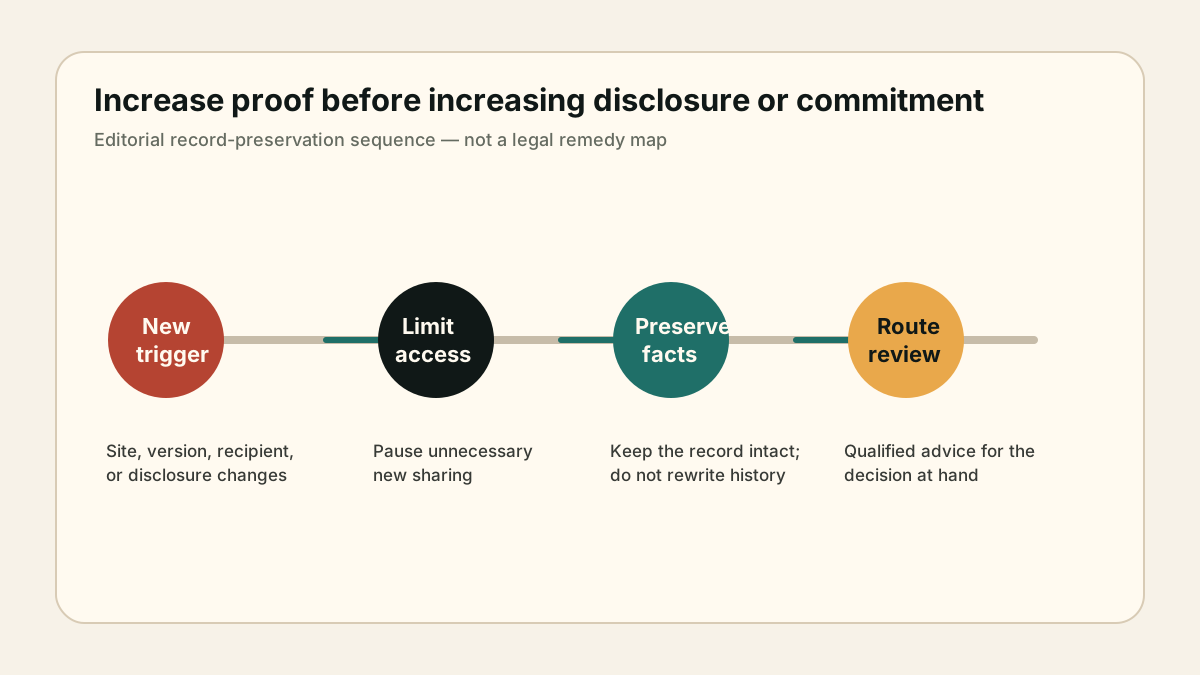
Editorial escalation sequence. It is a record-preservation and decision-routing model, not advice on a particular legal remedy or investigation.
The buyer file to prepare before counsel is needed
When a lawyer, patent agent, trademark agency, insurer, customer, or senior decision-maker asks what happened, a short factual packet is more useful than a long narrative. Keep it current enough to answer these questions:
| Question | Record to prepare |
|---|---|
| What is the asset? | File or item name, version, description, and why it matters to the product or business |
| Who owns or controls it? | Legal entity, creator or inventor information where relevant, customer or licensor role, and unresolved ownership points |
| What was shared? | Release register, recipient legal entity and individuals, source/version, purpose, channel, and onward-sharing permissions |
| What control existed? | Access list, storage location, approval history, confidentiality notice or agreement reference, and change log |
| What changed? | Timeline of prototypes, tooling, product revisions, sites, entities, names, public disclosures, and production events |
| What is the immediate decision? | Whether to disclose, pause, launch, file, investigate, preserve evidence, or obtain qualified advice |
If the relationship is still early, use the file to reduce the next disclosure. If production is live, use it to connect change control with the data and assets involved. If a dispute or suspected misuse is in view, stop treating the file as a sourcing project and obtain prompt, qualified advice. The outcome will depend on facts the public sources cannot decide: the governing documents, entities, technical history, access, jurisdiction, language, timing, and evidence.
Method and limitations
This desk-research article uses the current 2025 Anti-Unfair Competition Law text, an official Civil Code text, CNIPA’s published patent and trademark materials, and WIPO’s general trade-secret guidance. It does not review a supplier, contract, product, filing, technical package, dispute, or court record. It does not provide legal advice, assess enforceability, or recommend a filing, agreement, counterparty, or remedy.
Use it to prepare a controlled factual record for a manufacturing relationship. Before you sign, file, publish, disclose, transfer, investigate, or make an accusation, have qualified advisers review the specific facts and the current rules that apply.