
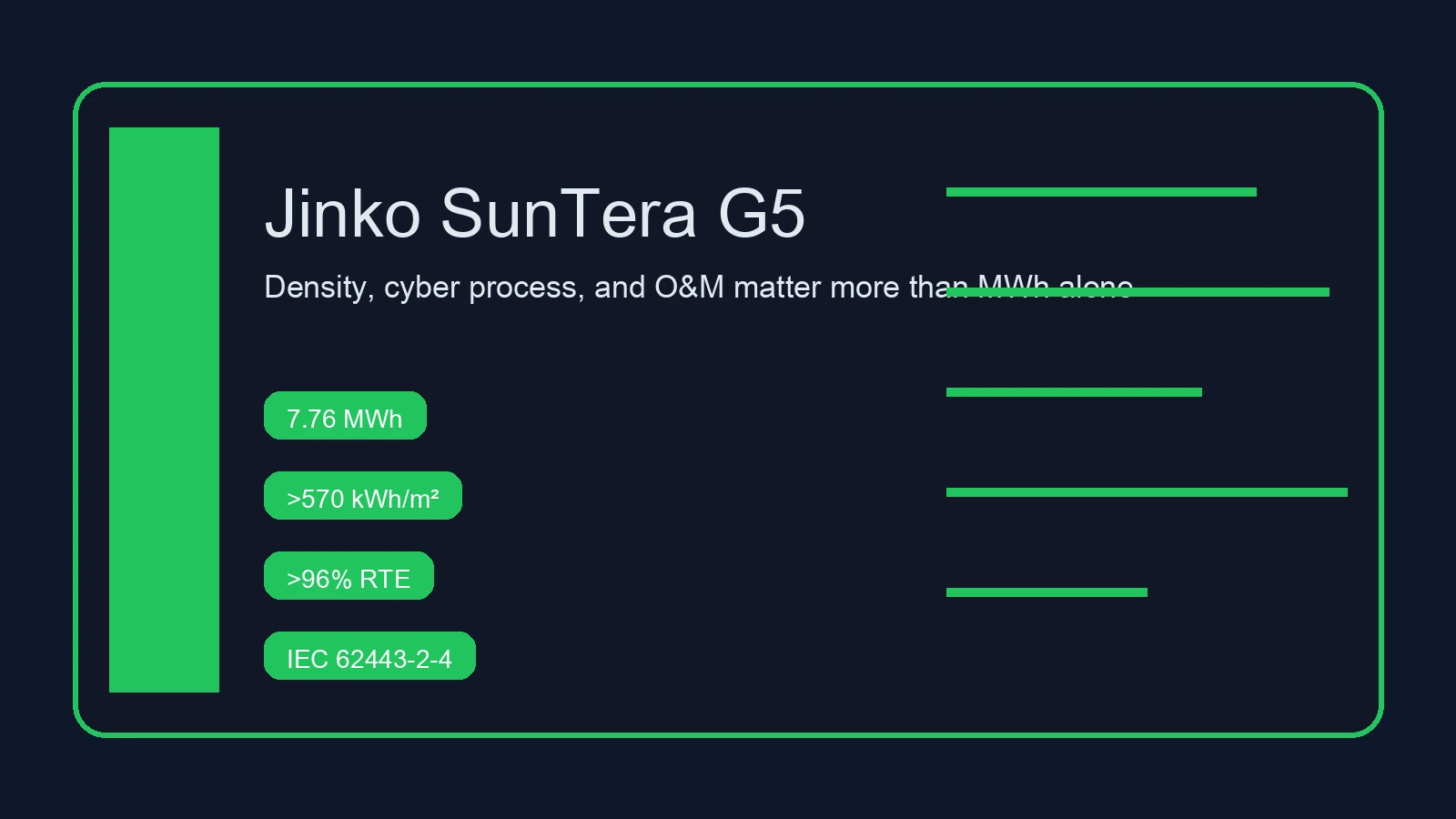
The battery storage headline from JinkoSolar's June 2 SNEC briefing was easy to spot: the company launched the SunTera G5, a 7.76 MWh utility-scale energy storage system based on a standard 20-foot container footprint.
The more useful buyer story sits underneath that number.
Jinko said the SunTera G5 reaches more than 570 kWh per square meter of areal energy density, more than 96% round-trip efficiency, and a 25-year life target with state of health at or above 70%. It also said the system integrates AI-based battery health prediction, proactive fault alerts, and intelligent O&M optimization for use cases including industrial parks, renewable integration, AI data centers, and grid-side storage. In parallel, the company has been building its ESS credibility outside product launch season: Jinko's North American ESS business won IEC 62443-2-4 cybersecurity certification in February, and Jinko said in its Q1 2026 results that ESS shipments rose significantly year over year to about 1.42 GWh on a proof-of-delivery basis.
That combination turns SunTera G5 into more than a capacity announcement. It is a buyer filter for what now matters in Chinese BESS competition: energy density, land economics, cyber process, and service quality.
Source File
This article was reviewed on 2026-06-30 against JinkoSolar's 2026-06-02 SNEC launch note, Jinko ESS's IEC 62443-2-4 cybersecurity certification release, JinkoSolar's Q1 2026 results, and related site work in China Battery Storage Boom: Grid-Scale BESS Explained and CATL's Xiamen Storage Testbed Is a Bankability Signal. The article treats SunTera G5 density, efficiency, AI O&M, lifecycle, and cyber claims as diligence inputs, not as automatic project bankability or cybersecurity approval.
Quick Answer
| Buyer question | Practical answer |
|---|---|
| Is SunTera G5 mainly a “bigger box” story? | No. The useful signal is the combination of density, RTE, AI O&M claims, and Jinko's effort to look more credible on cyber process. |
| What should buyers verify first? | Land-use savings, thermal and degradation assumptions, alarm quality, remote-access rules, and service ownership. |
| Why does cyber matter here? | Storage increasingly sits inside critical infrastructure and AI-data-center power stacks. Secure lifecycle process now affects bankability. |
| Does 7.76 MWh alone make it a better buy? | No. Higher density helps only if the site really has land, interconnection, or balance-of-plant constraints that value compactness. |
| What is the evergreen bridge? | China Battery Storage Boom: Grid-Scale BESS Explained and CATL's Xiamen Storage Testbed Is a Bankability Signal explain why buyers now need a station-level diligence file, not just a cell or cabinet spec sheet. |
What Jinko Actually Announced
Jinko's SNEC release included four claims that matter for utility and C&I buyers.
| Claim | Jinko's position | Why buyers should care |
|---|---|---|
| 7.76 MWh in a standard 20-foot format | Higher capacity per footprint | Land-constrained sites and some urban or industrial projects may value compactness more than pure nameplate. |
| >570 kWh/m² areal density | “World-leading” density framing | Higher density changes civil works, internal layout, and spacing assumptions, but also increases diligence pressure on thermal and maintenance design. |
| >96% round-trip efficiency | Higher operating economics | Small efficiency gains matter at utility scale only when modeled against actual duty cycle, PCS losses, ambient conditions, and revenue stack. |
| AI O&M + health prediction | Better reliability and lower manual intervention | The benefit depends on alarm precision, data ownership, patching, and operator workflow, not on AI branding alone. |
Density Is Useful Only When It Solves A Real Constraint
The storage market still overuses a lazy metric: more MWh must be better.
That is wrong in the same way “more W per module” can be wrong in solar. Density only matters if it removes a binding constraint.
| Site condition | Why density matters | Why it may not matter |
|---|---|---|
| Urban or industrial land constraint | More MWh per footprint can reduce civil footprint and improve project fit. | If the site already has abundant land, density may not deserve a premium. |
| Interconnection window is fixed | Higher energy in the same footprint can help optimize duration and dispatch economics. | If revenue is power-limited rather than energy-limited, the extra density may not improve returns much. |
| Retrofit behind-the-meter site | Compact layout can simplify siting around existing buildings and infrastructure. | Existing fire-separation rules or access lanes may erase some density advantage. |
| AI data center energy design | Compact storage can help where land near load is valuable. | If the main bottleneck is transformer, switchgear, or cooling architecture, storage density alone is not decisive. |
A Dense BESS Needs A Better Thermal File, Not A Shorter One
Higher density does not eliminate engineering. It increases the need for engineering clarity.
As storage systems move from generic container sales toward site-optimized systems, buyers need a better thermal and degradation file. The question is not only whether the unit can pass a factory test. The question is how it behaves across cycle profile, ambient temperature, augmentation assumptions, maintenance access, and fault-isolation scenarios.
This is exactly the lesson from CATL's Xiamen Storage Testbed Is a Bankability Signal. Station-level evidence matters because the real problem in BESS is not getting cells into a box. It is proving how the box behaves in the field.
| Dense-BESS diligence area | Buyer question |
|---|---|
| Thermal management | What ambient range, cycle rate, and heat-rejection assumptions support the performance claims? |
| Service access | Does higher packing density complicate inspection, replacement, or fault isolation? |
| Fire strategy | How are detection, suppression, segregation, and emergency response handled at system level? |
| Augmentation path | How will capacity retention and replacement planning work through years 10, 15, and 20+? |
| Availability modeling | What outage assumptions are embedded in the revenue model? |
The AI O&M Pitch Is A Process Story
Jinko said SunTera G5 uses AI for battery health prediction, proactive fault alerts, and intelligent O&M optimization.
That is not inherently trivial. In storage, earlier warning on imbalance, thermal drift, or component failure can change response time and reduce downtime. But buyers should treat “AI O&M” as a process claim, not as a software badge.
The useful questions are operational:
| AI O&M claim | Operational question |
|---|---|
| Health prediction | What failure modes can be predicted with evidence, and what is the false-positive rate? |
| Proactive alerts | Who receives the alert, how fast, and what is the human playbook after the alert? |
| O&M optimization | Which maintenance tasks are actually deferred, reduced, or scheduled more accurately? |
| Reliability improvement | Is there field evidence, or only model logic? |
| Data collection | What telemetry leaves site, and who can access raw or derived asset data? |
Why The Cyber Certification Actually Matters
Jinko's February certification is easy to ignore because it predates the SunTera G5 launch. Buyers should not ignore it.
The IEC 62443-2-4 certification validates secure development lifecycle practices for industrial control system service providers. Jinko said the scope covers threat modeling, risk assessment, vulnerability management, patching, secure supply chain, and lifecycle management across people, process, and products.
That does not mean every deployment is automatically secure. It does mean the vendor understands that storage is increasingly evaluated like critical infrastructure, not like an isolated battery cabinet.
For utilities, data centers, and regulated industrial users, this changes the supplier conversation.
| Old storage buying question | Better 2026 question |
|---|---|
| How many MWh fit in the container? | What is the secure lifecycle for telemetry, remote service, patches, and incident response? |
| What is the warranty term? | Who owns the cyber obligations during the operating life of the asset? |
| Can it meet the EPC schedule? | Can it meet utility, lender, and enterprise cyber review without rewriting the project? |
Jinko's Q1 ESS Shipments Give The Launch More Weight
Scale is not everything, but it matters.
In Q1 2026 Jinko said ESS shipments rose significantly year over year to about 1.42 GWh on a proof-of-delivery basis, with a higher contribution from overseas markets supporting gross-margin improvement. That is still much smaller than the scale associated with the largest Chinese storage specialists, but it means Jinko is not presenting SunTera G5 from a zero-base ESS position.
The business context matters for buyers because it affects supplier seriousness.
| Business signal | Buyer implication |
|---|---|
| Rising ESS shipments | The storage business is not only a side story attached to modules. |
| Overseas-heavy contribution | Buyers should expect the company to optimize for markets with stricter utility, service, and compliance expectations. |
| Integrated solar-plus-storage strategy | Jinko is trying to sell platform value, which can help some buyers and lock in others. |
Buyers Need A Vendor-Boundary Checklist
Once a supplier sells module, storage, monitoring, and service together, buyers need to define the vendor boundary more clearly.
| Boundary question | Why it matters |
|---|---|
| Who controls firmware and patch approval? | Storage assets have long lives and growing cyber expectations. |
| Who owns analytics and raw telemetry? | AI O&M depends on data access and retention. |
| Who handles fault escalation? | A dense utility BESS failure can involve EPC, owner, PCS, EMS, and vendor simultaneously. |
| Can the buyer swap layers later? | Lock-in risk rises when storage, software, and service are bundled. |
| What happens if remote connectivity is restricted? | Some enterprise buyers will not accept always-on external access. |
A Practical BESS Buyer Checklist
Before shortlisting SunTera G5, buyers should ask for written evidence in these areas:
| Diligence area | Minimum answer |
|---|---|
| Land economics | Show the actual footprint and civil-cost benefit versus lower-density alternatives. |
| Thermal behavior | Provide ambient, cycling, and service assumptions behind density and efficiency claims. |
| Degradation | Explain how the 25-year SOH target is modeled and what augmentation plan is assumed. |
| O&M workflow | Define who sees alerts, who acts, and what the expected false-positive burden is. |
| Cyber lifecycle | Provide patching, vulnerability response, access control, and vendor remote-support rules. |
| Integration boundary | Clarify responsibilities across battery, PCS, EMS, EPC, and owner operations. |
| Alternative option | Compare against a lower-density or simpler system that might fit the project with less complexity. |
Buyer Takeaway
Jinko's SunTera G5 should not be read as just another “bigger storage box” announcement. The real signal is that Chinese BESS competition is moving toward a higher bar: compactness, software-assisted O&M, and increasingly explicit cyber-process language.
That is useful for buyers, but only if they answer the right questions. Does higher density solve a real site constraint? Are the thermal and degradation assumptions transparent? Can the AI-O&M stack be governed in your security model? Is service ownership clear over a 20-plus-year asset life? If those answers are strong, the product is worth serious review. If not, 7.76 MWh is just a brochure number.
Methodology
This article is based on JinkoSolar's 2026-06-02 SNEC launch note, Jinko's IEC 62443-2-4 certification release, and JinkoSolar's Q1 2026 results. It connects those sources to prior site analysis in China Battery Storage Boom: Grid-Scale BESS Explained, CATL's Xiamen Storage Testbed Is a Bankability Signal, China battery storage boom, and Sungrow's Grid-Forming Proof and Europe Factory Matter for Buyers.
Claim Confidence File
| Claim | Confidence | Evidence boundary |
|---|---|---|
| JinkoSolar SunTera G5 density claims are useful screening signals for BESS buyers | Medium-high | Based on company/product materials in the article; project-level performance still needs contract documents and bankability review. |
| Higher energy density automatically lowers delivered project risk | Low | The article treats density as one variable alongside safety, degradation, warranty, thermal design, certification, and service. |
| Buyers should request certifications, PCS/EMS compatibility, warranty terms, degradation curves, and project references | High | This is a procurement checklist conclusion rather than a contested market statistic. |
| The article independently validates field performance for every SunTera G5 configuration | Low | The evidence boundary is public product/source material, not a multi-year field test. |
FAQ
Does 7.76MWh make SunTera G5 automatically better than lower-density BESS?
No. Higher density helps when land, civil works, interconnection, or behind-the-meter footprint is the binding constraint. If the project is not footprint-constrained, thermal behavior, safety, service, and cost may matter more than density.
Why does cybersecurity matter for a battery storage container?
Utility BESS increasingly depends on telemetry, remote service, patching, AI O&M, and integration with critical infrastructure. A cybersecurity process claim affects bankability only when the buyer can verify access control, patch workflow, vulnerability response, and incident ownership.
What should buyers request before shortlisting SunTera G5?
Request the site layout comparison, thermal assumptions, degradation model, fire-safety file, O&M workflow, cybersecurity lifecycle documentation, service owner, and a simpler baseline product for payback comparison.