

The useful thing about Solis at SNEC 2026 is not that it had another full-scenario storage booth in Shanghai.
The useful thing is that Solis put three buyer files next to each other: residential certification, installer-friendly battery packaging, and C&I control-layer consolidation. That combination matters more than the launch language because European storage buyers are not only asking whether a Chinese inverter brand can sell them a battery. They are asking whether the same supplier can make the certification, installation, monitoring, upgrade, warranty, and support boundaries legible enough to reduce project risk.
Solis' own SNEC PV+ 2026 release says `IntelliHome` and `FlexHome` received the `TUV SUD Mark` for the European market, while `EverCore` uses a separated DC-AC architecture and folds PCS, PV grid connection, on/off-grid switching, and intelligent energy management into one control system. That is a procurement story, not just a product story.
Source File
| Source | What it supports | Why it matters |
|---|---|---|
| Solis SNEC PV+ 2026 release | TUV SUD Mark claim for IntelliHome/FlexHome and EverCore positioning | Primary launch source for the article |
| SolisStorage IntelliHome page | Residential storage-inverter and battery configuration details | Helps buyers map certification claims to quoted residential systems |
| SolisStorage EverCore page | C&I integrated PV-storage product scope | Primary product source for EverCore architecture |
| EverCore global flyer PDF | Capacity, PCS/PV/STS/EMS integration, protection ratings, and scalability claims | Datasheet-level source for buyer diligence |
| PV Magazine residential storage coverage | Third-party context on the Solis residential storage portfolio | External check on vendor launch language |
Quick Answer
| Buyer question | Practical answer |
|---|---|
| What changed at SNEC 2026? | Solis tied `TUV SUD Mark` residential storage, a broader home battery lineup, and `EverCore` C&I integration into one storage-platform story. |
| Why does that matter? | European buyers can read the launch as a trust, commissioning, and support-boundary file rather than another booth recap. |
| What products matter most? | `IntelliHome`, `FlexHome`, and `EverCore`; the important object is the whole storage operating stack. |
| What should buyers verify? | Certification scope, grid-code fit, installer training, firmware/OTA ownership, monitoring access, spare parts, and warranty counterparty. |
| Evergreen bridge | Read this with China Solar Dominance: Supply Chain Power, Profit Crisis, Deye Inverter Buyer Risk: Warranty and Sol-Ark, Hoymiles Microinverters: Company and Warranty Map, and importing solar panels from China. |
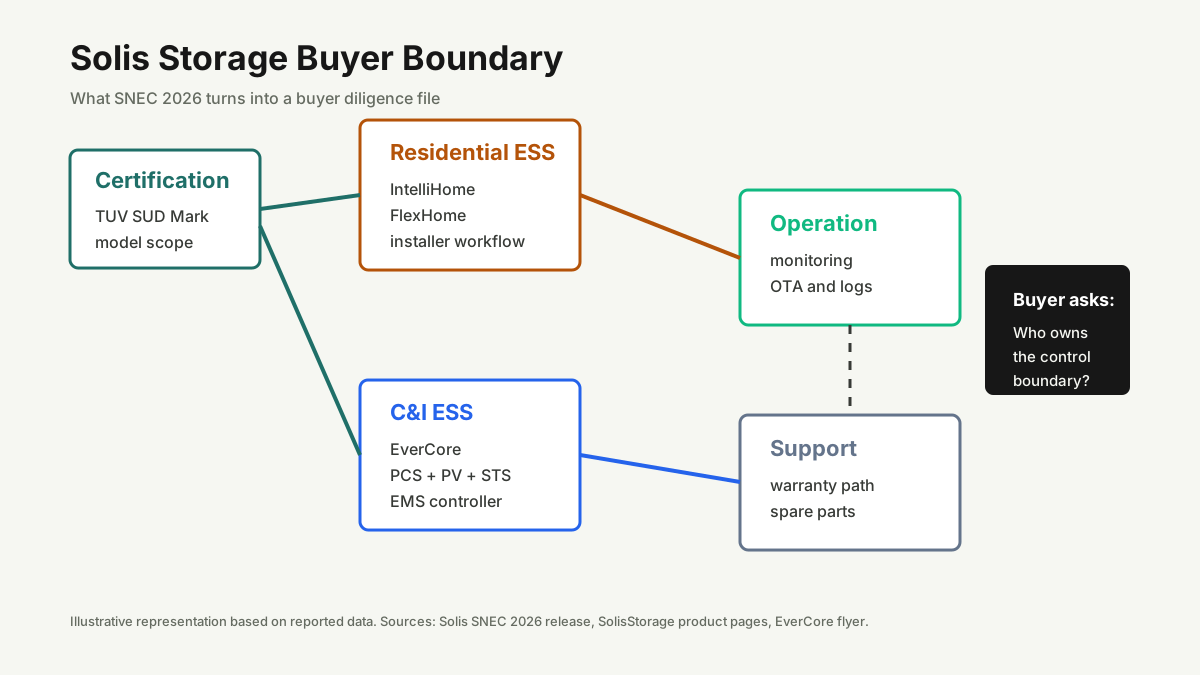 Source: China Made & Tech analysis based on Solis SNEC 2026 release, SolisStorage product pages, and Solis EverCore flyer.
The Protagonist Is Not A Battery. It Is Solis Trying To Become A Storage Counterparty
The protagonist here is Solis itself. The company has long been easier to understand as an inverter brand than as a complete storage-system supplier. That distinction matters because the buyer job changes as soon as a supplier moves from "box with a datasheet" to "system that touches the house, grid, cloud, installer, and support desk."
The desire is clear: Solis wants to be treated as a safer integrated storage choice for residential and C&I buyers, especially in Europe. The obstacle is equally clear: Europe is a trust market. A low price or broad product catalog is not enough if the buyer cannot prove certification scope, country-level grid compatibility, service availability, firmware update behavior, and who answers when an installer cannot commission a system.
That is why the TUV language in the SNEC release matters. A certification mark is not a magic shield. It does not answer every grid, installer, warranty, or cybersecurity question. But it gives buyers a more concrete starting point than a vendor statement that a product is "safe" or "European ready." It moves the discussion from brand promise to testable documentation.
The environment around this story is the larger shift described in China Solar Dominance: Supply Chain Power, Profit Crisis. Chinese solar advantage is no longer only module scale or low-cost assembly. It increasingly shows up in power electronics, storage systems, battery packaging, monitoring software, and the ability to push a product family through international certification and channel training quickly. Solis is one example of that shift.
What The TUV SUD Mark Does And Does Not Prove
Solis said at SNEC that `IntelliHome` and `FlexHome` received the `TUV SUD Mark` after testing and evaluation for the European market. That is the strongest residential signal in the launch because it speaks to the first trust barrier: can this storage product be assessed by an independent testing body under a recognizable European-market framework?
For a buyer, the certification claim should trigger a document request, not a celebration. The practical question is not "does the product have a TUV badge?" The practical question is "which exact model, firmware version, inverter pairing, battery configuration, protection rating, and intended market does the mark cover?"
This distinction matters because Solis' residential portfolio is not one product. The SolisStorage IntelliHome page describes IntelliHome as a residential "storage inverter + battery" solution with 5 kWh, 10 kWh, and 16 kWh battery options paired with 5-20 kW low-voltage storage inverters. PV Magazine's March 2026 coverage of the Solis residential storage portfolio reported that the broader new battery lines use LFP chemistry, support 90% depth of discharge, and are designed around cycle-life and battery-management claims. It also described FlexHome as a low-voltage stackable system with IP66 protection and a 5-40 kWh range in roughly 5 kWh steps.
That gives buyers a better inspection map. The useful diligence file now has at least four layers:
| Layer | What Solis is signaling | What a buyer should request |
|---|---|---|
| Certification | TUV SUD Mark for IntelliHome and FlexHome | Certificate number, covered models, test scope, valid markets, and expiry or revision conditions |
| Battery platform | LFP residential storage with multiple capacities | Cell chemistry documentation, BMS behavior, parallel rules, and usable capacity by configuration |
| Inverter pairing | Storage inverter plus battery package | Approved inverter list, grid-code firmware, backup behavior, and country-specific commissioning notes |
| Post-install operation | SolisCloud, remote monitoring, OTA, support | Data ownership, installer account permissions, update policy, warranty process, and spare-part path |
The Residential Story Is About Installer Risk
Residential storage fails commercially when the system is technically acceptable but operationally messy. European installers do not only need a battery that passes tests. They need a repeatable commissioning path, clear error codes, firmware that does not create surprise truck rolls, and a distributor or manufacturer that can resolve edge cases before the customer loses confidence.
That is why IntelliHome and FlexHome should be read through installer economics. A storage system that looks cheap on the quote sheet can become expensive if it requires repeated site visits, if the installer has to interpret unsupported battery/inverter combinations, or if the monitoring platform hides the data needed to diagnose faults.
Solis' SNEC release says the residential products were developed around safety, electrical performance, grid compatibility, rapid commissioning, and intelligent energy management. That is the right problem set. But the buyer should still separate three things:
- Certification evidence: documents that prove the tested product scope.
- Installation evidence: manuals, wiring rules, training materials, and country-specific commissioning workflows.
- Operational evidence: monitoring permissions, OTA change logs, warranty response, and spare-part availability.
The third layer is often underweighted. It is also where Deye Inverter Buyer Risk: Warranty and Sol-Ark remains relevant. With distributed energy hardware, buyers are not only choosing an inverter or battery. They are choosing a long-lived control relationship with a manufacturer, a distributor, a monitoring platform, and a support workflow.
EverCore Moves The Same Problem Into C&I
The C&I side of the launch makes the control issue more explicit. Solis introduced `EverCore` as a commercial and industrial energy storage system meant to reduce installation complexity and improve long-term operation. The EverCore product page describes a PV-storage integrated unit for 230 VAC three-phase C&I systems, with 60-75 kW output and 100 kWh storage capacity in one listed series. It says the system combines PCS charge/discharge, grid-connected PV generation, off-grid diesel generator switching, EMS, and energy storage.
The EverCore global flyer adds more procurement-relevant detail. It describes integrated PCS, PV, STS, and EMS under one centralized controller, backup switching under 10 ms, IP66 inverter protection, IP55 cabinet protection, C5 anti-corrosion protection, and scalability up to 1.25 MW / 15.66 MWh. It also lists 100.5 kWh, 120.6 kWh, and 261.2 kWh rated energy capacity options in the datasheet.
Those numbers are useful because they reveal the real buyer promise. Solis is not merely saying "we sell C&I storage." It is saying a buyer can collapse several integration decisions into a pre-integrated architecture:
| Procurement object | Traditional friction | EverCore-style promise | Buyer risk that remains |
|---|---|---|---|
| PCS and PV integration | Separate design and compatibility checks | Integrated power electronics | Verify field performance, service access, and country-level grid settings |
| Backup switching | Extra equipment and coordination | Sub-10 ms switching claim in flyer | Confirm supported loads and switching behavior under real site conditions |
| Thermal management | Heat and service complexity | Separated airflow and cabinet design | Validate derating, cleaning schedule, and high-temperature operation |
| Scaling | Multi-vendor system design | Parallel and AC/DC expansion path | Check controller limits, warranty coverage, and commissioning responsibility |
| O&M | Fault diagnosis across vendors | Centralized control and monitoring | Confirm who owns alarms, logs, firmware, and escalation |
Why The SNEC Timing Matters
SNEC launches can become noise because every booth produces a "full-scenario" or "whole ecosystem" message. Solis' event is worth covering only because it connects to a live market pressure. Residential storage buyers in Europe are more skeptical than they were during the early battery boom. Installers have learned that warranty, commissioning, firmware, cloud access, and battery/inverter compatibility can decide whether a system is profitable to sell.
At the same time, C&I buyers want fewer project interfaces. A factory, business park, farm, warehouse, or small industrial campus may need PV self-consumption, backup power, generator integration, peak shaving, and monitoring, but it may not have the internal engineering team to manage a complex bespoke architecture. That creates space for Chinese inverter brands to move up the stack.
This is the same strategic pattern visible in other China storage stories on the site. Hoymiles Microinverters: Company and Warranty Map shows how a power-electronics company becomes more than a component supplier when it controls product families and channel trust. China Solar Dominance: Supply Chain Power, Profit Crisis explains why the next stage of Chinese solar power is not only volume but also system integration. Solis fits both patterns.
The turning points are straightforward:
- Solis built global recognition around inverters and installer channels.
- The company launched a broader SolisStorage residential battery portfolio in early 2026.
- At SNEC 2026, it put European certification and C&I integration into the same storage narrative.
That progression is more useful than another SNEC recap because it shows the direction of travel: from inverter sale to storage counterparty.
What English SERP Still Misses
English coverage of this launch mostly repeats the public claims: TUV certification, full-scenario storage, EverCore, residential systems, and Europe. That is fine as news. It is thin as a buyer file.
The missing analysis is not hidden in one secret document. It is in the way the documents should be assembled. A buyer needs the official SNEC release, the product pages, the datasheet or flyer, third-party industry coverage, and the local distributor's support terms in one file. Without that, the launch becomes an attractive but incomplete marketing claim.
A useful buyer file should answer:
- Does the certification cover the model and configuration being quoted?
- Is the battery/inverter pairing approved for the country and grid code?
- Who can change firmware settings after installation?
- What data does the installer retain if the end customer changes installer or distributor?
- How quickly can the buyer get replacement modules, PCS parts, gateway hardware, or warranty approval?
- What happens if SolisCloud, a local distributor portal, or an installer account becomes the bottleneck?
- Which claims are universal product claims, and which are market-specific launch claims?
This is why the article belongs in a storage procurement path rather than only a news path.
Buyer Checklist: What To Audit Before Treating Solis As A Safer Shortcut
For a European residential buyer, ask for the certificate package before the quote becomes final. That package should identify the exact IntelliHome or FlexHome model, applicable inverter models, firmware assumptions, installation conditions, and country-level grid requirements. If the seller cannot map the certificate to the quoted configuration, treat the certification claim as incomplete.
For installers, request the commissioning workflow. The key questions are practical: how many account types exist, who can see battery data, how OTA updates are approved, whether the customer can move monitoring access between installers, and how Solis handles failed updates or misconfigured backup settings.
For C&I buyers looking at EverCore, ask for a system responsibility matrix. The matrix should name the party responsible for PCS, battery cabinet, STS, EMS, cloud monitoring, diesel-generator interface, fire-safety integration, grid settings, and spare parts. A pre-integrated system is valuable only if the responsibility matrix is simpler than a multi-vendor system.
For distributors, test the support counterparty. Does Solis support the market directly, or is the buyer dependent on a local distributor's inventory and technical staff? Which parts are stocked locally? What is the replacement process? Does the warranty start from shipment, commissioning, or customer handover?
For analysts and serious readers, do not overread the launch. The SNEC file shows Solis trying to become a more complete storage supplier, but it does not by itself prove European market share, field reliability, or bankability. Those require installed-base data, installer feedback, warranty history, and country-level channel evidence.
Reader Judgment
The correct takeaway is not "Solis is now safer because it has TUV certification." That is too simple.
The better judgment is that Solis has made its storage ambition more auditable. IntelliHome and FlexHome give residential buyers a certification-centered starting point. EverCore gives C&I buyers a clearer integrated-system object to evaluate. The launch is useful because it turns a broad storage portfolio into a checklist of documents, responsibilities, and operating boundaries.
For a buyer, the decision is not whether Solis had a good SNEC booth. The decision is whether Solis can reduce the number of parties you must coordinate without making the control layer harder to exit later.
Claim Confidence File
| Claim | Confidence | Evidence boundary |
|---|---|---|
| Solis TUV-linked storage claims can strengthen a buyer file when matched to exact SKUs and certificates | Medium-high | Supported by the article's cited product/certification materials; buyers still need certificate numbers and local-code review. |
| A TUV reference makes every storage deployment compliant | Low | The article treats certification as SKU- and jurisdiction-specific, not a blanket approval. |
| Procurement should connect datasheet, certificate, warranty, firmware, and after-sales entity | High | This is the buyer-control logic of the article. |
| The article independently validates long-term field failure rates | Low | It does not claim a private fleet reliability dataset. |
Methodology
This article uses Solis' official SNEC PV+ 2026 release, the SolisStorage IntelliHome product page, the SolisStorage EverCore product page, the EverCore global flyer PDF, and PV Magazine's March 2026 residential storage coverage. Claims are treated as vendor claims unless independently documented by a certification body, customer project, or third-party field data.
Frequently Asked Questions
Does TUV SUD Mark mean Solis storage is automatically approved across Europe?
No. It is a useful trust signal, but buyers still need the certificate number, covered models, firmware assumptions, inverter pairing, battery configuration, intended market, and country-level grid-code documents.
Why does EverCore matter for C&I buyers?
EverCore matters because it combines PCS, PV grid connection, switching, EMS, and storage into one integrated system claim. That can reduce interface friction, but only if the buyer can verify the responsibility matrix and support boundary.
What should installers ask before selling IntelliHome or FlexHome?
Installers should ask for commissioning workflows, supported inverter/battery combinations, monitoring permissions, OTA update rules, warranty process, local spare-parts availability, and what happens if customer ownership or installer access changes.
Is Solis now a complete storage-system supplier?
Solis is clearly moving in that direction, but buyers should treat the SNEC launch as an auditable starting point rather than proof of long-term field reliability. Installed-base data and warranty history still matter.