

The useful part of Growatt's SNEC 2026 story is not that the company had a large booth or a broad storage portfolio.
The useful part is that Growatt is trying to make a mid-market commercial energy project look less like five vendor workstreams and more like one deployment file. That is a more important claim than another "solar + storage ecosystem" slogan because factories, business parks, commercial buildings, and small industrial sites often do not have the engineering capacity to stitch together PV, battery, diesel backup, smart loads, monitoring, warranty, and service from scratch.
Growatt's SNEC 2026 recap highlighted residential storage, balcony storage, C&I storage, smart energy management, and EUPD Southeast Asia recognition. The buyer signal is the `RISE 261H-XH` C&I system. Growatt says it integrates solar, battery, and diesel generator access, uses a 261kWh LFP battery, supports 10 MPPTs, switches on/off grid within 10 ms, and scales up to 1.25MW / 2.61MWh.
That is not only a spec list. It is an attempt to own the C&I interface.
Source File
This article was reviewed on 2026-06-30 against Growatt's official SNEC 2026 recap, the Growatt RISE 261H-XH product page, PV Magazine's May 2026 RISE 261H-XH specification coverage, EUPD Group's Top Brand PV methodology page, and related site work in China Solar Dominance: Supply Chain Power, Profit Crisis, China Battery Storage Boom: Grid-Scale BESS Explained, and Deye Inverter Buyer Risk: Warranty and Sol-Ark. The article treats Growatt's integration, switching, generator, monitoring, and brand-recognition claims as buyer-diligence prompts, not independent field validation or bankability proof.
Quick Answer
| Buyer question | Practical answer |
|---|---|
| What changed at SNEC 2026? | Growatt put its integrated solar + storage story around `RISE 261H-XH`, residential storage, balcony storage, and monitoring rather than only inverter hardware. |
| Why does that matter? | The strongest buyer value is reduced project-interface friction for C&I sites that need PV, storage, backup, and smart energy management. |
| What numbers matter? | 261kWh LFP battery, 50/63/85/125kW output versions, 10 MPPTs, 10 ms switching, 95% depth of discharge, and scaling to 1.25MW / 2.61MWh. |
| What should buyers verify? | Generator integration, monitoring access, backup behavior, thermal design, installer training, warranty boundaries, and service response. |
| Evergreen bridge | Read this with China Solar Dominance: Supply Chain Power, Profit Crisis, China Battery Storage Boom: Grid-Scale BESS Explained, Deye Inverter Buyer Risk: Warranty and Sol-Ark, and importing solar panels from China. |
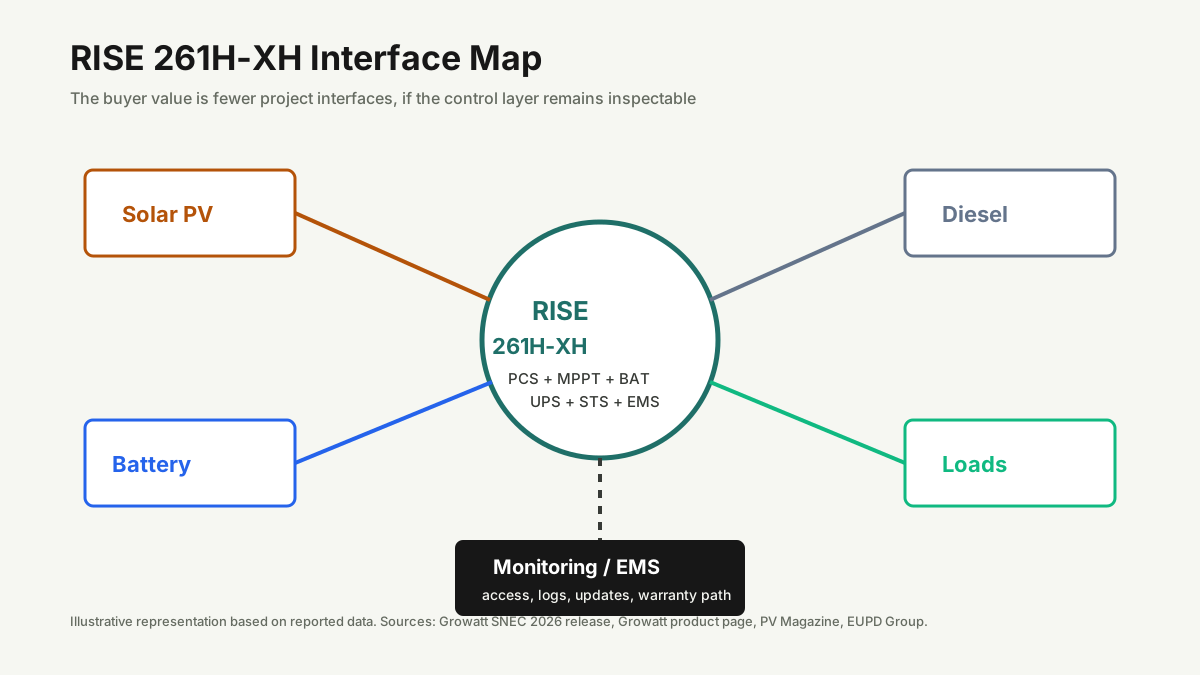 Source: China Made & Tech analysis based on Growatt SNEC 2026 release, Growatt product page, PV Magazine reporting, and EUPD methodology page.
The Protagonist Is A Channel-Heavy Inverter Brand Moving Up The Project Stack
The protagonist is Growatt. Its desire is to be treated not only as a distributed inverter supplier but as an integrated distributed-energy solution provider. Its obstacle is trust at the project boundary. A buyer may believe Growatt can sell hardware. The harder question is whether Growatt can reduce site-level coordination without making the buyer dependent on a closed control layer that becomes difficult to troubleshoot or exit.
This matters because the environment around Growatt is changing. In distributed solar, the margin and differentiation are moving from simple inverter boxes toward storage, software, monitoring, installer support, and lifecycle service. That is the same pattern behind China Solar Dominance: Supply Chain Power, Profit Crisis: Chinese solar strength is increasingly about the surrounding energy hardware stack, not only panels.
Growatt's SNEC event gives the story two useful turning points. First, the company launched `RISE 261H-XH` in May 2026 as a named all-in-one hybrid energy storage system for C&I deployment. Second, at SNEC it placed that system inside a broader booth narrative that included residential storage, balcony energy, C&I storage, smart energy management, and regional brand recognition.
That makes the launch more useful than a generic booth recap. It shows where Growatt wants the buyer to see the company: not at the component edge, but at the project interface.
Why RISE 261H-XH Is The Real Signal
The RISE 261H-XH product page is more revealing than the SNEC headline. It describes an all-in-one system built around readiness, integration, safety, scalability, and ease of handling. The page lists UPS and black start, pre-commissioning for C&I scenarios, a fully integrated `PCS+MPPT+BAT+UPS+STS+EMS` system, intelligent monitoring, aerosol fire extinguishing, and scalability up to 1.25MW / 2.61MWh.
PV Magazine's May 2026 coverage adds details that turn those claims into a buyer checklist. It reported that the system comes in 50kW, 63kW, 85kW, and 125kW output configurations on the same 261kWh storage platform. It also reported a 261kWh LFP battery based on 3.2V / 314Ah cells, 95% depth of discharge, liquid cooling for the battery, smart air cooling for the PCS, a cell temperature-difference target within 3 C, 100% three-phase unbalanced backup-load support, and 160% rated AC overload capacity for 10 seconds.
Those details show why the article belongs in a buyer-file lane. The system is not just a battery cabinet. It is trying to combine:
| Interface | Growatt's integrated claim | Buyer diligence question |
|---|---|---|
| Solar input | 10 MPPTs and high PV input options | Does the design fit the site's roof/string layout and future expansion? |
| Battery | 261kWh LFP, 95% depth of discharge | What degradation and warranty terms apply under daily cycling? |
| Backup | UPS, black start, 10 ms switching | Which loads are supported, and under what transfer conditions? |
| Diesel hybrid | Generator/AC-coupled input | Is the generator logic field-tested and documented for the buyer's use case? |
| Controls | PCS, MPPT, battery, UPS, STS, EMS | Who can access logs, change settings, and approve firmware updates? |
| Scaling | Up to 10 units, 1.25MW / 2.61MWh | How does warranty and commissioning work in multi-unit systems? |
This Is A Deployment-Speed Story More Than A Chemistry Story
The chemistry is not the main point. LFP is expected in this category. The stronger signal is packaging.
Growatt is trying to make the system easier to move, connect, commission, and monitor. Its product page says the unit is pre-commissioned, supports whole-cabinet transportation, and can be handled by forklift or crane. PV Magazine reported the cabinets measure 1,400 mm x 2,150 mm x 1,300 mm, weigh 2.6 tons, operate from -25 C to 55 C, tolerate up to 95% relative humidity, operate up to 3,000 meters altitude, and carry an IP55 ingress protection rating.
Those are practical details for C&I buyers. A factory energy manager may care less about the elegance of the battery stack than whether the equipment fits the yard, can be delivered without unusual handling, survives local heat and humidity, and can be commissioned without a long shutdown.
That is the deployment-speed story. The product is aimed at a buyer who wants:
- Solar self-consumption without a bespoke engineering project.
- Backup power without building a separate UPS architecture.
- Diesel hybridization without creating a control mess.
- Peak shaving and time-of-use management without hiring a full energy-control team.
- Monitoring that can explain the system to both the owner and installer.
That also means the buyer should not let the supplier hide behind "all-in-one." The phrase is useful only if it lowers installation and service friction. If it merely shifts complexity into a proprietary dashboard, the buyer has not reduced risk; it has relocated risk.
The EUPD Signal Is Channel Trust, Not Technical Certification
Growatt's SNEC release also highlights recognition from EUPD Research in Southeast Asia. That is worth mentioning, but it should be read correctly.
EUPD's own Top Brand PV page explains that its awards are based on market research and installer-focused brand assessment, not on a technical product test in the way a safety certification would be. EUPD says it analyzes brand image and reaches solar installation companies through its installer monitor process.
That makes the signal useful for channel trust. It suggests Growatt has installer awareness and market presence in the region. It does not prove that RISE 261H-XH performs as claimed, that every country has adequate spare parts, or that the buyer's project will be bankable.
The correct buyer use is:
| Signal | What it can support | What it cannot prove |
|---|---|---|
| EUPD recognition | Installer awareness, brand perception, regional channel credibility | Product safety, field reliability, warranty performance, or system bankability |
| SNEC booth | Current product direction and strategic messaging | Installed project outcomes |
| Product page | Claimed configuration and feature set | Country-specific commissioning success |
| PV Magazine report | Useful third-party summary of disclosed specs | Independent field testing |
| Buyer references | Real operating evidence | Only valid if comparable site conditions exist |
Balcony Storage And Residential Products Extend The Installer Relationship
RISE 261H-XH is the strongest C&I signal, but the smaller products in Growatt's SNEC story also matter. The company highlighted balcony storage, residential storage, and smart energy management. Those products may not decide a factory project, but they help explain Growatt's channel strategy.
Distributed energy is relationship-heavy. An installer who sells a residential battery, balcony system, or small commercial package becomes familiar with the monitoring platform, warranty process, training materials, and support escalation path. That familiarity can help a brand move into bigger jobs. It can also create lock-in.
The buyer should therefore ask a broader question: is Growatt winning because its hardware price is attractive, because the installer channel already knows the software and support path, or because the integrated package genuinely reduces project risk?
This is the same structural issue raised in Deye Inverter Buyer Risk: Warranty and Sol-Ark. The hardware spec is only one part of the purchase. The app, cloud, support counterparty, update cadence, and channel control can become the real risk layer.
What English SERP Still Misses
Most English results around Growatt still treat the company as either a price-driven inverter brand or a generic distributed-solar supplier. That misses the more useful buyer question: what happens when a Chinese inverter brand tries to own more of the C&I project interface?
The missing source file is not one hidden report. It is a combined reading of the SNEC recap, RISE product page, PV Magazine's specification summary, EUPD's award methodology, and the buyer's own site constraints.
For a C&I buyer, the key search result should not only answer "what is RISE 261H-XH?" It should answer:
- Which project interfaces does it collapse?
- Which risks remain outside Growatt's responsibility?
- Is the 10 ms switching claim relevant to the buyer's loads?
- Can generator integration be configured by local installers?
- What does monitoring reveal to the owner versus installer versus distributor?
- How does multi-unit scaling change warranty, commissioning, and service?
- Does regional brand recognition translate into local support capacity?
That is the difference between a rewritten press release and a buyer file.
The Commissioning Test Should Be Written Into The Quote
The easiest way to misuse Growatt's integrated story is to treat it as a shortcut around engineering diligence. The better use is to turn the integration claim into a commissioning checklist before the purchase order is signed.
For a C&I site, the quote should define which functions will be demonstrated during factory acceptance, site acceptance, and first-month operation. If the project relies on 10 ms transfer, the test should include the exact load class that the buyer expects to protect. If the project relies on diesel-generator access, the test should include generator start, synchronization, load handover, alarm response, and return-to-grid behavior. If the project relies on smart energy management, the test should show exportable logs, owner permissions, time-of-use rules, and failure history.
This is where an all-in-one system can be genuinely useful. It gives the buyer one place to ask for evidence. But it also means vague acceptance criteria become dangerous. A buyer who accepts "solar, storage, diesel, UPS, and EMS are integrated" without defining acceptance tests may discover too late that the feature exists in a brochure but not in the local installer workflow.
The practical procurement move is simple: ask Growatt or the channel partner to attach a commissioning sequence, responsibility matrix, and data-access schedule to the commercial offer. If they can do that cleanly, the integration claim becomes more credible. If they cannot, the buyer should treat the system like a promising component set rather than a turnkey risk reducer.
Buyer Checklist: What To Verify Before Treating Growatt As A Shortcut
For factories, start with the load list. Identify which loads require backup, which loads can shed, which loads are sensitive to transfer time, and whether 10 ms switching is meaningful for the actual process. Do not let a headline switching number replace a load study.
For EPCs, request the generator-integration manual and commissioning workflow. The product is interesting because it includes diesel generator access, but generator control can create edge cases around synchronization, load priority, islanding, and alarm handling.
For owners, ask who holds the monitoring account. If the installer, distributor, and manufacturer all touch the monitoring system, the owner needs data export, permission transfer, and fault-history access in writing.
For multi-unit projects, request a responsibility matrix. It should identify who owns PCS, battery cabinet, STS, EMS, firmware updates, fire-safety integration, thermal alarms, spare parts, and warranty escalation.
For Southeast Asia buyers, separate brand recognition from service coverage. EUPD recognition can support the case that Growatt has channel presence, but buyers still need local spare-part inventory, trained installer lists, response-time commitments, and country-specific grid documentation.
For analysts, watch whether Growatt publishes more project references for RISE 261H-XH. A strong product page is the beginning of the evidence file, not the end.
Reader Judgment
The correct takeaway is not that Growatt showed many products at SNEC. The better takeaway is that Growatt is trying to make C&I energy storage a packaged deployment decision.
That is valuable for the right buyer. A small industrial site or commercial campus may benefit from a pre-integrated system if it reduces engineering work, commissioning time, and support fragmentation. But the same integrated architecture can create dependency if the owner cannot access data, configure controls, change installers, or escalate support outside the original channel.
So the buyer decision is not "is Growatt a known inverter brand?" The buyer decision is "does Growatt's integrated package reduce the number of project risks I must manage, or does it hide them inside a system I cannot inspect?"
Methodology
This article uses Growatt's official SNEC 2026 recap, the Growatt RISE 261H-XH product page, PV Magazine's May 2026 RISE 261H-XH specification coverage, and EUPD Group's Top Brand PV methodology page. Vendor claims are treated as claims unless backed by third-party field evidence, certification documents, customer references, or project operating data.
Claim Confidence File
| Claim | Confidence | Evidence boundary |
|---|---|---|
| Growatt's SNEC 2026 integrated-storage positioning is relevant to distributed ESS buyers | Medium-high | Based on cited SNEC/company materials; availability, certification, and local support must be checked by market. |
| Integrated storage removes installer, warranty, and grid-code risk | Low | The article treats integration as a packaging signal, not as proof of bankability or compliance. |
| Buyers should verify model numbers, certifications, battery compatibility, monitoring rights, and service path | High | This is the article's operational due-diligence recommendation. |
| The article proves final landed cost or incentive eligibility for each country | Low | Those depend on local origin, tariff, tax, and installation facts outside the public product file. |
FAQ
Is Growatt RISE 261H-XH a turnkey C&I storage system?
It is marketed as an all-in-one C&I system, but buyers should treat "turnkey" as something to prove during commissioning. Generator behavior, backup loads, monitoring access, data ownership, warranty boundaries, and installer responsibility still need written acceptance tests.
Why does 10 ms switching matter for a C&I buyer?
It matters only if the protected load actually needs that transfer behavior. Buyers should test the exact load class, generator sequence, islanding logic, and return-to-grid behavior before paying for a backup claim.
Does EUPD recognition prove product reliability?
No. EUPD recognition is useful as a channel and brand signal, especially with installers, but it is not the same as field reliability, safety certification, bankability, or country-specific service coverage.