
By China Made & Tech Team · August 22, 2026
The familiar story of Chinese manufacturing goes like this: a factory begins as an OEM, upgrades into an ODM, then eventually becomes an own-brand manufacturer. It is neat, optimistic, and usually too simple to help with a real product, supplier, distribution, or sourcing decision.
The problem is not that the three terms are useless. The problem is that readers often turn them into a score: OEM is low on the ladder, ODM is higher, and a visible brand is the final proof that a company has “made it.” That reading can hide the question that matters after a quotation arrives: who is responsible for this exact product, in this market, under this agreement?
Guangdong Xinbao Electrical Appliances offers a useful current counterexample. In its 2025 annual-report summary, the Shunde small-appliance company describes export work carried out mainly through OEM/ODM arrangements while also developing domestic own brands. The same disclosure says overseas brand owners handle brand-channel sales and service, while product realization—including R&D, design, and manufacturing—largely sits with Chinese firms. It also describes dedicated own-brand product-definition and marketing teams alongside shared planning, design, quality-control, and logistics resources. Xinbao’s 2025 annual-report summary
That is not evidence that every Chinese appliance producer works the same way. It is evidence that the labels can coexist inside one company. A firm can make a product for another brand, offer a design platform to a customer, operate several names of its own, and rely on shared engineering or supply resources across those activities. The right reader conclusion is not “this company is at stage three.” It is “which role is this company playing in the offer in front of me?”
Start with the national industrial-cluster map and the county factory-town guide for the system that makes these roles possible. Then use this article to keep the system from becoming a shortcut for supplier qualification.
The short answer: these are role bundles, not a universal ladder
For a buyer, the most helpful working definitions are deliberately narrow.
- OEM normally signals that a manufacturer is producing an item for another party’s product program. The other party may supply the design, specification, brand, channel, or some combination of them.
- ODM normally signals that the manufacturer contributes a product design, a reusable platform, or significant development work in addition to production. It does not by itself say who owns every design change, tool, market variation, or certificate.
- Own-brand manufacturing—often called OBM—signals that the manufacturer or its affiliate sells a product under a brand it operates. It does not by itself identify the legal seller, importer, service company, factory, app operator, or contractual remedy for the product you will buy.
Those definitions are a map for questions, not a substitute for an agreement. The same commercial relationship can carry more than one label. A supplier can manufacture an established customer’s design, offer its own platform design to a second customer, and sell a related product under its own name. A brand can own the consumer relationship while using contract producers. A factory can develop a product but license a design or tool on terms that differ across markets.
The dividing line is therefore not prestige. It is the allocation of responsibility.
| Label on the offer | Useful first question | What the label cannot establish by itself |
|---|---|---|
| OEM | Who supplied and controls the product specification for this order? | the exact design owner, tool owner, factory, test scope, or after-sales party |
| ODM | Which parts of the product, tooling, firmware, and change control come from the manufacturer’s platform? | exclusivity, market rights, IP assignment, certification coverage, or freedom to modify |
| own brand / OBM | Which company is making the public promise to the market? | who manufactured this model, which seller is authorized, or how a claim will be resolved locally |
| private label | Which party may use the name, packaging, and product presentation? | that the underlying product, revision, factory, or warranty is exclusive to that label |
| “factory direct” | Which legal entity will take the order and receive payment? | that this entity owns the plant, design, channel, or support obligation |
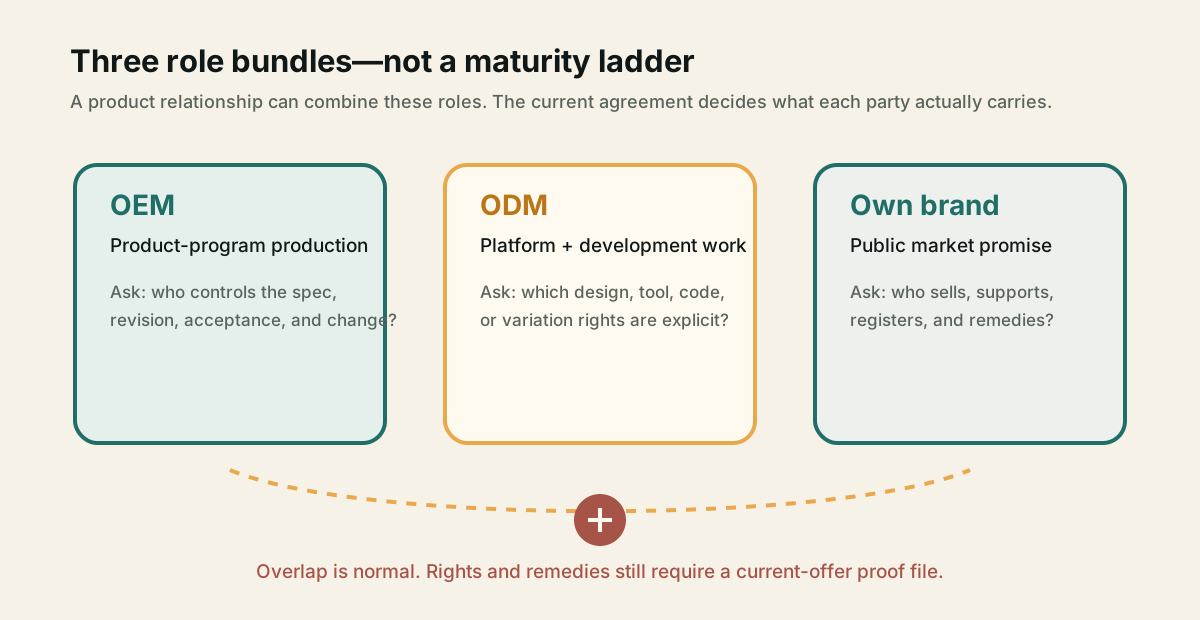
Editorial role map: a company can combine these roles. The current agreement, not the label, allocates the product and commercial responsibilities.
The same product idea can produce three very different offers
Imagine a distributor that wants to sell a compact connected power product in one destination market. The product category is the same in all three conversations, but the working file should change with the arrangement.
In the first conversation, the distributor supplies an approved specification, label artwork, destination requirements, and acceptance criteria. The producer offers to make it. Calling that OEM may be useful, but the critical file is the controlled specification: who approves a component substitution, which tests apply, which revision is being quoted, and what happens if the producer discovers a design issue during production?
In the second conversation, the producer offers an existing platform with a choice of enclosure, capacity, accessories, and software settings. Calling that ODM may be useful, but the critical file becomes the variation boundary: what is already a platform feature, what is buyer-specific, which changes need validation, whether the buyer may sell in a named territory, and whether the producer may offer a substantially similar product elsewhere.
In the third conversation, the distributor is asked to carry the producer’s public brand. Calling that own-brand or OBM may be useful, but the critical file becomes the market promise: who is the authorized seller, which entity holds the warranty, who imports or registers the product, where parts and repairs go, how an app account is created or transferred, and which party must deliver a replacement if the product fails.
These are not three grades of the same relationship. They are three different maps of product control, commercial exposure, and customer responsibility. They can even exist at once. A factory might make a customer-designed version for one buyer, offer a platform configuration to another, and sell a branded sibling product through a distributor. The similarities in hardware do not eliminate the need to document the different rights, channels, and remedies.
That is why price comparisons become misleading when the role map is missing. A lower OEM quote may omit a development task the buyer must carry. An ODM quote may include a platform but not the variation or market rights the buyer assumed. A branded-product quote may include a service promise whose territorial and channel conditions are not attached to the proposed purchase route. Compare the entire documented bundle before comparing the unit price. In a live sourcing decision, the cost of an undefined role often appears after the quoted unit price has stopped being negotiable.
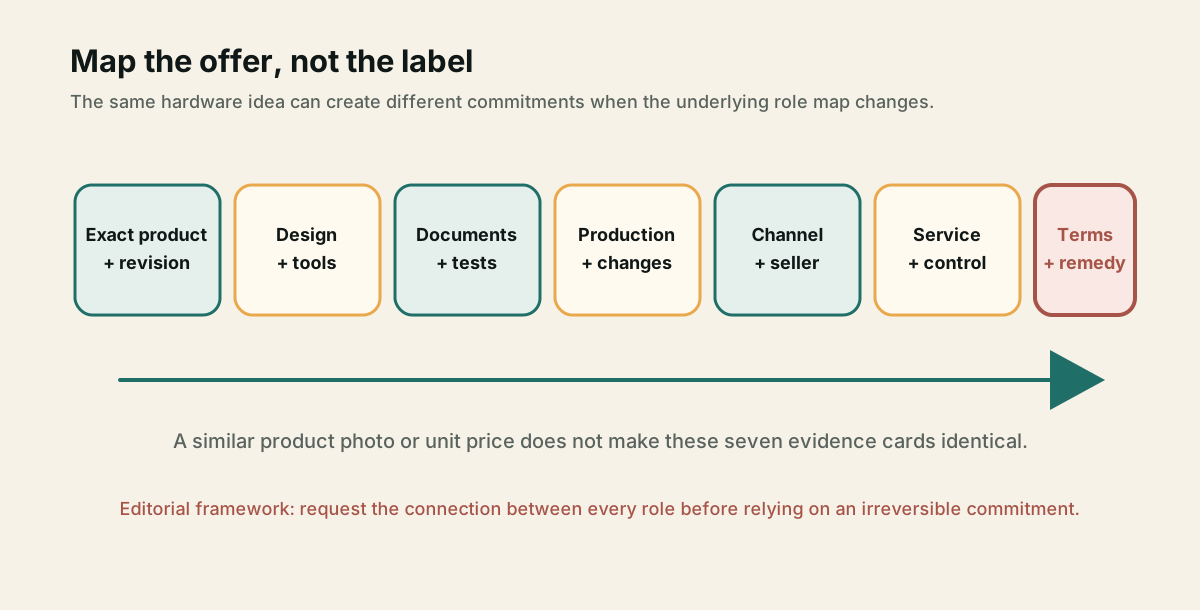
Editorial evidence file: similar hardware and pricing do not make design rights, documents, channel, service, or remedies identical.
Xinbao’s disclosure: a manufacturer can run the models in parallel
Xinbao is a useful protagonist precisely because its public description refuses a clean graduation story. The company says its export business is mainly OEM/ODM. In the same account, it says that international brand owners are responsible for brand-channel sales service while product realization—R&D, design, and manufacturing—takes place in the Chinese production side. It also says the company has been expanding its domestic own-brand business. Read the filing’s business description
That description makes three practical points.
First, a contract-manufacturing relationship can contain deep product work. “OEM” in a trade-show conversation does not tell you whether the factory only assembles a supplied design or also participates in industrial design, development, tooling, validation, and ramp-up. The answer belongs in the specification, development plan, tooling terms, test plan, and change-control process—not in a sales label.
Second, a company’s own brand does not erase its OEM/ODM work. A buyer who sees the name Donlim, Morphy Richards, Barsetto, or another Xinbao-operated brand should not infer that every product offered by the group follows the same supply route, quality system, product revision, country configuration, or support pathway. The relevant question is narrower: which legal entity and product family are named in this offer, and what documents connect them?
Third, operating a brand can reuse manufacturing capabilities without making every capability exclusive to that brand. Xinbao’s filing describes product definition and marketing by dedicated teams, while planning, R&D design, quality control, and logistics are organized as shared resources. That is an operating model. It does not tell an outside buyer who owns a particular mold, whether a product platform is exclusive, or whether a competing label may use a similar configuration. Xinbao’s own-brand section
This is why a buyer should resist the urge to use OEM, ODM, and OBM as identity tags. They are better read as prompts to map the product relationship.
What each model changes in the buyer file
The practical difference appears when a product changes, fails, crosses a border, or reaches a customer. Those moments expose the roles a broad label tends to compress.
OEM: the specification and change-control question
An OEM claim should make a buyer ask: what did the buyer, brand, distributor, or manufacturer actually supply to the product program?
For the exact SKU, request the controlled specification; approved drawings or images where appropriate; bill-of-material or critical-component boundaries; revision history; acceptance criteria; and the process for changing a component, firmware, label, packaging, or test requirement. If a customer supplied a design, identify who may alter it. If the factory proposed improvements, identify who accepts them and whether they become part of the approved product file.
The buyer does not need to own every technical input to obtain a workable product. But the approval path must be visible. A hardware quotation that says “OEM” while leaving the revision, change control, and acceptance criteria unstated is not made clearer by the word OEM.
ODM: the platform, rights, and variation question
ODM can be commercially attractive because it may give a buyer access to a product platform, engineering capability, and faster route to a market-specific configuration. It can also create ambiguity if the buyer assumes that a customized colour, enclosure, accessory pack, firmware screen, or packaging treatment means the underlying design is exclusive.
Ask which elements are the supplier’s existing platform; which elements are developed specifically for the buyer; what changes require new validation; who holds the design records and tools; what happens to those records at the end of the relationship; and whether the product, drawings, code, certification material, or tooling can be reused. Match those answers to the contract and destination market.
For connected hardware, the platform question extends beyond the physical unit. Who maintains firmware? Which app, cloud account, or installer portal is needed? Can the buyer transfer an account? Is a region or network restriction embedded in the configuration? The hidden-hardware-champions evidence file explains why that control layer must be checked separately from the logo on the product.
Own brand: the market promise question
An own brand adds a public-facing commercial layer. Someone must define the product line, choose the market, operate or appoint channels, issue product information, handle registrations or user accounts where relevant, receive complaints, and maintain a route for service, parts, returns, or replacements. The brand can be operated by the manufacturer, an affiliate, a licensee, a regional distributor, or a mix of those entities.
Midea’s 2025 annual report illustrates the scale of that added layer in one stated company case. It reported that overseas OBM revenue exceeded 45% of its overseas smart-home revenue in 2025, and linked that business to self-operated country coverage as well as localized supply-chain, distribution, service, and application operations. The denominator matters: this is a company-reported share of Midea’s overseas smart-home business, not a benchmark for China or a score for any product. Midea’s overseas OBM disclosure
The buyer lesson is simpler than the number: an own-brand operation is not only a design or marketing exercise. It may involve local entities, warehouses, distributors, repair routes, product registration, apps, channel conditions, and a service handoff. Those layers need to be checked against the exact product and country.
Anker’s 2025 half-year report provides a second, bounded channel example. It reported a 67.42% online and 32.58% offline revenue split, including third-party platforms and direct sites. That split is neither a product-quality measure nor a warranty-performance score. It simply makes the route-to-market layer visible: a brand can meet buyers through more than one channel, and a marketplace listing does not by itself identify the party that will carry every post-sale obligation. Anker’s channel table
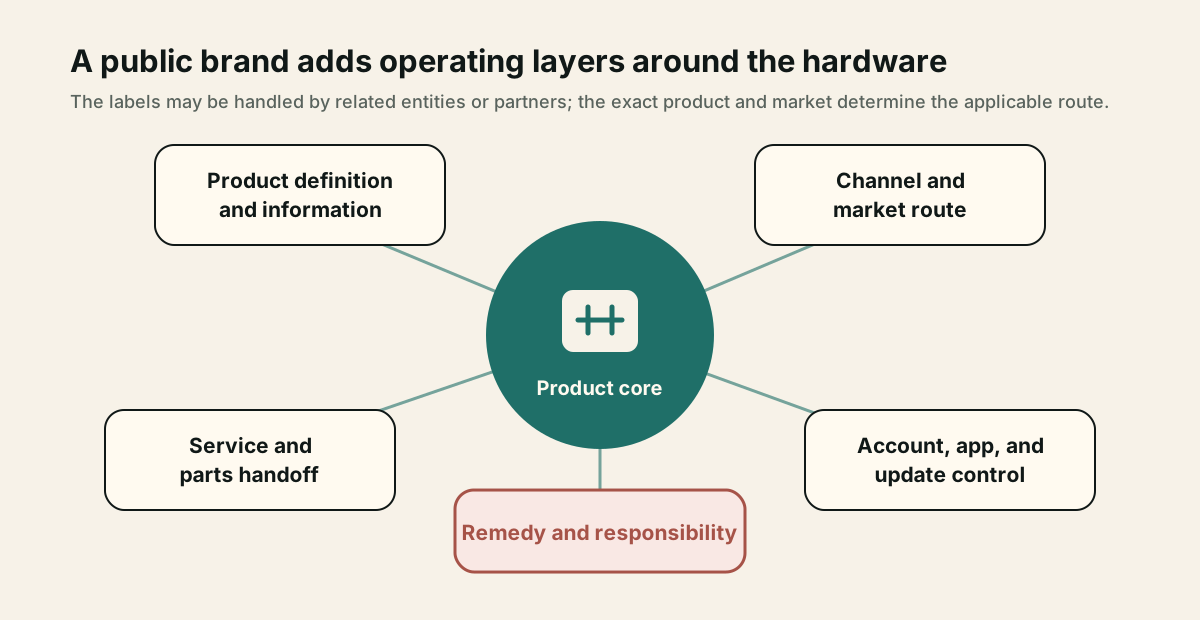
Editorial operating map: the layers around a public brand may involve different entities or partners and must be matched to the exact product and market.
Why the label is no longer enough
The gap between making hardware and operating a hardware product is widening. The product may contain software, a cloud account, an app, a subscription, diagnostics, firmware updates, installer access, remote support, spare-parts systems, or end-of-life responsibilities. An installation or distribution relationship can add training, configuration, data, and compliance duties that are not visible in a product photo.
China’s 2025–2028 service-oriented-manufacturing plan frames this at a policy level: it defines the model as embedding service across a product lifecycle and encourages hardware-plus-software-plus-service industrial arrangements. That policy does not certify a manufacturer or prove that a product is well supported. It is useful because it reinforces the buyer’s practical boundary: the manufacturing label does not complete the product file. The seven-agency implementation plan
This matters most where the physical product is only one part of the delivered system. A robot mower, inverter, storage product, drone, connected appliance, industrial tool, or control board may be assembled perfectly yet still leave a buyer exposed if the account, update path, service entity, product revision, destination configuration, or contractual remedy is unclear.
The same caution applies to an attractive brand story. A well-known name can be a useful discovery lead. It cannot confirm a factory’s relationship to a marketplace seller, a distributor’s authorization, the scope of a document, or the validity of a warranty for a particular purchase route. For a method to investigate those separate layers, see how to find a factory in China and quality control at Chinese factories.
The role map a quotation should make visible
Before comparing prices, map the offer through these questions.
| Role or evidence | Ask for | Why it matters |
|---|---|---|
| legal seller and payee | quotation entity, invoice entity, payment beneficiary, and relationship among them | identifies who is making and receiving the commercial commitment |
| product boundary | exact model, revision, configuration, accessories, labels, and destination market | prevents a product-family page from standing in for the offered unit |
| design and tooling | design source, approved changes, tool ownership or access, platform limits, and exit terms | determines who may change, reuse, or move the product relationship |
| product evidence | test reports, certificates, manuals, declarations, and their holder, model, market, and date | keeps a general document from being applied to the wrong configuration |
| production route | named factory or manufacturing manager where disclosed, critical outsourced processes, and approved change route | separates a sales claim from the actual production path |
| channel and brand | brand owner, authorized seller evidence, importer, territory, and product-registration route | identifies who may sell and support the product in the target market |
| service and control | warranty holder, first service contact, return or repair route, parts plan, app, account, firmware, and data boundary | makes post-sale operation part of the purchase decision |
| remedies | acceptance terms, defect procedure, timing, replacements, credits, and dispute path | converts a sales promise into a commitment that can be used if something goes wrong |
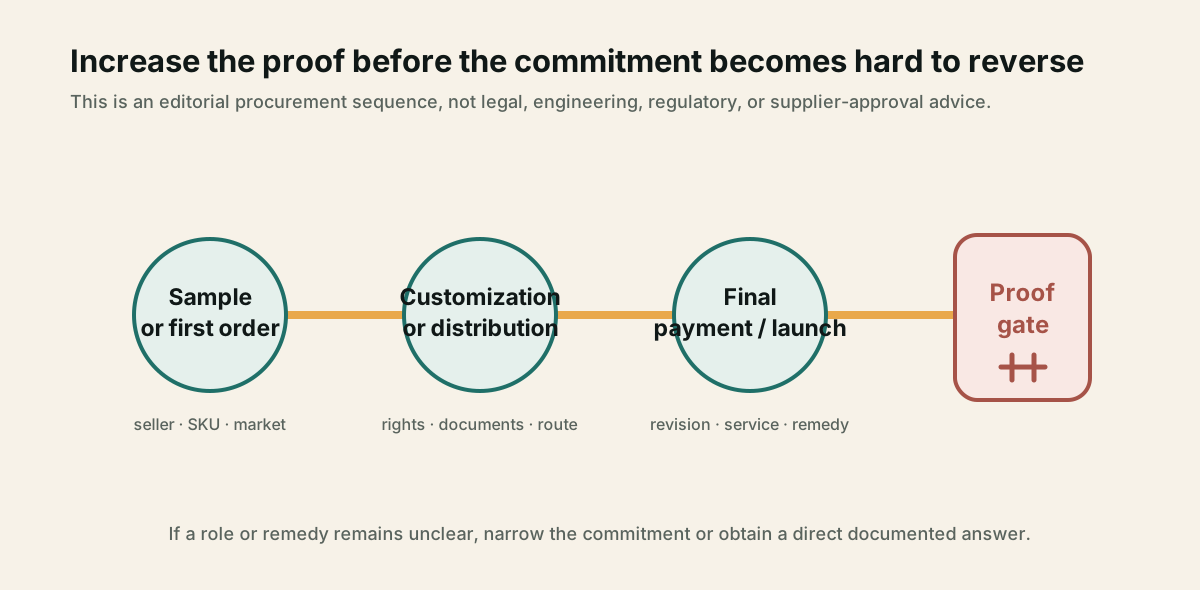
Editorial procurement sequence: increase the proof before a financial, operational, or public-market commitment becomes hard to reverse.
A practical sequence for OEM, ODM, and own-brand offers
Before a sample or first order
- Record the exact SKU, revision where visible, target market, seller, and proposed brand.
- Ask whether the offer is an existing factory platform, a customer-controlled design, a customized platform, or a branded finished product.
- Save the product page, quotation, specification, warranty or returns page, and any app or service information that applies to the actual market.
- Identify the legal seller, invoice issuer, and payment beneficiary before treating a marketplace or brand page as the counterparty.
Before customization, distribution, or tooling spend
- Freeze the product boundary and set a written change-control route for components, firmware, packaging, labels, and testing.
- Separate platform rights from buyer-specific work: document design inputs, tools, code, drawings, model variants, certificates, and rights at the end of the relationship.
- Map the destination-market channel: brand owner, importer, authorized distributor, service provider, installer, or app operator where applicable.
- Put acceptance criteria, test scope, service handoff, parts support, and remedies into the commercial file rather than leaving them in chat messages or promotional pages.
Before final payment or public launch
- Recheck that the serial, lot, revision, documents, labels, market configuration, and service terms match the final product.
- Confirm who receives a claim first, what proof is required, where the product goes, and who decides whether a repair, replacement, return, or credit applies.
- Confirm any account transfer, firmware, software, data, subscription, or remote-service dependency before the product becomes operational.
- Treat an unresolved role as an unresolved commitment. Narrow the order, obtain a written answer, or postpone the irreversible step.
The better way to read China’s manufacturing evolution
Chinese manufacturing systems do make it possible for a company to combine product development, fast iteration, tooling, production, global channels, and a public brand. The cluster map explains the local product ecosystems that can support that combination. But the presence of a cluster, a factory, an ODM capability, or an own brand does not settle the terms of a particular transaction.
The better story is not OEM → ODM → own brand as a universal ascent. It is a continuing rearrangement of roles. A manufacturer may add design services without owning the final brand. A brand may add direct sales without manufacturing every component. A distributor may provide local service without controlling the product change. A platform can add an app or account layer without taking responsibility for the hardware warranty. Each shift creates a new document to read and a new responsibility to locate.
For a buyer, that is good news as well as caution. The labels can help you form sharper questions. They become valuable when they lead to the exact entity, model, market, document, service route, and remedy you will actually rely on.
Method and limitations
This desk-research guide was prepared by China Made & Tech Team from public company disclosures by Xinbao, Midea, and Anker, plus the official 2025–2028 service-oriented-manufacturing implementation plan, reviewed through August 22, 2026. No factory was visited or audited; no supplier, contract, product, tool, app, certificate, customs route, service case, legal entity, or transaction was independently verified.
Company filings describe their publishers’ stated operations and figures. They do not establish the design rights, factory relationship, product quality, channel authorization, warranty performance, or commercial outcome for a reader’s particular offer. OEM, ODM, and own-brand terminology can vary by company and agreement. Recheck the exact product, entity, market, contract, documents, service path, and remedies before relying on a purchase, distribution, installation, sourcing, or product-launch decision.