

The short answer: U.S. entries of Annex I and Annex II unmanned aircraft systems (UAS) covered by the August 13 Section 232 proclamation face their stated duty bands from September 3, 2026. The Annex III component provision begins later, on February 9, 2027. That is a real procurement event, but it is not a shortcut to deciding any particular drone, payload, docking station, spare, or kit. The buyer still needs the applicable tariff classification, a complete configuration record, entry facts, origin and valuation work, and the current agency implementation material. China’s August 5 export-control posture is a separate review; a result on one side does not answer the other.
For U.S.-bound drone orders, the practical object is no longer a model name and a commercial invoice. It is a controlled file. That file must tell a consistent story about what the product is, what is inside it, when it will enter, what tariff treatment is being asserted, who owns the import decision, what China-side export review applies, and what changes would invalidate the earlier answer. The point is not to make an importer perform a customs broker’s or counsel’s job. It is to prevent the far more common failure: treating a policy headline as if it were a classification, a duty calculation, or an export licence.
The U.S. action is especially easy to misread because it combines different Annexes, different dates, scope notes, conditional pathways, and a future implementation mechanism. The China-side measure creates a different kind of confusion: it is often described as a “drone ban,” even though the official notice concerns listed dual-use drones, key components, and related technology subject to a strict U.S.-bound case-by-case posture. Readers who need the China export file itself should start with China Drone Export Controls 2026: U.S. Buyer File. This article concentrates on the additional U.S. importer file.
What changes on September 3—and what waits until February
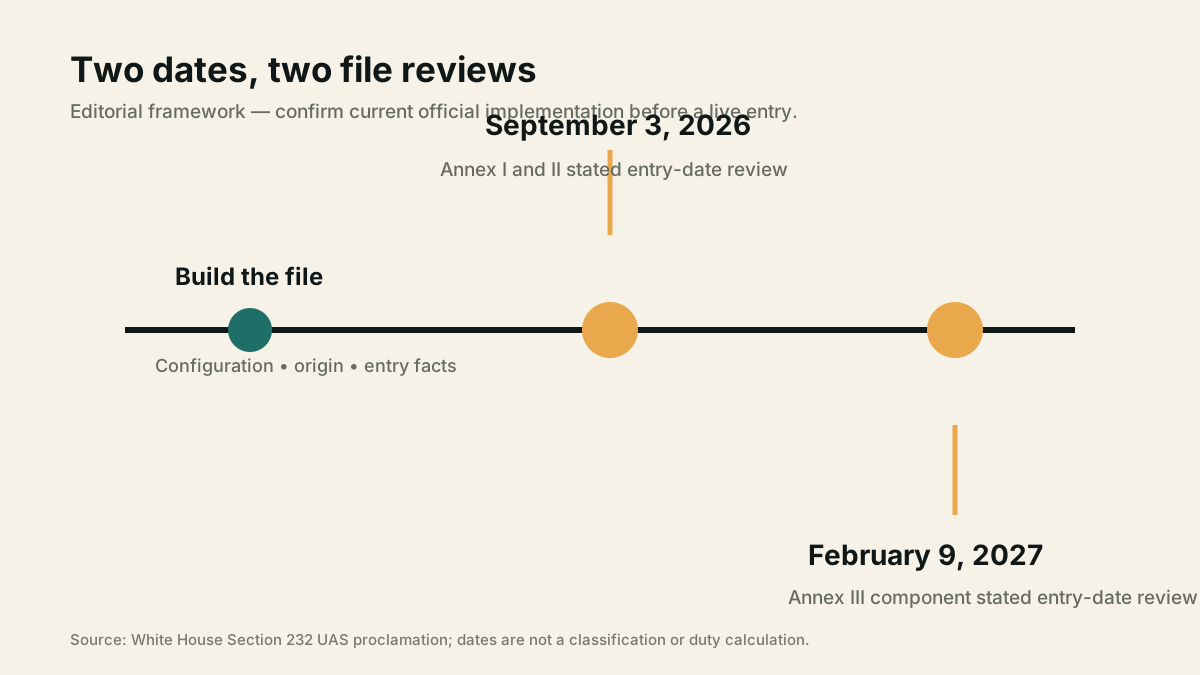
The starting document is the August 13 U.S. proclamation. It says that entries for consumption, or withdrawals from warehouse for consumption, on or after 12:01 a.m. Eastern time on September 3, 2026 receive a 100% Section 232 duty for articles in Annex I and a 25% Section 232 duty for articles in Annex II, subject to the proclamation’s stated clauses. The text separately says the 25% duty for Annex III components begins on February 9, 2027. The contemporaneous Federal Register public-inspection version is useful as a dated copy of the same operative action.
That produces two immediate planning dates, not one generic “drone-tariff date.”
| Decision moment | What the public record says | What the importer must not assume |
|---|---|---|
| Before September 3, 2026 | A buyer can still build the file, confirm commercial terms, and identify the planned entry date. | That a shipment date, factory completion date, or vessel departure alone decides the applicable entry treatment. |
| September 3, 2026 | Annex I’s stated 100% duty and Annex II’s stated 25% duty apply to covered entries or warehouse withdrawals from the specified time, subject to the proclamation’s conditions. | That every UAS, every part, or every Chinese-origin product is in one rate bucket. |
| February 9, 2027 | The Annex III component provision’s stated 25% duty begins. | That a component’s later date answers its intended-use, overlap, tariff-line, value, or entry facts. |
| Any live entry | Commerce may make further HTSUS, end-use-certification, and administrative determinations through Federal Register notice. | That the August 13 text is the last implementation document that needs checking. |
The rate is also not a landed-cost quote. The proclamation says the duties are additional to other duties, taxes, fees, exactions, and charges unless it specifies otherwise. It does not calculate an importer’s final payment obligation for a given transaction. A real entry can involve classification, valuation, origin, applicable trade remedies, other tariff programs, broker filings, and facts that are absent from a purchase-order summary. If a sourcing team needs to model costs, it should ask its customs and trade advisers to model the actual item and entry facts. The business team’s job is to make sure the advisers receive a stable, complete product and commercial record.
The useful planning question is “what enters when?”
This sounds elementary, but it fixes several recurring mistakes.
First, distinguish the item’s planned entry or warehouse-withdrawal moment from the order date, production-complete date, shipping date, invoice date, and arrival date. Those facts can all matter operationally, but the public rule’s effective language is framed around entry or withdrawal. A buyer who wants to manage a goods-in-transit situation should preserve timestamps, carrier documentation, warehouse status, commercial documents, and the exact products in each movement rather than relying on a sales representative’s assurance that goods “left before the tariff.”
Second, distinguish a finished system from separately imported material. A purchase agreement may call everything “the drone system,” while customs-facing documents divide it among airframes, remote controllers, docking stations, payloads, batteries, chargers, spares, repair assemblies, and technical accessories. The Annexes—not a bundle name—are the place to begin the scope review. This is also why a kit’s commercial logic cannot substitute for a part-by-part document map.
Third, do not turn a future date into an exemption. The later Annex III date is a defined timing feature in the public rule; it does not say that every part imported earlier is outside every other provision, nor does it decide how an article is classified. The right internal label is “requires item and date review,” not “safe until February.”
The three Annexes are a scope map, not a shipment answer
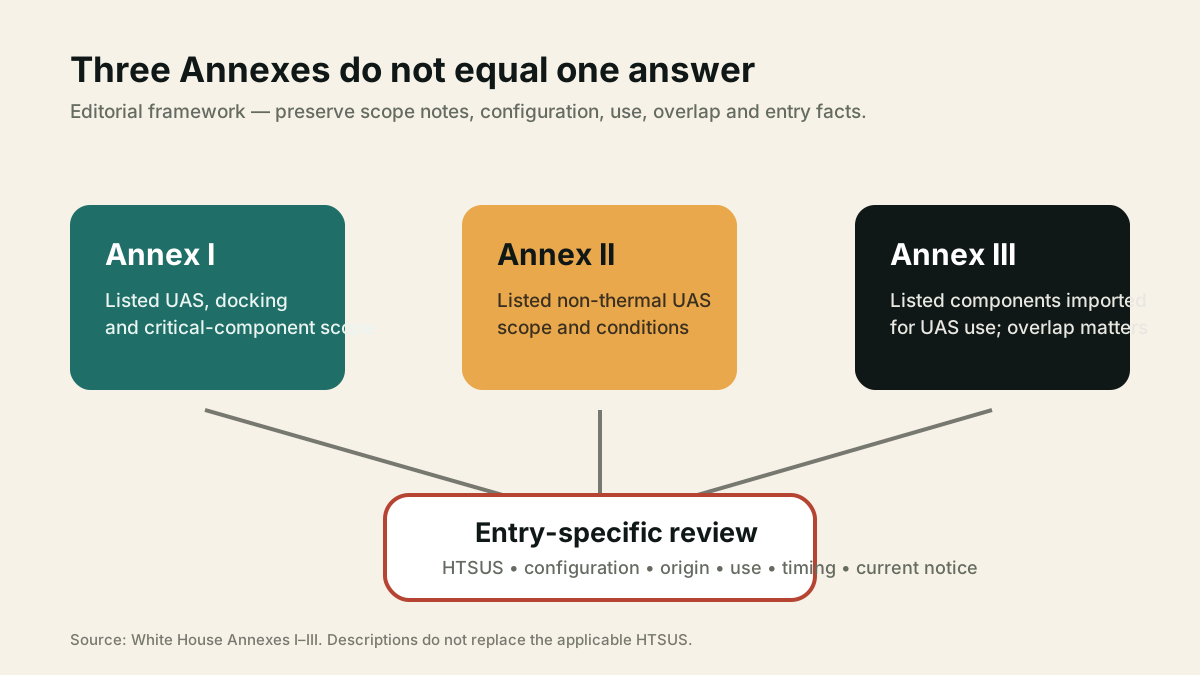
The proclamation points to three different Annexes. They should be read together with their limitations, not paraphrased into a single product category.
Annex I contains the articles subject to the stated 100% rate. Its prefatory note says that the descriptions are provided for convenience and do not supersede the Harmonized Tariff Schedule of the United States (HTSUS). That sentence is a major operational boundary. It tells an importer not to reverse-engineer a binding classification from a plain-English description, product brochure, or weight figure. It also cautions against treating a supplier’s marketing term—“inspection drone,” “industrial drone,” “agriculture drone,” or “thermal drone”—as an entry conclusion.
Annex II identifies a stated 25% category for listed non-thermal UAS in the code ranges and conditions it sets out. Annex III lists articles imported for use in UAS and specifies that an overlap with Annex I receives only the Annex I rate. The details are not decorative. The public materials include differences involving product type, thermal imaging, weight, intended use, code range, and overlap. An importer who reads only a press summary may see “drones and components” and miss the exact boundary that determines whether a fact is relevant.
The following translation is deliberately conservative:
| Annex | Public-rule role | Importer-file question |
|---|---|---|
| Annex I | Identifies listed UAS, docking stations, and critical components for the stated 100% duty from September 3. | Does the proposed entry fit the applicable tariff-line and scope record, including the note that descriptions do not supersede the HTSUS? |
| Annex II | Identifies listed non-thermal UAS in its specified code ranges and conditions for the stated 25% duty from September 3. | What is the item’s exact configuration, including the characteristics that the Annex makes material? |
| Annex III | Identifies listed articles imported for use in UAS for the stated 25% component duty from February 9, 2027, subject to its overlap rule. | Is the article imported for the stated use, does an overlap apply, and what current implementation material governs the entry? |
Do not let an invoice description become a classification strategy
Invoices are built for commercial clarity, payment, and logistics. They are not always built to carry the technical detail required for tariff analysis. “UAV component,” “drone accessory,” “camera module,” or “spare part” may be sufficient for a commercial packing list but insufficient for a reviewer who must determine whether a particular item falls into a listed scope and whether its purpose is relevant. The remedy is not to make every invoice an engineering manual. It is to connect the invoice line to a controlled product master and supporting technical file.
That controlled product master should have a change owner. If a supplier changes a sensor, adds thermal capability, ships a new battery or controller revision, changes a payload bundle, moves production, changes the declared manufacturer, or substitutes a part, the earlier scope assessment may need review. The change-control point is essential for the drone market because a seemingly modest revision can alter radio, sensing, payload, software, weight, component, or commercial-document facts. A procurement team that approves one “representative sample” but does not control configuration drift is not managing the entry file; it is managing a memory of the entry file.
The same caution applies to country labels. The Section 232 action is written around covered imports and stated scope, not a simple brand list. “Made in China,” “assembled in a third country,” and “Chinese brand” are not interchangeable descriptions for origin analysis. Nor does an importer’s desire to diversify manufacturing establish origin. Keep product origin work in the file, attribute it to the appropriate people and records, and do not publish or rely on a country conclusion that the available production and transformation evidence cannot support.
For background on the commercial ecosystem surrounding the dominant incumbent, see DJI Drone Dominance: How It Built a 70% Share. Market structure can help a buyer understand supplier exposure and replacement pressure. It cannot answer an Annex or origin question for a particular entry.
Conditional pathways are evidence files, not shortcuts
The proclamation contains language that can look like relief at first glance. That is exactly why it needs to be read as a conditional document workflow rather than a supplier talking point.
One clause provides lower-rate treatment for products of Japan, South Korea, Taiwan, Switzerland, Liechtenstein, the European Union, and the United Kingdom under specified ceilings and certification conditions. The condition described in the proclamation is not merely a statement of national origin on an invoice. It turns on the importer’s certification that substantially all critical components and technology are produced in named jurisdictions or the United States, with country-specific maximum rates stated in the action. The proclamation says Commerce will determine the process and inform Customs and Border Protection.
Another clause authorizes Commerce to establish an onshoring program. It describes conditions including a plan to build, refurbish, or expand a U.S. manufacturing facility and construction beginning before January 20, 2029. It also says approved plans may import covered products and production equipment duty-free during construction, subject to the program’s terms. That is not a general “we plan to localize” exception. It is an agency-administered possibility whose applicability depends on a plan, an approval, timing, supporting documents, and whatever process Commerce establishes.
The proclamation also delays the effective date for Annex I and II products of companies and products listed in specified U.S. programs as of September 2, 2026, for 180 days after the proclamation. Again, the operative verbs matter: named listed companies and products, a program status date, a specific deferral, and Commerce notice to CBP. “Our supplier is government-friendly,” “our product is used by a public agency,” or “we have heard it is on a list” are not replacements for an official, item-specific record.
An independent KPMG analysis of the action similarly highlights the different dates and conditional clauses, but it should be read as explanation, not as a decision for a transaction. The source documents and the current agency process remain controlling for the action itself.
| Claimed pathway | What a buyer should request | What should trigger a hold |
|---|---|---|
| Lower-rate country treatment | Written assertion of the claimed path, component-and-technology sourcing evidence, underlying origin records, proposed certification language, and an owner for the Commerce/CBP process. | The claim relies on a country label, lacks component evidence, or has no current agency-process confirmation. |
| Onshoring program | The actual plan, construction timeline, approval status, scope of covered products or equipment, and a legal/compliance owner. | A commercial roadmap is presented as approval, construction timing is unclear, or the item is assumed eligible without a program decision. |
| Listed-program date deferral | Official list evidence tied to the exact company and product, the relevant as-of date, and the current Commerce notice. | The evidence is a sales claim, a generic product family statement, or does not identify the exact item. |
| Drawback or other commercial treatment | The applicable legal framework, content evidence, record retention approach, and qualified review of the actual import/export chain. | A finance assumption is being carried without the required product and transaction documentation. |
Factory plans and program labels do not erase product facts
Two types of statement deserve special caution. The first is a supply-chain statement: “the product is made elsewhere,” “the technology is domestic,” or “the critical components are local.” These may be relevant facts, but their evidentiary value depends on the rule, definition, component mapping, records, and certification process. A sourcing organization should make them testable claims, not put them in a slide deck and call the question closed.
The second is a program statement: “Blue UAS,” “Framework,” “FCC conditional approval,” or a similar label. The proclamation names particular programs for a timing clause, but it does not turn every invocation of a program into an automatic Section 232 result. The product, company, date, program record, and agency notice must line up. The same discipline applies to the broader buyer issue of U.S. authorization, procurement eligibility, cybersecurity, and operational approval. Those are important parallel controls, but each has its own legal and evidentiary basis.
The implementation record remains live
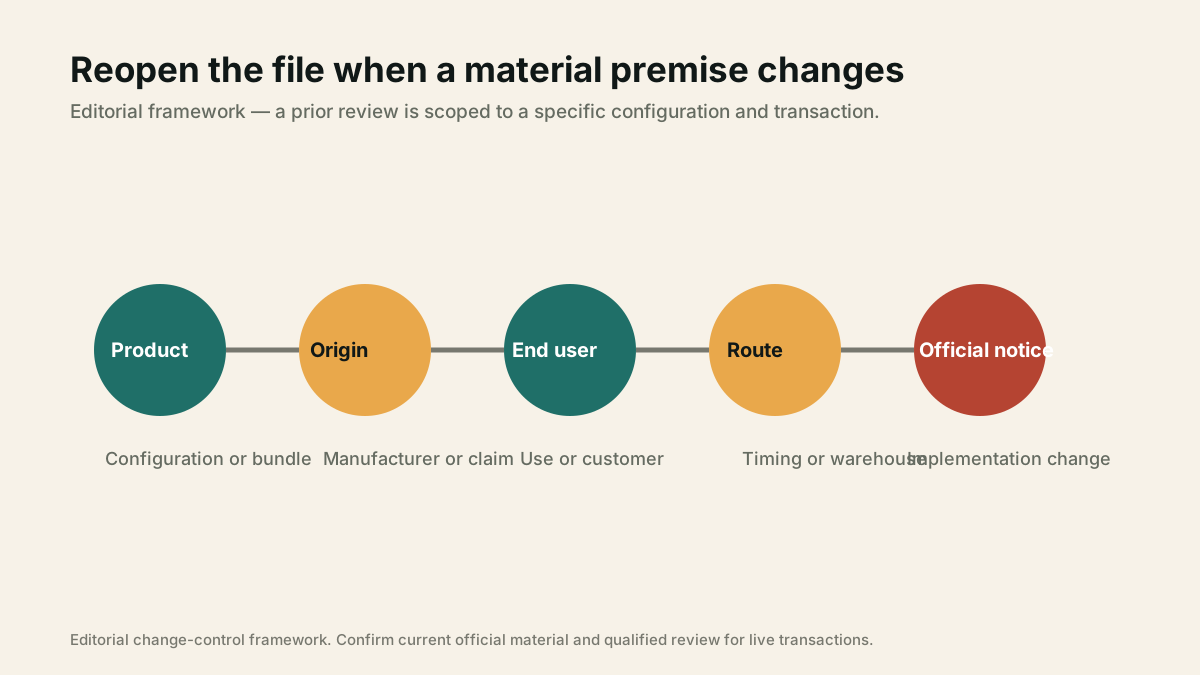
The proclamation expressly authorizes Commerce to determine necessary HTSUS, end-use-certification, and administrative measures through Federal Register notice. That provision is the reason a good importer file has a “last official check” field. It is not enough to save the August 13 proclamation and declare the work complete. Before release, the responsible owner should check the latest official notice, record the check date and source, identify whether a change affects the product or claimed pathway, and send material changes to the qualified reviewer.
This is different from endless monitoring. A well-designed file uses event triggers:
- A scheduled pre-entry check for every order crossing a relevant effective date.
- A recheck when the supplier changes the configuration, factory, manufacturer, declared origin, packaging, bundle, or commercial description.
- A recheck when the importer changes the intended use, end customer, route, warehouse plan, or valuation structure.
- A recheck when Commerce, CBP, or another relevant authority issues implementation material that could touch the category.
- A recheck when the claimed country treatment, onshoring program, listed-program status, or China export authorization changes.
The reviewer does not need to rediscover every fact every time. The goal is to determine whether a material premise changed. That is why the file should show version history: which configuration was reviewed, which documents were used, who made the decision, what was assumed, and what expires. A simple change log often prevents the most expensive error—reusing an answer for a product that is no longer the same product.
The current public record also explains why a supplier’s “tariff included” offer should be unpacked. It may be a commercial price term, not a legal conclusion about classification or liability. Ask what the offer covers, who is importer of record, which goods and revisions it covers, what entry date it assumes, whether it is contingent on any program claim, and what happens if the government treatment differs from the assumption. Do not ask a salesperson to certify a result they do not control. Ask the commercial and compliance teams to expose the assumptions and assign the review.
China export review is a separate gate
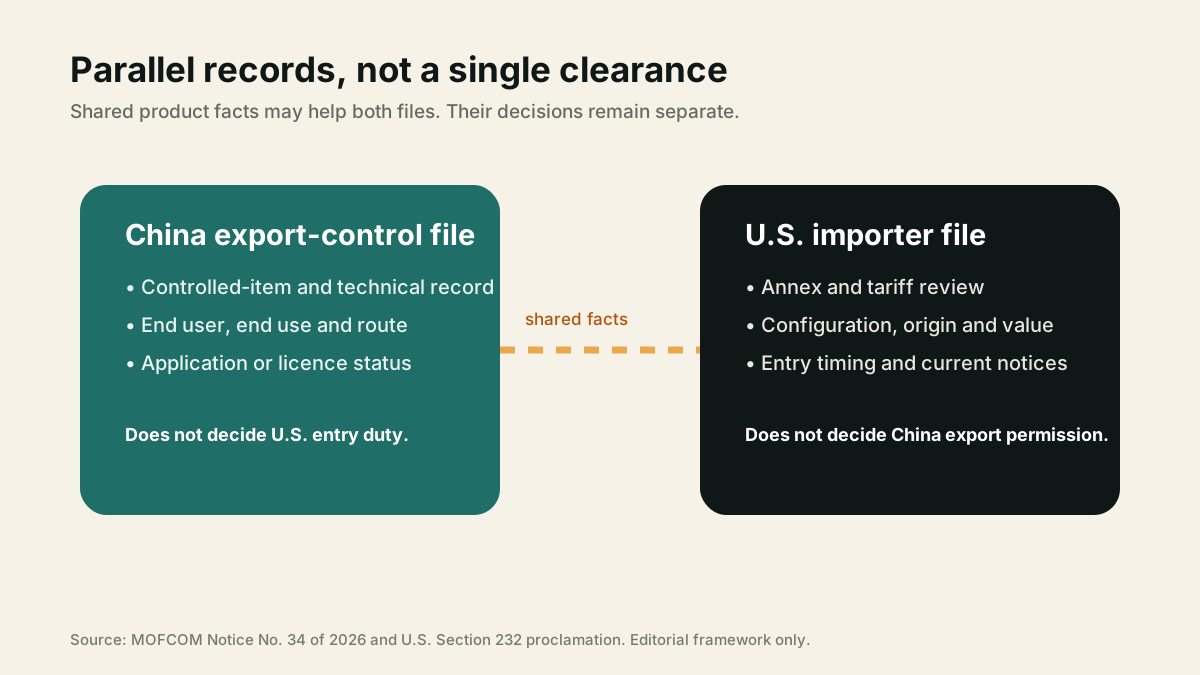
China’s Notice No. 34 of 2026, issued on August 5, states that exports to the United States of listed dual-use drones, key components, and related technology are subject to strict case-by-case review without licence-facilitation treatment. The important boundary is “listed” dual-use items and related technology, not a blanket statement that every Chinese drone is forbidden. Independent Reuters reporting likewise described the measure as targeting items already subject to dual-use controls rather than an across-the-board ban.
This China-side question and the U.S. Section 232 question can interact commercially, but they are not substitutes:
| Gate | Core question | Typical evidence | What it cannot decide |
|---|---|---|---|
| China export control | Is a listed dual-use item, key component, or related technology being exported to the United States, and what review or licence path applies? | Controlled-item analysis, technical record, end user/end use, route, application and licence materials. | U.S. tariff classification, Section 232 treatment, U.S. entry duty, or a U.S. procurement decision. |
| U.S. Section 232 | Does the entry fall within the applicable U.S. scope, rate, date, condition, and implementation framework? | Tariff and product analysis, configuration, origin and valuation work, entry timing, program evidence, current official notices. | China export permission or a China-side licensing conclusion. |
| U.S. equipment/procurement/operational controls | Can the product be authorized, bought, deployed, connected, insured, or used in the intended environment? | The separate rule, program, contract, security, safety, and operational evidence. | Either country’s export or tariff outcome. |
This is a good moment to revisit China Drone Export Rules 2026: Reseller Filing Checklist if the business includes resale, repair, software, or a distributor network. A transaction can become more complex after the purchase order: spares, returns, diagnostics, firmware, technical data, replacement payloads, and a new end user can each change the evidence picture. The original file should anticipate those flows rather than treat post-sale support as an operational footnote.
Build an importer file that survives a handoff
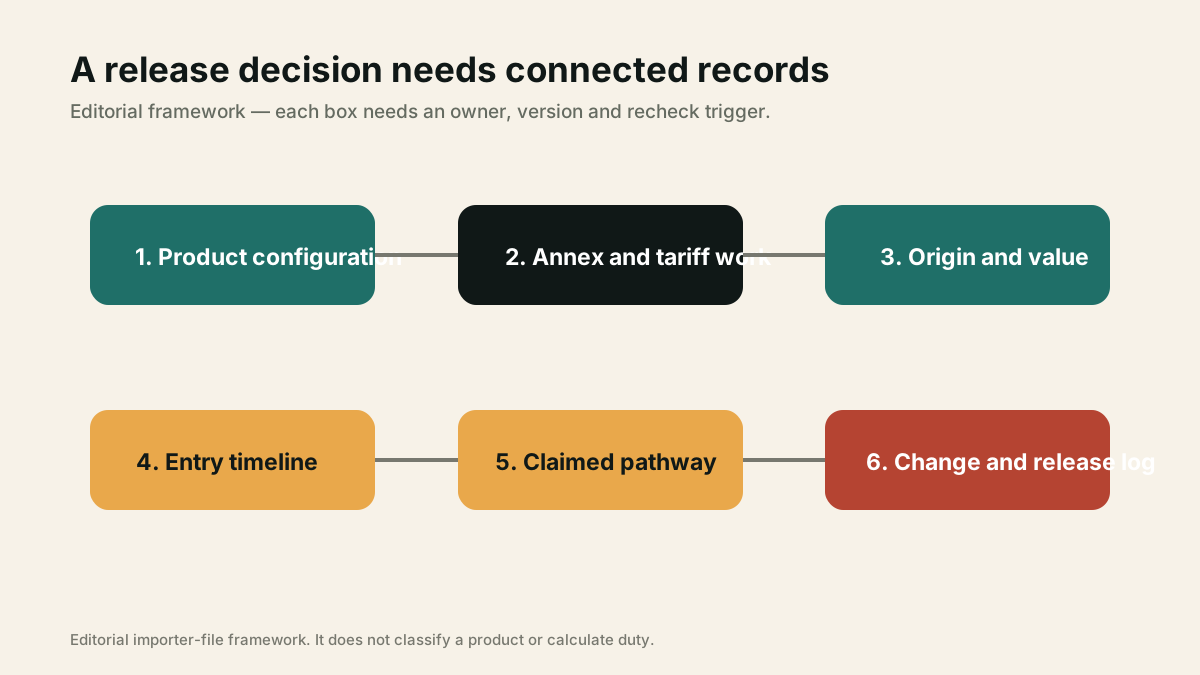
An effective importer file is not necessarily long. It is traceable, versioned, and owned. Every critical assertion has a source, a scope, a date, and a person accountable for reopening it. The file can be organized into seven folders or system records.
1. Product identity and configuration
Record the commercial SKU, internal part number, model, revision, payload, sensor and communications configuration, controller/dock relationship, battery and charger status, accessories, software or firmware identifiers where material, and photos or data sheets. A product family label is not enough. The goal is to answer the basic question: “Is the item presented for entry the same configuration that the analysis reviewed?”
2. Tariff and Annex working record
Keep the proposed tariff treatment work with its reviewer, source documents, date, assumptions, and unresolved questions. Link it to the Annexes and current official implementation material, but do not imply that copying an Annex PDF into a folder resolves classification. The record should identify which technical or use facts bear on the scope and where those facts came from.
3. Origin, manufacturer, and valuation record
Preserve the manufacturer, production and transformation evidence, claimed country of origin, bill of materials or sourcing records relevant to a claimed pathway, invoice, packing list, purchase terms, assists or other valuation-sensitive facts where applicable, and the name of the party responsible for the import declaration. This is the place to surface uncertainty early. If the business is relying on a particular country-treatment assertion, the evidence must be more specific than a marketing statement.
4. Entry timeline and logistics record
Track the planned entry date, carrier milestones, warehouse status, port or routing plan, customs broker instructions, and changes. The file should make it easy to distinguish goods that have been ordered, goods in production, goods in transit, goods in a warehouse, and goods being entered. It should also show which date assumption was used in the cost model.
5. Claimed-pathway record
If anyone claims lower-rate country treatment, an onshoring plan, or a listed-program deferral, create a separate evidence packet. Include the claim’s precise legal and product scope, underlying documentation, reviewer, agency status, current notice, expiry or recheck date, and decision. If the packet is incomplete, label the claim as unverified. Do not allow “possible exception” to become “assumed exception” simply because a purchase order is late.
6. China export-control record
For U.S.-bound products from China, keep the controlled-item, technical, end user, end use, route, application or licence, and change-control material in a parallel but linked file. The two files can use the same approved product master, customer, and route data. They should not collapse their conclusions into one workflow state. A change to the end user or technical configuration should trigger both owners.
7. Decision, release, and change log
The final record should state who may release the order to payment, shipment, entry, deployment, repair, or resale; what the decision was; which documents supported it; which facts remain assumptions; and what forces a recheck. This turns a complicated rule set into a usable operating control. The buyer does not need every person to become a trade lawyer. The buyer needs the right question to stop at the right owner before the goods move.
Decision matrix: pre-order, transit, and post-effective-date orders
The practical file changes as the transaction progresses.
| Order state | Immediate objective | Minimum file actions | Stop or escalate when |
|---|---|---|---|
| Quotation or supplier selection | Avoid basing price and delivery on an untested tariff or export assertion. | Freeze the evaluated configuration; identify intended import route and party; request product, origin, and China-side control information; identify whether any conditional pathway is being claimed. | The supplier cannot identify the exact configuration, manufacturer, origin basis, or export-review owner. |
| Purchase order before shipment | Convert assumptions into a decision file before money and production lock in. | Obtain reviewed technical and commercial documents; set entry-date scenario; separate airframes, components, and kits; assign current-official-notice check; document who owns China-side licence work. | A product change, origin change, route change, end-user change, or unverified exception changes the premise. |
| Goods in production or transit | Protect the entry decision from late document and timeline surprises. | Preserve carrier and warehouse milestones; reconcile shipment contents to reviewed configuration; refresh the implementation check; keep broker and internal owners aligned. | Documents conflict, the planned entry date changes, or the invoice line cannot be reconciled to the product master. |
| Entry on or after September 3 | Make the actual entry file match the rule and the product. | Use the current qualified review, current official materials, correct commercial documents, and evidence for any claimed pathway. | The team is relying on a generic “drone tariff” answer, a stale notice check, or a supplier assurance without evidence. |
| Components approaching February 9, 2027 | Prepare for the later Annex III component decision point. | Map parts, intended use, overlap questions, value and entry facts; schedule a fresh implementation review. | The business assumes every component is outside scope until the date without reviewing other applicable rules. |
This broader document discipline overlaps with the habits in Quality Control in Chinese Factories: Build a Defect-to-Release Evidence Chain. Quality controls establish whether a product meets agreed requirements; trade and export records establish whether the transaction can move under the relevant rules. They are separate files, but both fail when product revisions, subcontractors, and document versions drift without an owner.
Write the release decision in one sentence
Before the goods move, require the accountable owner to write a plain-English decision sentence: “For the identified configuration and entry scenario, the team has completed the current review, attached the supporting record, and has no unowned condition that prevents release.” If that sentence cannot be written without qualifiers such as “probably,” “the supplier says,” “we believe,” or “it should be exempt,” the file is not ready. The required next step may be modest: obtain a revised data sheet, reconcile one invoice line, establish the importer of record, seek an official-program confirmation, or request qualified review. But it should be explicit.
This sentence is not a legal conclusion. It is a control against organizational ambiguity. It makes clear whether the business has a documented decision, an unresolved assumption, or a commercial choice to pause. It is also reusable. If a product revision, supplier change, end-user change, routing change, or government notice later appears, the original sentence gives the team a precise reason to reopen the file rather than debating whether a past approval was “close enough.”
Three scenarios that deserve different treatment
Scenario 1: A finished enterprise aircraft enters in early September
The urgent questions are whether the exact airframe and attached items have been mapped to the relevant U.S. scope analysis, whether the entry timeline has been confirmed, whether product features and documentation match the reviewed configuration, and whether a claimed pathway is actually documented. The buyer should also verify that China export-control work has reached the appropriate state for the exact item, end user, end use, and route. A commercial supplier statement that the aircraft is “not affected” is an escalation signal, not a release condition, unless it is backed by the record the qualified reviewer needs.
Scenario 2: A repair depot imports a mixed box of spares
This is where bundle language becomes dangerous. A repair kit may contain parts with different tariff descriptions, different intended uses, different values, and different operational destinations. The team should split the box into a component map and ask which lines are covered by the current review. It should preserve the repair purpose, end customer, return flow, and any technical-data or software-support facts that matter to the China-side file. Do not let a small shipment bypass the process because its dollar value or physical size feels less significant.
Scenario 3: A buyer is considering a future local-assembly or onshoring narrative
The business may have a credible strategic plan, but a plan is not approval. Keep the commercial roadmap separate from any official program application or agency determination. The sourcing team can collect the production, component, facility, schedule, and investment facts that may be needed later, while the compliance and legal owners determine whether and how a program applies. The landed-cost forecast should make its assumptions visible and be revised when the authoritative process—not a planning meeting—changes the status.
FAQ
Do all Chinese drones face a 100% U.S. tariff on September 3, 2026?
No headline can answer that question for an individual item. The proclamation sets a 100% Section 232 rate for Annex I listed articles and a 25% rate for Annex II listed articles from September 3, subject to its conditions. The item’s classification, configuration, entry facts, and current implementation material still need qualified review.
Are UAS components covered from the same date as finished drones?
Not as a single category. The proclamation says the Annex III component provision begins on February 9, 2027, while Annex I and II have the September 3 effective date. A component’s tariff line, intended use, overlap rule, value, and other entry facts remain material.
Does a China export licence resolve the U.S. tariff question?
No. China’s export-control review and the U.S. Section 232 entry question are separate decisions. They may use some of the same technical and transaction facts, but neither government’s answer substitutes for the other jurisdiction’s review.
Can an onshoring plan eliminate the Section 232 duty?
The proclamation authorizes Commerce to establish an onshoring program and describes conditions for approved plans. A corporate localization plan, by itself, is not an approval or a transaction-specific duty conclusion. Preserve the plan and its evidence, then follow the official agency process.
What is the fastest useful action for a buyer this week?
Freeze the product configuration for each U.S.-bound order, map each commercial line to the actual product or component, identify the planned entry date, and assign owners for the U.S. importer file and the China export-control file. That produces the facts a qualified reviewer needs and exposes what is still unknown.
Method and limitations
This is desk research current to August 26, 2026. It reads the White House proclamation, its three official Annexes, the dated Federal Register public-inspection record, and China’s August 5 notice, with narrow independent and specialist context. It is not legal, customs, brokerage, export-control, or transaction advice.
No public source in this review classifies a reader’s SKU, determines its final origin or value, calculates duty, confirms an agency exception, or decides a China export licensing outcome. The government materials also contemplate later implementation steps. Before a live payment, shipment, entry, warehouse withdrawal, repair, software transfer, or resale decision, verify the current official record and obtain qualified review of the actual product and transaction.
Related reading
- China Drone Export Controls 2026: U.S. Buyer File
- China Drone Export Rules 2026: Reseller Filing Checklist
- DJI Alternatives 2026: The Enterprise Buyer Reality
- DJI Drone Dominance: How It Built a 70% Share
- Quality Control in Chinese Factories: Build a Defect-to-Release Evidence Chain
By China Made & Tech Team. We publish evidence-bound buying and manufacturing analysis for teams working with China’s technology supply chains.